Gut & Hormones
The Estrobolome: How Your Gut Bacteria Help Handle Your Estrogen
A group of gut microbes may quietly shape your estrogen balance, and simple, food-first habits could help support them.
Here is a phrase you may not have heard before, even though it describes something happening inside you right now: the estrobolome. It sounds made up, but it is real. Your estrobolome is a group of gut bacteria (and their genes) that help your body handle estrogen, one of your key hormones.
Scientists first named the estrobolome in the context of breast-health research, and the idea has grown from there (Kwa 2016). The short version: your gut and your hormones talk to each other, and that conversation may matter across your whole life, from your monthly cycle to perimenopause and beyond.
Let me walk you through how it works, in plain English, and be honest about what we know and what we do not.
What is the estrobolome, really?
Think of your gut as home to trillions of tiny microbes. Most of them are helpful. Together, this community is called your gut microbiome. The estrobolome is a smaller slice of that community: the microbes and genes that specifically get involved with estrogen (Kwa 2016).
Here is the neat part. Your liver takes used estrogen and attaches a little tag to it (a step called conjugation) so it can leave your body through your gut. Tagged estrogen is basically switched "off" and ready to go.
But certain gut bacteria make an enzyme called beta-glucuronidase. An enzyme is just a tool that speeds up a chemical step. This particular enzyme snips the tag back off. That flips the estrogen back "on" into its active form, so instead of leaving your body, some of it gets reabsorbed and sent back into circulation (Baker 2017).
So your gut bacteria help set the dial. More of that enzyme activity may mean more estrogen gets recycled and stays in you. Less may mean more gets cleared out. Researchers have actually watched this happen in the lab: specific human gut bacteria and their enzymes reactivated estrogen from its tagged, "off" form (Ervin 2019).
Why this matters for women, across life stages
Estrogen does a lot for you. It plays a role in your cycle, mood, bones, heart, and skin. So anything that nudges your estrogen up or down is worth understanding. (Our hormones section is full of guides like this one.) Researchers think the gut-estrogen connection may touch several parts of women's health (Hu 2023):
- Your monthly cycle. Estrogen rises and falls across the month, and your gut is part of the system that helps manage it.
- PCOS. Some studies find differences in the gut microbiomes of women with polycystic ovary syndrome, a common hormone condition (Baker 2017). Our deep dive into PCOS and your gut covers this link.
- Perimenopause and menopause. As estrogen shifts during this stage, gut health may be one of the many factors in the mix (Hu 2023). (See what actually changes in perimenopause.)
- Breast-health research. Because some breast tissue responds to estrogen, scientists are studying whether estrobolome patterns relate to risk. This is an active research question, not a settled answer (Kwa 2016).
The word researchers keep using is dysbiosis. That just means the gut community is out of its usual balance, often with less variety of microbes. Lower variety has been linked with changes in how estrogen gets processed (Baker 2017). (Dysbiosis also stars in the leaky gut conversation, and we sorted what leaky gut really means from the hype.)
The honest part: this science is still young
I want to be straight with you, because you deserve that. The estrobolome is a genuinely exciting idea, but a lot of the research is still early.
Much of it comes from animal studies, lab-dish experiments, or studies that spot a link but cannot prove one thing causes the other. A link is not the same as a cause. For example, when scientists studied women with and without endometriosis, they did not find big differences in gut beta-glucuronidase activity between the groups, a sign the picture is more tangled than a simple on-off switch (Pai 2023).
Even the lab work comes with caveats. In one study, gut bacteria clearly reactivated estrogen, yet blocking that one enzyme did not reduce tumors in mice. The authors concluded the estrobolome is likely many overlapping processes, not a single lever you can pull (Ervin 2019). A 2025 review of human studies found the results were mixed and did not line up neatly (Larnder 2025).
So please be cautious with anyone who promises a quick fix for your hormones through your gut. We are not there yet. What we can say is gentler: your gut appears to be part of how your body manages estrogen, and taking care of your gut is a smart, low-risk thing to do for many reasons.
Gut-supportive habits with real backing
Good news. The habits that support a healthy, varied gut are the same simple ones you have probably heard about. They are safe, affordable, and good for you overall, even setting hormones aside.
Eat more fiber and more kinds of plants
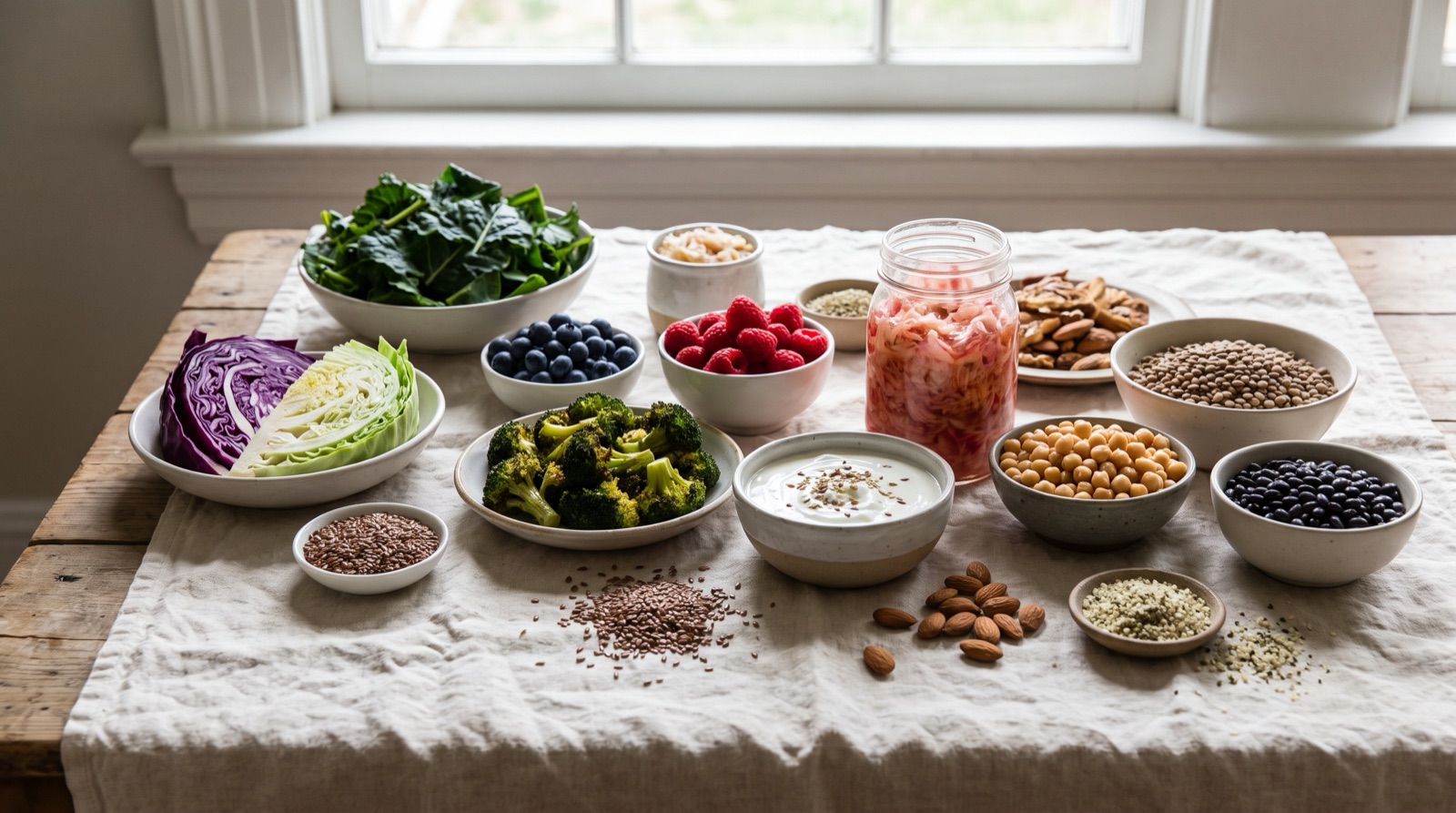
Fiber feeds your helpful gut bacteria and helps keep things moving, which supports clearing out what your body no longer needs. (That feeding role is the prebiotic idea, and our guide to probiotics, prebiotics, and postbiotics explains it in plain English.) Older research found that different diets changed how much estrogen left the body through the stool (Adlercreutz 1994). Aim for variety: think leafy greens, beans and lentils, berries, whole grains, nuts, seeds like flax, and cruciferous vegetables such as broccoli and cabbage. The goal is a colorful, plant-rich plate, not perfection.
Add fermented foods
Fermented foods are foods with live, friendly microbes, like yogurt, kefir, sauerkraut, kimchi, and miso. In a well-run Stanford study, people who ate more fermented foods grew a more diverse gut community and showed lower signs of inflammation. Interestingly, a high-fiber diet shifted the gut too, but in a different way (Wastyk 2021). More variety in your gut is generally a good sign. Start small if these foods are new to you, and pick ones with "live and active cultures" on the label.
Go easy on the things that harm your microbes
You do not need to be perfect here. But a few habits can knock your gut out of balance over time: heavy alcohol use, a diet built mostly on ultra-processed foods with little fiber, and using antibiotics when they are not truly needed. Antibiotics can be life-saving, so never skip them when your doctor prescribes them. Just do not reach for them for things they cannot treat, like most colds.
A gentle reality check
Not every study agrees that diet strongly changes estrogen. A large study of premenopausal women found that fiber and fat intake were not strongly tied to their estrogen patterns (Oh 2015). So think of fiber and fermented foods as broad support for your gut and your health, not as a guaranteed way to move your hormones.
The bottom line
Your gut and your estrogen are in conversation, and the estrobolome is a big part of that story. The science is early and still unfolding, so stay curious and a little skeptical. But the takeaway is comforting: the very habits that support a healthy gut, more fiber, more plant variety, and some fermented foods, are safe, doable, and good for you in many ways.
If you are dealing with hormone symptoms that worry you, irregular cycles, tough perimenopause changes, or anything that feels off, please talk to your doctor. Food is a lovely place to start, and you do not have to figure it all out alone.
References
- Kwa M, et al. The Intestinal Microbiome and Estrogen Receptor-Positive Female Breast Cancer. J Natl Cancer Inst. 2016. PMID: 27107051
- Baker JM, et al. Estrogen-gut microbiome axis: Physiological and clinical implications. Maturitas. 2017. PMID: 28778332
- Hu S, et al. Gut microbial beta-glucuronidase: a vital regulator in female estrogen metabolism. Gut Microbes. 2023. PMID: 37559394
- Ervin SM, et al. Gut microbial beta-glucuronidases reactivate estrogens as components of the estrobolome. J Biol Chem. 2019. PMID: 31636122
- Larnder AH, et al. The estrobolome: Estrogen-metabolizing pathways of the gut microbiome and their relation to breast cancer. Int J Cancer. 2025. PMID: 40177842
- Pai AH, et al. Gut Microbiome-Estrobolome Profile in Reproductive-Age Women with Endometriosis. Int J Mol Sci. 2023. PMID: 38003489
- Wastyk HC, et al. Gut-microbiota-targeted diets modulate human immune status. Cell. 2021. PMID: 34256014
- Oh H, et al. Dietary Fat and Fiber Intakes Are Not Associated with Patterns of Urinary Estrogen Metabolites in Premenopausal Women. J Nutr. 2015. PMID: 26180245
- Adlercreutz H, et al. Estrogen metabolism and excretion in Oriental and Caucasian women. J Natl Cancer Inst. 1994. PMID: 8021957
Common questions
What is the estrobolome in simple terms?
The estrobolome is the group of gut bacteria and their genes that help your body handle estrogen. They make an enzyme that can switch used estrogen back to its active form, so some of it gets recycled instead of leaving your body. In short, your gut is part of how you manage this hormone (Kwa 2016; Baker 2017).
Can improving my gut health balance my hormones?
Maybe help, but do not expect a quick fix. The science is still early, and much of it comes from animal or lab studies that show links rather than proof. Supporting your gut with fiber, plant variety, and fermented foods is safe and good for you overall, but it is not a guaranteed way to change your estrogen. Talk to your doctor about hormone symptoms (Larnder 2025; Oh 2015).
Which foods support a healthy estrobolome?
The same foods that support a healthy, varied gut in general. Load up on fiber and lots of different plants, like greens, beans, berries, whole grains, seeds, and cruciferous veggies. Add fermented foods such as yogurt, kefir, sauerkraut, kimchi, and miso, which have been linked to a more diverse gut (Wastyk 2021).
Does the estrobolome change during menopause?
Estrogen shifts a lot during perimenopause and menopause, and researchers think the gut is one of many factors involved in how your body manages that change. This is an active area of study, so the details are still being worked out (Hu 2023).