Gut Health
Probiotics, Prebiotics, and Postbiotics: A Plain-English Guide for Women
Three confusing words, one simple idea: feed your gut well, and it tends to take good care of you.
Walk down any grocery aisle and you will see them everywhere. Probiotics. Prebiotics. And now a newer one, postbiotics. They sound almost the same, so it is easy to mix them up. It is also easy to feel like you are supposed to buy all three, right now, or your gut is somehow falling behind.
Take a breath. You do not need to spend a fortune to have a happy gut. Once you know what these three words actually mean, the whole thing gets a lot simpler. So let's slow down and go through them one at a time, like a friend explaining it over coffee.
Meet your gut, the busiest room in the house
Inside your gut lives a huge community of tiny living things, mostly bacteria. Scientists call this your gut microbiome. Think of it as a garden. When the garden is diverse and well-fed, it tends to run smoothly. These microbes help you break down food, make certain vitamins, and talk to your immune system, which is your body's defense team.
Here is where the three "biotics" come in. Each one plays a different role in that garden.
Probiotics: the live, helpful bacteria
A probiotic is a live, friendly microorganism that can give you a health benefit when you get enough of it. That is the definition a large panel of scientists agreed on, so it is a good one to trust (Hill 2014).
In garden terms, probiotics are like adding more good plants to the soil. You are bringing in living, helpful bacteria.
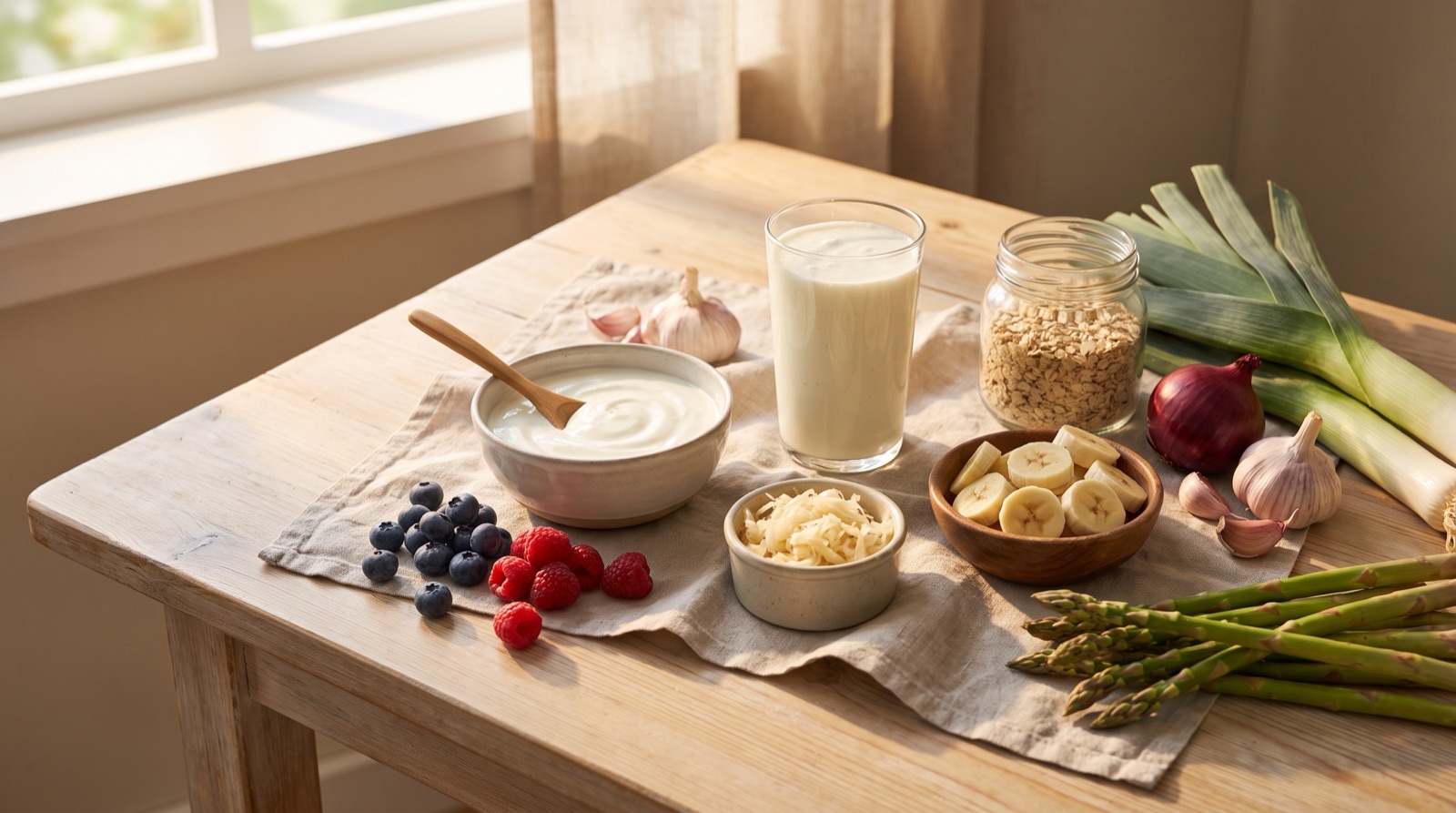
You do not have to get them from a pill. Many everyday foods are full of them, especially fermented foods, which are foods that friendly microbes have partly "pre-digested" for you. Good picks include:
- Yogurt with live and active cultures
- Kefir, a tangy, drinkable cousin of yogurt
- Sauerkraut and kimchi (the refrigerated, unpasteurized kinds)
- Miso and tempeh, both made from soy
One tip worth knowing: the type of bacteria matters. Different strains do different things, and a strain that helps with one issue may do nothing for another. So "probiotic" is less like a single medicine and more like a whole category of them (Hill 2014).
Prebiotics: the food that feeds them
If probiotics are the good plants, prebiotics are the fertilizer. A prebiotic is a substrate, basically a food source, that your helpful gut microbes use, and that gives you a health benefit in return (Gibson 2017).
Most prebiotics are certain fibers, the parts of plants your body cannot fully digest on its own. You cannot break them down, but your gut bacteria can. When they feast on these fibers, they grow and do more of their helpful work.
The lovely part? Prebiotics come from regular, budget-friendly plant foods. No special label needed. Try to fill your plate with:
- Onions, garlic, and leeks
- Bananas, especially ones that are still a little green
- Oats, barley, beans, and lentils
- Asparagus and artichokes
- Apples and berries
Notice something? These are just... vegetables, fruits, whole grains, and beans. A colorful, fiber-rich plate is a prebiotic plate. You are already halfway there.
Postbiotics: the good stuff bacteria make
Here is the newest word, and the one that trips people up most. When your gut bacteria eat those prebiotic fibers, they do not just grow. They also make helpful compounds. Those compounds are postbiotics.
A group of experts defined a postbiotic as a preparation of non-living microbes and/or their parts that gives you a health benefit (Salminen 2021). In plain terms: postbiotics are the beneficial "leftovers" of bacteria doing their job. Even the non-living parts can be useful to you.
The most talked-about examples are short-chain fatty acids, including one called butyrate. Butyrate is a favorite fuel for the cells that line your colon. Research suggests these short-chain fatty acids help keep your gut lining strong, feed those lining cells, and send signals that touch things like appetite and blood sugar (Blaak 2020).
Here is the part I love. You do not usually need to buy postbiotics. When you eat prebiotic fibers, your own gut bacteria make postbiotics like butyrate for you, fresh and free. Food first, and your body handles the rest. (Curious about butyrate pills anyway? We covered which butyrate supplement form actually works.)
How the three fit together
Let's put the whole garden in one picture:
- Prebiotics are the fertilizer (fibers from plants).
- Probiotics are the good plants (live, helpful bacteria).
- Postbiotics are the harvest (helpful compounds like butyrate that bacteria make).
You feed the garden (prebiotics), you can add good plants (probiotics), and the garden rewards you (postbiotics). They are a team, not a competition.
Why gut health matters, especially for women
Your gut is not just about digestion. It is closely tied to your immune system, and it helps make and manage substances that affect mood and hormones. In fact, your gut bacteria help handle your estrogen. For women, the day-to-day stuff matters too: bloating, constipation, and gut discomfort are common, and they often shift with your monthly cycle, pregnancy, and menopause.
A well-fed gut also seems to calm low-grade inflammation, which is like a small fire smoldering in the body. In one careful study, healthy adults who ate more fermented foods each day saw more variety in their gut bacteria and lower levels of several inflammation markers (Wastyk 2021). More variety in your gut garden is generally a good sign.
What the evidence does, and doesn't, show
Now for the honest part, because you deserve the real story, not the hype.
Fiber has the strongest track record. A large review that pooled many studies found that people who eat more fiber tend to have a lower risk of serious conditions like heart disease and type 2 diabetes, with benefits landing around 25 to 29 grams of fiber a day (Reynolds 2019). Most of us fall short of that, so simply eating more plants is one of the most proven moves you can make. Our fiber guide shows how to close the gap without the bloat.
Probiotics can help some people, sometimes. For a condition called irritable bowel syndrome (IBS), which brings belly pain and bloating, a 2023 review of 82 trials found that certain probiotics may ease symptoms. But the authors were clear that the quality of the evidence was mostly low, and results varied a lot by strain (Goodoory 2023). Translation: a probiotic might help you, it might not, and the right one depends on the specifics. Our full guide to whether you need a probiotic walks through them.
Postbiotics are promising but early. The science on short-chain fatty acids is genuinely exciting, but much of the strongest data still comes from lab and animal studies, and researchers say we need more well-run human trials (Blaak 2020). So it is fair to be curious about postbiotic products, and also fair to keep your money in your pocket for now.
The honest bottom line: a fiber-rich, plant-heavy plate with some fermented foods is the best-supported plan. Supplements are a maybe, not a must. If you decide a supplement is worth trying, compare the best probiotic for women over 40 by strain and disclosed dose before you pay for a big CFU number.
Simple ways to start this week
No overhaul required. Small, steady steps win here.
- Add one fermented food a day. A spoonful of yogurt, a little kefir in a smoothie, or a forkful of sauerkraut alongside dinner.
- Aim for plants at every meal. A handful of berries, some beans in your salad, an extra vegetable on your plate.
- Go slow with fiber. If you add a lot too fast, you may feel gassy or bloated. Increase gradually and drink water.
- Feed variety. Different plants feed different bacteria, so mix it up across the week.
A quick, caring note: if you have ongoing gut symptoms, a health condition, a weakened immune system, or you are pregnant, talk to your doctor or a registered dietitian before starting a probiotic or prebiotic supplement. This article is for learning, not a substitute for care that fits you.
The takeaway
Probiotics are the good bacteria. Prebiotics are the fibers that feed them. Postbiotics are the helpful compounds those bacteria make. You do not need all three in pill form. A colorful plate, a little something fermented, and a bit of patience will feed your gut garden beautifully. (More gentle, science-first guides live in our gut health section.) Simple, doable, and kind to your body. You've got this.
References
- Hill C, et al. The International Scientific Association for Probiotics and Prebiotics consensus statement on the scope and appropriate use of the term probiotic. Nat Rev Gastroenterol Hepatol. 2014. PMID: 24912386
- Gibson GR, et al. The International Scientific Association for Probiotics and Prebiotics (ISAPP) consensus statement on the definition and scope of prebiotics. Nat Rev Gastroenterol Hepatol. 2017. PMID: 28611480
- Salminen S, et al. The International Scientific Association of Probiotics and Prebiotics (ISAPP) consensus statement on the definition and scope of postbiotics. Nat Rev Gastroenterol Hepatol. 2021. PMID: 33948025
- Blaak EE, et al. Short chain fatty acids in human gut and metabolic health. Benef Microbes. 2020. PMID: 32865024
- Wastyk HC, et al. Gut-microbiota-targeted diets modulate human immune status. Cell. 2021. PMID: 34256014
- Goodoory VC, et al. Efficacy of Probiotics in Irritable Bowel Syndrome: Systematic Review and Meta-analysis. Gastroenterology. 2023. PMID: 37541528
- Reynolds A, et al. Carbohydrate quality and human health: a series of systematic reviews and meta-analyses. Lancet. 2019. PMID: 30638909
Common questions
What is the simplest way to remember the difference between probiotics, prebiotics, and postbiotics?
The simplest way to remember the difference between probiotics, prebiotics, and postbiotics is to think of a garden. Prebiotics are the fertilizer, which are fibers from plants that feed your gut bacteria. Probiotics are the good plants, which are the live, helpful bacteria themselves. Postbiotics are the harvest, which are the helpful compounds like butyrate that bacteria make when they are well-fed.
Do I need to take supplements to get these, or can I get them from food?
Food first is a great plan. You get prebiotics from fiber-rich plants like onions, garlic, oats, beans, and bananas. You get probiotics from fermented foods like yogurt, kefir, sauerkraut, and kimchi. And your own gut bacteria make postbiotics for you when you feed them enough fiber. Supplements are optional, not required.
Are probiotic supplements proven to work?
Whether probiotic supplements work depends on the issue and the strain. For some issues, like irritable bowel syndrome, certain probiotics may help ease symptoms, but a large 2023 review found the overall quality of the evidence was mostly low and results varied a lot by the specific strain (PMID: 37541528). A probiotic might help you, or it might not. If you want to try one, talk to your doctor or a dietitian about which strain fits your goal.
How much fiber should I aim for, and how do I add it without discomfort?
Research suggests benefits around 25 to 29 grams of fiber a day, and most people fall short (PMID: 30638909). Add fiber slowly over a couple of weeks rather than all at once, and drink plenty of water. Going too fast can cause gas and bloating, so gentle and steady is the way.
Why does gut health matter more for women?
Your gut is tied to your immune system and helps manage substances that affect mood and hormones. Women also commonly deal with bloating and constipation that can shift with the monthly cycle, pregnancy, and menopause. A well-fed, diverse gut may also help calm low-grade inflammation, which supports how you feel day to day.