Supplements
Electrolyte Powders: Who Actually Needs Them, and Who Is Buying Flavored Salt
The sodium in one stick can be half your daily limit. Here is the short list of situations where that is useful, and the much longer list where it is just an expensive drink.
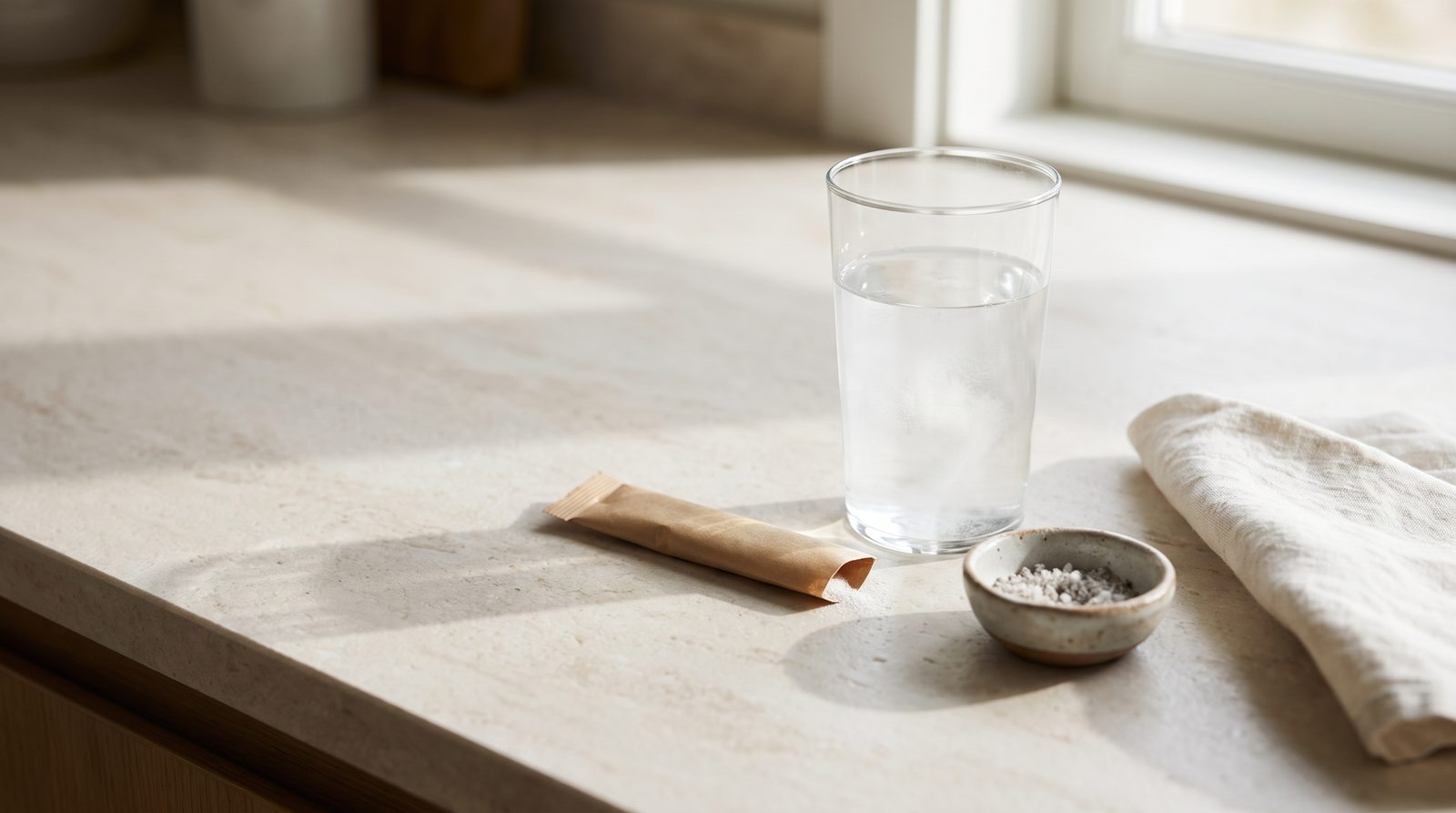
Electrolyte powders went from a thing ultrarunners carried in ziplock bags to a thing sitting on kitchen counters next to the coffee. The sticks are colorful, the flavors are good, and the marketing suggests that if you are tired, foggy, or crampy, you are probably just low on electrolytes.
Some of that is fair. Most of it is not. Here is who actually benefits, what a stick is really made of, and how to tell the difference between a useful product and expensive flavored salt.
What is actually in the packet
Strip away the branding and most electrolyte powders are the same short list: sodium, potassium, magnesium, sometimes a little chloride, and a flavor system. Sodium is the main event and usually the biggest number on the label. Popular versions run anywhere from about 200 mg to 1,000 mg of sodium per stick.
For scale, the Dietary Guidelines suggest staying under 2,300 mg of sodium a day. A 1,000 mg stick is close to half of that in one glass of water.
That matters because most of us are not running low. Analysis of national survey data found that sodium intake exceeds the recommendation across every US population subgroup, and that it has not budged in a decade (Fulgoni, 2014). The picture is even sharper in pregnancy: in a nationally representative sample of pregnant women, 95 percent exceeded the tolerable upper intake level for sodium (Bailey, 2019).
So the starting assumption for most women, most days, is not a sodium deficit.
Who genuinely benefits
There are real situations where an electrolyte drink earns its place.
You are sick. Vomiting and diarrhea lose fluid and sodium together, and that is exactly the problem oral rehydration solutions were designed for. In a randomized trial comparing 13 drinks, researchers measured how much fluid people still held onto two hours later. Oral rehydration solution and milk both beat plain water. Sports drinks, coffee, tea, juice, and sparkling water did not (Maughan, 2016).
You are sweating hard for a long time. Long sessions in heat, back-to-back training days, or physical outdoor work. The key word is long. A short walk or a 45 minute class is not it.
You have a medical reason. Some conditions and medications genuinely raise sodium or fluid needs. If a doctor has told you to salt more, that is a real instruction and this article is not the one to override it.
You cannot eat much. If illness, appetite loss, or a very low carbohydrate diet has cut your food intake sharply, you may be getting less sodium than usual and feel it.
The part the ads get backwards
The scary story around electrolytes is that if you do not replace them, your blood sodium drops dangerously low. That condition is real. It is called hyponatremia. But the cause is usually the opposite of what the marketing implies.
In a study of 488 Boston Marathon runners who gave blood at the finish line, 13 percent were hyponatremic. What predicted it was gaining weight during the race, meaning drinking more fluid than they lost, and running longer than four hours. The composition of what they drank was not an independent risk factor (Almond, 2005).
A separate study followed runners through a 161 km ultramarathon, where nearly everyone was already taking sodium supplements. Blood sodium levels at the finish did not differ between the runners who got hyponatremia and those who did not, based on how much supplemental sodium they took. Overhydration was the thing that separated them (Hoffman, 2015).
Put plainly: for most people the risk is drinking too much water, not eating too little salt. An electrolyte packet does not protect you from overdrinking, and drinking more because the packet is in there can make it worse.
Sweat is not one-size-fits-all, and women lose less salt
How much sodium you actually lose in sweat varies enormously from person to person, and it is not well predicted by how fit you are, how big you are, or how much you sweat (Baker, 2017).
There is a sex difference worth knowing. Researchers collected sweat from 157 experienced marathoners during a race. Women had significantly lower sweat sodium than men, about 34 versus 44 mmol per liter. About 20 percent of the group were high salt losers, above 60 mmol per liter, and not one of the female runners was in that group (Lara, 2016).
That is a small sample of women, only 16 of them, so hold it loosely. But it points the same direction as everything else here: the aggressive sodium replacement being marketed to everyone was worked out for a subset of heavy-sweating athletes, and women are less likely to be in it.
Season to taste
One group of researchers modeled how much sodium athletes actually need to keep blood sodium stable across different sports and conditions. Their conclusion for a soccer match and even an elite marathon was that replacing sodium was unnecessary in every realistic scenario they ran. Athletes could choose sodium intake based on taste preference rather than physiological need. Only in a 160 km ultramarathon, and only when someone was a high salt loser replacing most of their fluid losses, did targeted sodium replacement start to matter (McCubbin, 2022).
The paper's own subtitle says it well: season to taste. If a salty drink makes you drink more and feel better, that is a legitimate reason to have one. It is just not a physiological emergency.
How to read a label without getting talked into anything
Check the sodium number first. If it is 800 to 1,000 mg and you are not doing long, hot, sweaty sessions, that is more than you need and it counts toward your daily total.
Check for added sugar. Some are sugar free, some carry 10 to 20 grams. Neither is wrong, but during a long workout the carbohydrate is doing something useful, and on the couch it is just a soft drink.
Ignore the long list of trace minerals. The amounts are usually tiny and there to make the label look impressive.
Look for third-party testing, the same as any supplement, since quality varies and you are relying entirely on the label.
Cheaper things that work about as well
If you want the benefit without the subscription, salt your food, eat potassium-rich foods like potatoes, beans, yogurt, and bananas, and drink to thirst. For a genuine rehydration need, a standard oral rehydration solution from the pharmacy is inexpensive and made for exactly that. Milk, per the hydration trial above, holds up surprisingly well too (Maughan, 2016).
The honest summary
Electrolyte powders are not a scam. They are a real tool with a narrow job: replacing fluid and sodium when you have genuinely lost a lot of both, through heavy prolonged sweating or through illness. Outside that job, for most women, they are a pleasant-tasting way to add sodium you were probably already getting enough of.
If tiredness is your actual complaint, it is worth checking the things that tend to be behind it. Iron, sleep, blood sugar swings, and thyroid function move fatigue far more reliably than a salt packet does. Electrolytes are the answer to a specific question, and for most of us on most days, it is not the question we are asking.
General information, not medical advice. If you have kidney disease, heart failure, high blood pressure, or take medication that affects sodium or potassium, talk to your doctor before adding electrolyte supplements.
References
- Almond CSD, et al. Hyponatremia among runners in the Boston Marathon. New England Journal of Medicine. 2005. PMID: 15829535
- Hoffman MD, Stuempfle KJ. Sodium supplementation and exercise-associated hyponatremia during prolonged exercise. Medicine and Science in Sports and Exercise. 2015. PMID: 25551404
- Maughan RJ, et al. A randomized trial to assess the potential of different beverages to affect hydration status: development of a beverage hydration index. American Journal of Clinical Nutrition. 2016. PMID: 26702122
- Baker LB. Sweating rate and sweat sodium concentration in athletes: a review of methodology and intra/interindividual variability. Sports Medicine. 2017. PMID: 28332116
- Lara B, et al. Interindividual variability in sweat electrolyte concentration in marathoners. Journal of the International Society of Sports Nutrition. 2016. PMID: 27478425
- McCubbin AJ. Modelling sodium requirements of athletes across a variety of exercise scenarios: identifying when to test and target, or season to taste. European Journal of Sport Science. 2022. PMID: 35616504
- Fulgoni VL, et al. Sodium intake in US ethnic subgroups and potential impact of a new sodium reduction technology: NHANES dietary modeling. Nutrition Journal. 2014. PMID: 25522786
- Bailey RL, et al. Estimation of total usual dietary intakes of pregnant women in the United States. JAMA Network Open. 2019. PMID: 31225890
Common questions
Do I need an electrolyte drink every day?
You almost certainly do not need an electrolyte drink every day. Sodium intake already exceeds the recommended limit across every US population subgroup, and among pregnant women 95 percent exceed the tolerable upper limit for sodium. A daily stick adds several hundred milligrams on top of a diet that is usually already sodium-rich. The situations that genuinely call for one are heavy sweating over a long period, illness with vomiting or diarrhea, a sharp drop in how much you are eating, or a specific instruction from your doctor.
Will electrolytes stop me from getting low blood sodium?
Electrolytes will not stop you from getting low blood sodium the way the marketing implies. Among 488 Boston Marathon runners, 13 percent finished with low blood sodium, and what predicted it was gaining weight during the race, meaning drinking more fluid than they lost, along with a race time over four hours. What they drank was not an independent risk factor. In a separate ultramarathon study where nearly everyone was taking sodium supplements, the amount of supplemental sodium did not separate the runners who developed low blood sodium from those who did not. Overhydration did. Drinking to thirst matters more than the packet.
Do women need less sodium replacement than men?
The available data point that way. In sweat collected from 157 marathoners during a race, women had significantly lower sweat sodium than men, roughly 34 versus 44 mmol per liter. About 20 percent of the runners were high salt losers, above 60 mmol per liter, and none of the women fell into that group. That sample only included 16 women, so it is not the last word, but the heavy sodium replacement being marketed broadly was worked out for high-sweating athletes, and women are less likely to be among them.
Is there anything that hydrates better than water?
For most everyday situations, water is fine. When you genuinely need to hold onto fluid, a randomized trial of 13 beverages measured how much fluid people retained two hours after drinking. Oral rehydration solution and milk, both full fat and skimmed, beat plain water. Sports drinks, cola, coffee, tea, juice, beer, and sparkling water did not differ from water. If you are recovering from a stomach bug, a pharmacy oral rehydration solution is the cheap, purpose-built option.
What should I look for on the label?
Start with the sodium number on the label. Sticks range from about 200 mg to 1,000 mg, and the higher end is close to half the suggested daily limit in a single glass. Then check added sugar, which is useful during a long workout and much less useful on the couch. Skip past the long list of trace minerals, since the amounts are usually too small to matter. And look for third-party testing, as with any supplement, because quality varies and the label is all you have to go on.