Supplements
Best Weight Loss Patches for Women Over 50: 5 Types Compared
Berberine, GLP-1, garcinia, vitamin and estrogen patches, checked against the trials behind them.
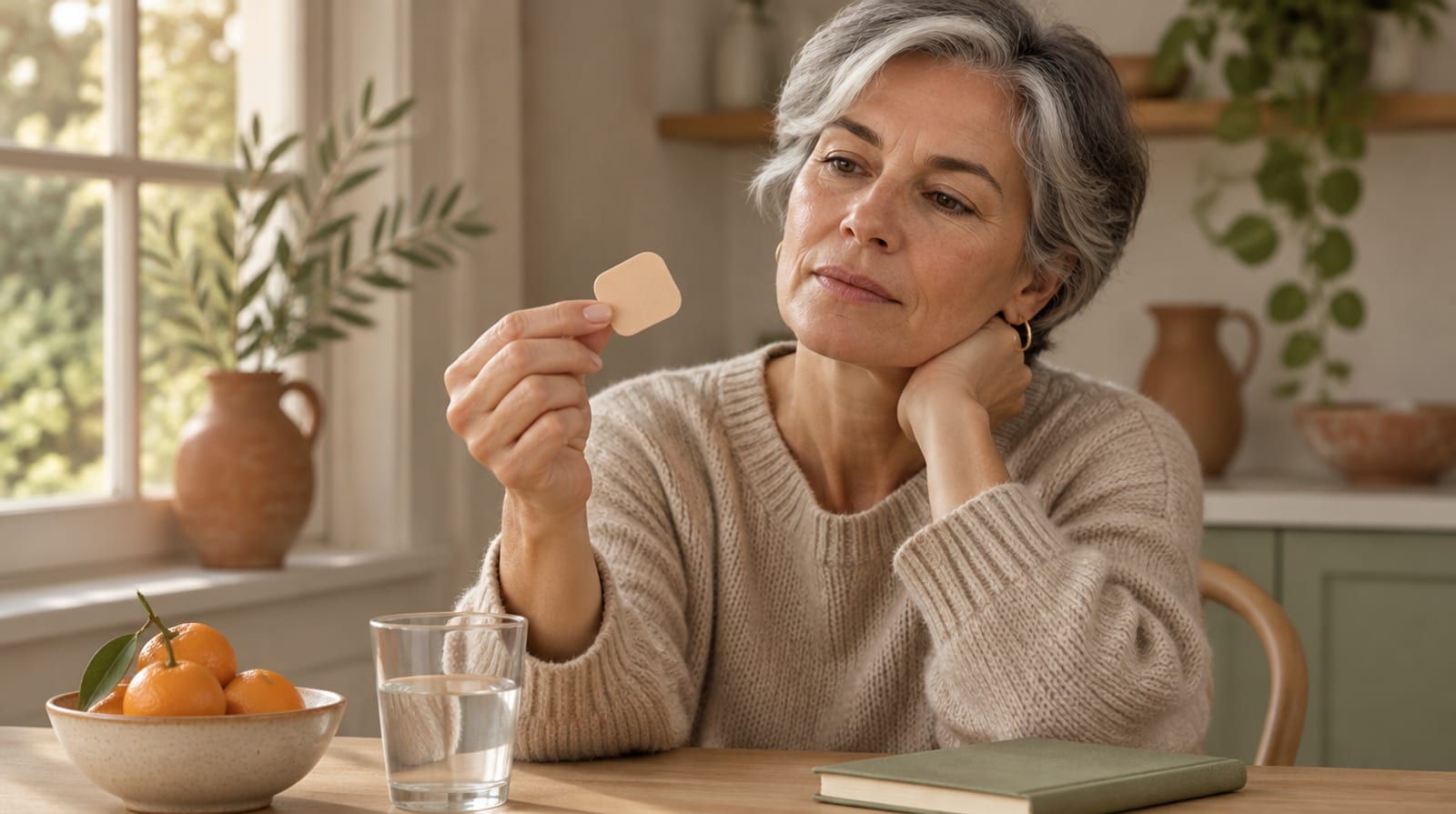
The best weight loss patches for women over 50 are, honestly, none of the over-the-counter ones: no weight loss patch sold without a prescription has a published human trial showing it helps you lose weight. The ingredients inside them, such as berberine, garcinia and green tea, were tested as pills, and even as pills they took off only about 1 to 2 kg. The one patch with real human data for midlife body fat is the prescription estrogen patch, and it is a menopause treatment, not a weight loss product.
How we compared weight loss patches
We compared five types of weight loss patches for women over 50 on five things: whether the label states a dose, whether that dose matches what human trials used, whether there is any human evidence the ingredient gets through skin into the blood, side effects, and cost compared with the pill version. Skin is built to keep things out. A classic dermatology review argued that molecules much bigger than 500 daltons cannot pass the outer skin layer at all, and every drug that works through a patch is under that size (Bos, 2000). Small size is needed, but it does not prove a patch delivers a useful amount.
| Patch type | Dose on label | Human trials of the patch | Evidence for the ingredient as a pill | Verdict |
|---|---|---|---|---|
| Berberine patch | Often unclear | None found | About 2 kg in 12 trials | Skip; the pill is what was studied |
| "GLP-1" blend patch | Blend, often no per-ingredient dose | None found | Depends on the blend | Skip |
| Garcinia or green tea patch | Varies | None found | Under 1 kg, short term | Skip |
| B12 or multivitamin patch | Usually stated | One study, worse than pills | Not a weight loss nutrient | Avoid for fixing a deficiency |
| Estrogen patch (prescription) | Exact, regulated | Many, for menopause | Less belly fat, no change in weight | Not for weight loss; ask your doctor |
Berberine patches: a studied ingredient in an unstudied form
Berberine patches are the most popular weight loss patch, but the weight loss research on berberine comes from capsules, not patches. A review of 12 randomized trials found berberine pills lowered body weight by about 2 kg compared with control (Asbaghi, 2020). Those trials used daily doses taken by mouth, and berberine is poorly absorbed even that way (Liu, 2016). We found no study that measured berberine in the blood after wearing a patch, so there is no way to know whether a patch delivers a dose anywhere near what the trials used. If berberine interests you, our review of what the berberine research actually shows covers doses, side effects and drug interactions.
"GLP-1" patches: a name, not a drug
"GLP-1" patches sold over the counter do not contain a GLP-1 drug. They are blends of plant extracts, often berberine, green tea or other herbs, named after the prescription medicines. Many list a proprietary blend without a dose for each ingredient, which makes it impossible to compare them with any trial. No published human trial has tested one of these patches for weight loss. The prescription GLP-1 medicines are injections or pills, and no GLP-1 patch has been approved for weight loss.
Garcinia and green tea patches: weak ingredients either way
Garcinia and green tea patches start from ingredients that did little even as pills. A review of 9 pooled trials found garcinia extract took off about 0.88 kg more than placebo in the short term, and stomach side effects were twice as common in one trial (Onakpoya, 2011). A Cochrane review of green tea found an average difference of 0.04 kg in trials run outside Japan, which is no real effect (Jurgens, 2012). A patch would have to beat the pill to be worth buying, and nothing suggests it does.
B12 and multivitamin patches: the one patch with a head-to-head test
B12 and multivitamin patches are the only patch type that has been compared with pills, and the patch lost. In a study of 44 gastric bypass patients, 82% of those who used a multivitamin patch for a year had at least one vitamin deficiency, compared with 41% of those taking pills, with lower vitamin D, B1 and B12 in the patch group (Saurabh, 2019). Doctors have also reported a 61-year-old woman who developed a serious thiamine deficiency after swapping her prescribed vitamin pills for a patch (Babu, 2024). These were people after weight loss surgery, so the gap may be smaller in others, but a patch is a poor bet if you are trying to fix a low level. B12 also does not cause weight loss; our guide to who is actually low in vitamin B12 explains who should test.
Weight loss patches for women over 50 and menopause belly fat
For women over 50, the patch with the most human evidence on body fat is the prescription estrogen patch, and it changes where fat sits rather than how much you weigh. During the menopause transition, the rate of fat gain doubles and lean mass starts to fall, even though the number on the scale climbs at about the same pace (Greendale, 2019). Across 107 trials, hormone therapy reduced abdominal fat by about 7% in women without diabetes (Salpeter, 2006). A Cochrane review found hormone therapy did not change body weight either way, so it does not cause weight gain and it does not take weight off (Norman, 2000). Estrogen patches are prescribed for hot flashes and other symptoms, they carry their own risks, and the decision belongs with your doctor. For the steps that do move the scale after 50, see our guide on how to lose weight after menopause.
The winner, and what to buy instead
No over-the-counter weight loss patch earns a recommendation for women over 50. Every one of them asks you to trust that skin delivers a dose nobody has measured. If you want a supplement, the ones with trial data are taken by mouth: in a review of 111 trials, psyllium fiber, glucomannan and a few others produced small weight losses of about 1 to 4 kg (Shahinfar, 2023). Our ranking of the best weight loss supplements for women over 50 compares them on dose and evidence, and the same problem of tiny doses shows up in weight loss gummies. More comparisons live in our supplements hub.
This article is general information, not medical advice. Talk with your doctor before starting any supplement or hormone therapy, especially if you take medicines for blood sugar, blood pressure or blood thinning.
References
- Bos JD, Meinardi MM. The 500 Dalton rule for the skin penetration of chemical compounds and drugs. Experimental Dermatology. 2000;9(3):165-169. PMID: 10839713
- Asbaghi O, Ghanbari N, Shekari M, et al. The effect of berberine supplementation on obesity parameters, inflammation and liver function enzymes: a systematic review and meta-analysis of randomized controlled trials. Clinical Nutrition ESPEN. 2020;38:43-49. PMID: 32690176
- Liu CS, Zheng YR, Zhang YF, Long XY. Research progress on berberine with a special focus on its oral bioavailability. Fitoterapia. 2016;109:274-282. PMID: 26851175
- Onakpoya I, Hung SK, Perry R, Wider B, Ernst E. The use of Garcinia extract (hydroxycitric acid) as a weight loss supplement: a systematic review and meta-analysis of randomised clinical trials. Journal of Obesity. 2011;2011:509038. PMID: 21197150
- Jurgens TM, Whelan AM, Killian L, et al. Green tea for weight loss and weight maintenance in overweight or obese adults. Cochrane Database of Systematic Reviews. 2012;12:CD008650. PMID: 23235664
- Saurabh S, Gao Y, Maduka S, et al. Is transdermal multivitamin patch effective in gastric bypass patients? Obesity Surgery. 2019;29(12):3818-3823. PMID: 31302845
- Babu HM, Spiro AJ, Hoang TD, Shakir MKM. Micronutrient deficiency and Wernicke's encephalopathy in the setting of over the counter transcutaneous multivitamin patch use following bariatric surgery. AACE Clinical Case Reports. 2024;11(1):36-39. PMID: 39896946
- Greendale GA, Sternfeld B, Huang M, et al. Changes in body composition and weight during the menopause transition. JCI Insight. 2019;4(5). PMID: 30843880
- Salpeter SR, Walsh JME, Ormiston TM, et al. Meta-analysis: effect of hormone-replacement therapy on components of the metabolic syndrome in postmenopausal women. Diabetes, Obesity and Metabolism. 2006;8(5):538-554. PMID: 16918589
- Norman RJ, Flight IH, Rees MC. Oestrogen and progestogen hormone replacement therapy for peri-menopausal and post-menopausal women: weight and body fat distribution. Cochrane Database of Systematic Reviews. 2000;(2):CD001018. PMID: 10796730
- Shahinfar H, Jayedi A, Torabynasab K, et al. Comparative effects of nutraceuticals on body weight in adults with overweight or obesity: a systematic review and network meta-analysis of 111 randomized clinical trials. Pharmacological Research. 2023;196:106944. PMID: 37778464
Common questions
Do weight loss patches really work?
Over-the-counter weight loss patches have no published human trial showing weight loss. Their ingredients were studied as pills, where they took off about 1 to 2 kg at most, and no study has measured how much of them a patch delivers into the blood.
Are weight loss patches safe for women over 50?
Most weight loss patches are unlikely to cause serious harm, but skin irritation is possible, and berberine can interact with some medicines if it is absorbed. The bigger risk is relying on a vitamin patch to fix a deficiency, since one study found patch users ended up more deficient than pill users.
Do GLP-1 patches work like the prescription drugs?
Over-the-counter GLP-1 patches contain plant extracts, not a GLP-1 drug, and they have not been tested against the prescription medicines. The prescription GLP-1 drugs are given as injections or pills under a doctor's care.
Can an estrogen patch help with menopause belly fat?
Hormone therapy reduced abdominal fat by about 7% across 107 trials in women without diabetes, but it did not change overall body weight. Estrogen patches are prescribed for menopause symptoms, not weight loss, and whether they suit you is a decision to make with your doctor.