Supplements
Best Weight Loss Supplements for Women Over 50, Compared
Seven popular options scored on the same five criteria, with what the trials found for weight, for muscle and for safety after menopause.
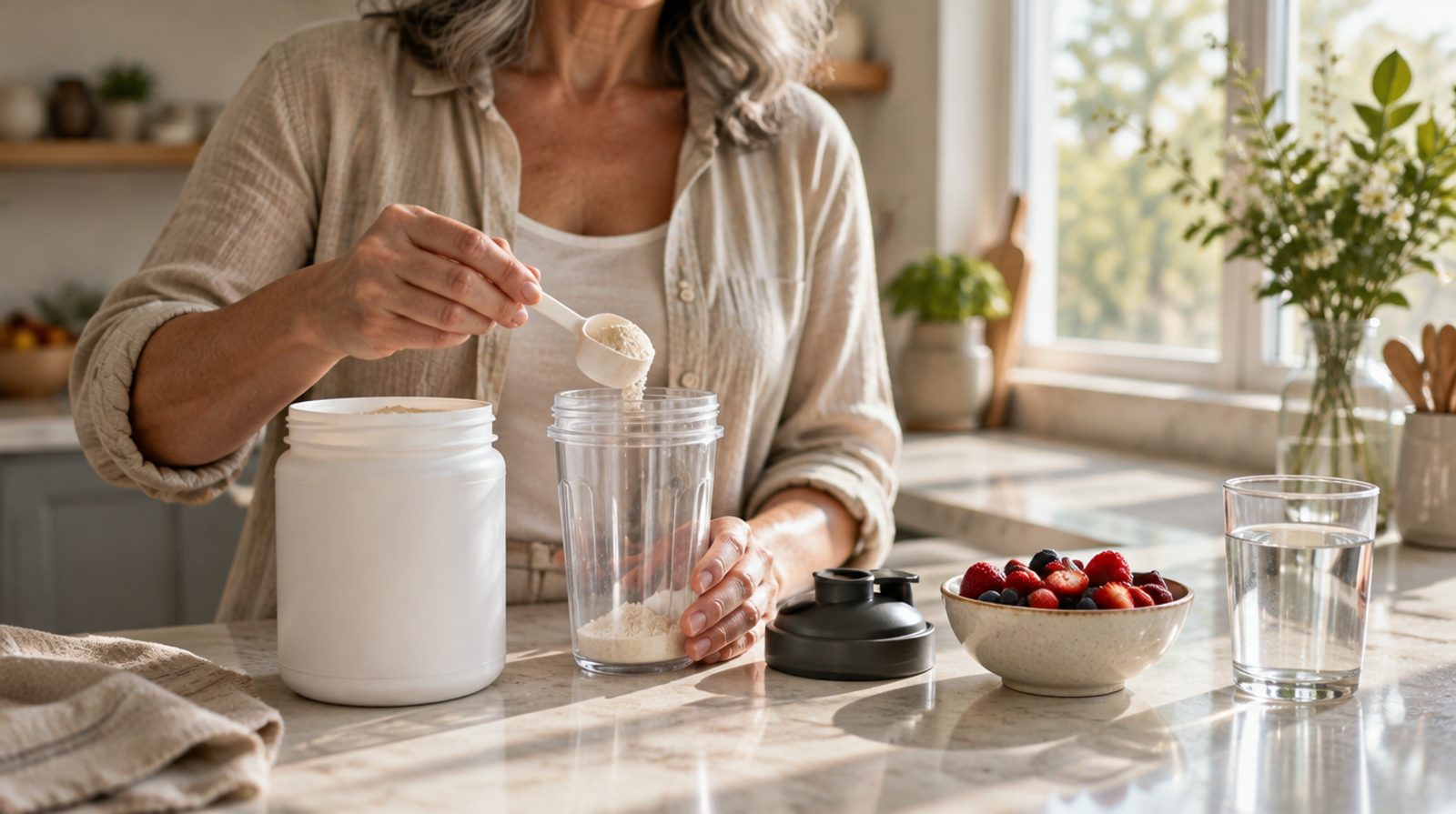
The best weight loss supplement for women over 50 is a plain protein powder, such as whey or soy, used to reach your daily protein target. It is not because protein melts fat. In trials it moved the scale only a little, but it helped protect muscle while weight came off, and muscle is what women lose fastest after menopause. Psyllium fiber is the runner-up. Green tea extract, glucomannan, berberine and chromium all came out small or unproven for weight in pooled trials, and stimulant fat burners carry the most risk.
That is the short answer. Below, seven popular options are scored on the same five criteria, with what the trials measured and what they did not. If you want the bigger picture first, read what really changes about weight loss for women over 50. It explains why your metabolism is not the main problem.
How we compared weight loss supplements
We scored each supplement on five criteria worth 1 to 5 points each, for a total out of 25.
- Evidence for weight. Pooled results from randomized trials in people, and how big the effect was.
- Evidence for keeping muscle. After 50, losing fat while keeping muscle matters more than the number on the scale.
- Safety. Side effects, liver or heart concerns, and drug interactions.
- Dose disclosed. Can you see the exact amount per serving, and does it match the trials?
- Cost per serving. You take these daily, so price adds up.
A fairness note. A supplement without strong trials is not proven useless. It has less to show you. We rank on what has been measured in people and say plainly where the measuring stops.
Weight loss supplements for women over 50, compared
| Supplement | What pooled trials found for weight | Main downside | Score |
|---|---|---|---|
| 1. Protein powder (whey or soy) | Small weight and fat loss; protects muscle with lifting | Works best with strength training | 21/25 |
| 2. Psyllium fiber | Mixed: about 2 kg in some reviews, no effect in others | Gas and bloating at first | 18/25 |
| 3. Creatine | Not a weight loss supplement; small muscle gains with lifting | Does nothing for the scale | 15/25 |
| 4. Glucomannan | No significant effect in one review, small in another | Must be taken with plenty of water | 12/25 |
| 5. Chromium picolinate | About 1 kg, low quality evidence | Effect of debatable value | 11/25 |
| 6. Berberine | No significant change in body weight | Stomach upset, drug interactions | 10/25 |
| 7. Green tea extract | No effect in trials outside Japan | Rare liver injury at high doses | 8/25 |
- Protein powder: weight 3, muscle 5, safety 5, dose disclosed 5, cost 3.
- Psyllium: weight 3, muscle 1, safety 5, dose disclosed 4, cost 5.
- Creatine: weight 1, muscle 4, safety 4, dose disclosed 4, cost 2.
- Glucomannan: weight 2, muscle 1, safety 3, dose disclosed 3, cost 3.
- Chromium picolinate: weight 2, muscle 1, safety 3, dose disclosed 4, cost 1.
- Berberine: weight 1, muscle 1, safety 2, dose disclosed 3, cost 3.
- Green tea extract: weight 1, muscle 1, safety 1, dose disclosed 2, cost 3.
Cost is scored high when a daily serving is cheap. Plain psyllium is often a few cents a day, while chromium is sold mostly in pricey blends.
Do weight loss supplements work for women over 50?
Weight loss supplements produce small results at best, usually a few pounds beyond diet alone. The largest comparison we found pooled 111 randomized trials with 6,171 adults who had overweight or obesity. It tested 18 supplements and concluded that supplements can produce a small weight loss (Shahinfar, 2023). Most of those trials were not in women over 50, so treat the numbers as a ceiling.
There is a reason supplements struggle here. Your metabolism does not slow down much in midlife. A study of daily energy use across the life course found it holds steady from about age 20 to 60, once body size is accounted for (Pontzer, 2021). So a pill that promises to restart your metabolism is selling a fix for a problem most women do not have. What does change is body composition: more fat, less muscle. That is why the top pick below is about muscle.
The winner: protein powder
Protein powder ranks first for women over 50 because it is the one supplement that helps you keep muscle while you lose weight. Whey and soy are complete proteins, they are cheap per gram of protein, and the label tells you exactly what is in the scoop.
The weight effect on its own is small. In a review of nine trials in people with overweight or obesity, whey protein lowered body weight by a little over half a kilogram and fat mass by about 1 kilogram more than control (Wirunsawanya, 2017). A larger review of 24 diet trials found that higher protein, lower calorie diets led to slightly more weight and fat loss and less muscle loss than standard protein diets with the same calories (Wycherley, 2012).
For women past menopause, the training matters. A review of trials in women aged 55 and older found whey improved arm strength and leg lean mass only when it was paired with resistance training. Whey did not change fat mass or body weight in either group (Kuo, 2022). So protein powder is not a fat burner. It is the support act for lifting weights.
Its downsides: dairy whey can upset some stomachs, a scoop adds calories, and flavored powders can carry added sugar. Choose a plain or lightly sweetened whey isolate, or soy if you avoid dairy, with no proprietary blend. Our guide to how much protein women need at every age has the daily targets. If you are torn between powders, see how collagen and protein powder compare for women over 40.
Runner-up: psyllium fiber
Psyllium is second because its weight results are mixed, but it is safe, cheap and helps with other things that matter after 50. It is the fiber in Metamucil and many store brands, and it forms a gel that slows digestion.
The reviews disagree. A review of six trials with 354 adults with overweight or obesity found that about 11 grams of psyllium a day, taken just before meals for an average of almost five months, lowered weight by about 2 kilograms and waist size by about 2 centimeters (Gibb, 2023). That review was written by researchers at Procter and Gamble, which makes Metamucil. A larger review of 22 trials found no significant effect on body weight, BMI or waist size (Darooghegi Mofrad, 2019). The large network review above placed psyllium among the more effective options, with moderate certainty (Shahinfar, 2023).
The fair reading: psyllium may help a little when it is taken before meals as part of a lower calorie diet, and it helps regularity and cholesterol either way. Start with a small dose and build up, and drink plenty of water with it. We compare it with other fibers in the best fiber supplement for women.
Creatine: for muscle, not the scale
Creatine is not a weight loss supplement, but it earns a place on this list because it helps women over 50 hold on to muscle when they train. A review of seven trials with 608 postmenopausal women found creatine plus strength training gave small gains in lean mass (about a third of a kilogram) and leg press strength. Benefits showed up at 5 grams a day or more with training. Trials of 3 grams or less without training found no effect (Naddafha, 2026).
Creatine can add a little water weight, so the scale may go up, not down. That is why it scores 1 for weight. If muscle is your goal, read what the creatine trials found in women over 50.
Glucomannan
Glucomannan, a fiber from konjac root, did not produce significant weight loss in the review most often cited. Across eight trials, people taking glucomannan lost 0.22 kilograms more than placebo, which was not statistically significant. Side effects included stomach discomfort, diarrhea and constipation (Onakpoya, 2014). The newer network review rated its small effect as low certainty evidence (Shahinfar, 2023).
Glucomannan swells a lot in water, so always take it with a full glass of water and never right before lying down.
Chromium picolinate
Chromium picolinate produced about 1 kilogram of extra weight loss over 12 to 16 weeks in a Cochrane review of six trials with 392 people. The reviewers called this an effect of debatable clinical relevance, rated the evidence low quality, and found no dose that worked better than another (Tian, 2013). Chromium is a common ingredient in blends, which makes the dose and the cost harder to judge.
Berberine
Berberine did not change body weight in two separate reviews of randomized trials. A review of 12 trials with 849 people found no significant change in weight or BMI, though waist to hip ratio dropped slightly (Amini, 2020). A second review of 10 trials found small drops in BMI and waist size, but no significant change in body weight (Xiong, 2020).
Berberine is better studied for blood sugar than for weight. It can cause stomach upset and can interact with medications, so ask your pharmacist before you try it. We go through the evidence in what the berberine research says.
Green tea extract
Green tea extract ranks last because it showed no real weight effect outside Japan and carries a rare but serious liver risk. A Cochrane review found that in six trials conducted outside Japan, the difference in weight loss was 0.04 kilograms, essentially zero. Trials in Japan showed losses from 0.2 to 3.5 kilograms, but were too different from each other to pool (Jurgens, 2012).
The safety concern is real. A United States Pharmacopeia review linked case reports of liver injury to green tea extract supplying 140 to about 1,000 milligrams of EGCG a day, with a higher risk when taken on an empty stomach (Oketch-Rabah, 2020). Brewed green tea as a drink is a different thing. If you like it, keep drinking it.
Is there a weight loss pill that works for women over 50?
Orlistat is the one over the counter weight loss product with a long, large trial, and it is a drug, not a supplement. In a four year trial of 3,305 adults with obesity, the prescription dose of 120 mg three times a day plus lifestyle changes led to 5.8 kilograms of weight loss, compared with 3.0 kilograms on placebo plus lifestyle changes (Torgerson, 2004). The over the counter version is half that dose. Orlistat works by blocking some of the fat you eat from being absorbed, so its side effects are digestive. Talk with your doctor about it, and about prescription options, if supplements are not enough.
Stimulant fat burners are the ones to avoid. A national study of US emergency department visits found that weight loss or energy products caused 71.8 percent of supplement related visits for palpitations, chest pain or a racing heart (Geller, 2015). That risk matters more as blood pressure and heart risk climb with age.
What helps more than any supplement after 50
Strength training paired with a modest calorie cut protects muscle better than any pill. In a six month trial of 160 adults over 65 with obesity, everyone in the exercise groups lost about 9 percent of their body weight. Those who did strength training, alone or with aerobic exercise, lost less lean mass and less hip bone density than those who did aerobic exercise only (Villareal, 2017). That trial included men and women, but the lesson holds: lift while you lose.
Build meals around protein, lift twice a week, walk most days and protect your sleep. Then add protein powder if food is not getting you to your protein target, and psyllium if you need more fiber. Vitamins are a separate question, covered in our comparison of which weight loss vitamins for women have trial support. If you are past menopause, our review of what the menopause weight trials found covers the rest. For more comparisons like this one, browse our supplement guides.
This article is general information, not medical advice. Talk with your doctor or pharmacist before starting a supplement, especially if you take medication for blood pressure, blood sugar, thyroid or blood thinning. We did not use affiliate links in this article. See our disclosure page for how we handle them.
References
- Shahinfar H, et al. Comparative effects of nutraceuticals on body weight in adults with overweight or obesity: a systematic review and network meta-analysis of 111 randomized clinical trials. Pharmacological Research. 2023. PMID: 37778464
- Pontzer H, et al. Daily energy expenditure through the human life course. Science. 2021. PMID: 34385400
- Wirunsawanya K, et al. Whey protein supplementation improves body composition and cardiovascular risk factors in overweight and obese patients: a systematic review and meta-analysis. Journal of the American College of Nutrition. 2017. PMID: 29087242
- Wycherley TP, et al. Effects of energy-restricted high-protein, low-fat compared with standard-protein, low-fat diets: a meta-analysis of randomized controlled trials. American Journal of Clinical Nutrition. 2012. PMID: 23097268
- Kuo YY, et al. Effect of whey protein supplementation in postmenopausal women: a systematic review and meta-analysis. Nutrients. 2022. PMID: 36235862
- Gibb RD, et al. Psyllium is a natural nonfermented gel-forming fiber that is effective for weight loss: a comprehensive review and meta-analysis. Journal of the American Association of Nurse Practitioners. 2023. PMID: 37163454
- Darooghegi Mofrad M, et al. The effects of psyllium supplementation on body weight, body mass index and waist circumference in adults: a systematic review and dose-response meta-analysis of randomized controlled trials. Critical Reviews in Food Science and Nutrition. 2019. PMID: 30880409
- Naddafha S, et al. Creatine monohydrate for lean mass, strength, and bone density in postmenopausal women: a systematic review and meta-analysis. Journal of the International Society of Sports Nutrition. 2026. PMID: 42141930
- Onakpoya I, et al. The efficacy of glucomannan supplementation in overweight and obesity: a systematic review and meta-analysis of randomized clinical trials. Journal of the American College of Nutrition. 2014. PMID: 24533610
- Tian H, et al. Chromium picolinate supplementation for overweight or obese adults. Cochrane Database of Systematic Reviews. 2013. PMID: 24293292
- Amini MR, et al. Effects of berberine and barberry on anthropometric measures: a systematic review and meta-analysis of randomized controlled trials. Complementary Therapies in Medicine. 2020. PMID: 32147051
- Xiong P, et al. The effect of berberine supplementation on obesity indices: a dose-response meta-analysis and systematic review of randomized controlled trials. Complementary Therapies in Clinical Practice. 2020. PMID: 32379652
- Jurgens TM, et al. Green tea for weight loss and weight maintenance in overweight or obese adults. Cochrane Database of Systematic Reviews. 2012. PMID: 23235664
- Oketch-Rabah HA, et al. United States Pharmacopeia (USP) comprehensive review of the hepatotoxicity of green tea extracts. Toxicology Reports. 2020. PMID: 32140423
- Torgerson JS, et al. XENical in the prevention of diabetes in obese subjects (XENDOS) study. Diabetes Care. 2004. PMID: 14693982
- Geller AI, et al. Emergency department visits for adverse events related to dietary supplements. New England Journal of Medicine. 2015. PMID: 26465986
- Villareal DT, et al. Aerobic or resistance exercise, or both, in dieting obese older adults. New England Journal of Medicine. 2017. PMID: 28514618
Common questions
What is the best weight loss supplement for women over 50?
A plain protein powder, such as whey or soy, is the best supplement for most women over 50 who want to lose weight. Its direct effect on the scale is small, but it helps protect muscle during weight loss, especially when paired with strength training (Kuo, 2022). Psyllium fiber is the runner-up.
Do weight loss supplements work after menopause?
Weight loss supplements produce small results after menopause, usually a few pounds at most beyond diet alone. A review of 111 trials of 18 supplements in adults with overweight or obesity concluded that supplements can produce only a small weight loss (Shahinfar, 2023).
Does protein powder help women over 50 lose weight?
Protein powder helps women over 50 keep muscle while losing weight more than it speeds up fat loss. In women 55 and older, whey improved strength and leg lean mass only with resistance training and did not change body weight or fat mass on its own (Kuo, 2022).
Is green tea extract safe for weight loss?
Green tea extract is not a good choice for weight loss. Trials outside Japan found essentially no weight effect (Jurgens, 2012), and a United States Pharmacopeia review linked rare liver injury to extracts supplying 140 to about 1,000 mg of EGCG a day (Oketch-Rabah, 2020). Brewed green tea as a drink is a different matter.
Does berberine help with weight loss for women over 50?
Berberine did not change body weight in a review of 12 randomized trials with 849 people, though waist to hip ratio dropped slightly (Amini, 2020). It is better studied for blood sugar, and it can interact with medications.
Can creatine help women over 50 lose belly fat?
Creatine does not burn belly fat. In postmenopausal women who did strength training, 5 grams a day or more gave small gains in lean mass and strength (Naddafha, 2026). It can add a little water weight, so the scale may not drop.
Are over the counter diet pills safe for older women?
Stimulant diet pills carry the most risk for older women. Weight loss or energy products caused 71.8 percent of US emergency visits for supplement related palpitations, chest pain or a racing heart (Geller, 2015). Ask your doctor before trying any of them.
What helps women over 50 lose weight more than supplements?
Strength training paired with a modest calorie cut does more than any supplement for women over 50. In a trial of older adults with obesity, those who added strength training to their diet lost less lean mass and hip bone density than those who did aerobic exercise only (Villareal, 2017).