Hormones
Weight Loss for Women Over 40: What the Trials Show
Your metabolism did not quit at 40. Here is what changes in your body, and what the trials say about diet, protein, lifting and sleep.
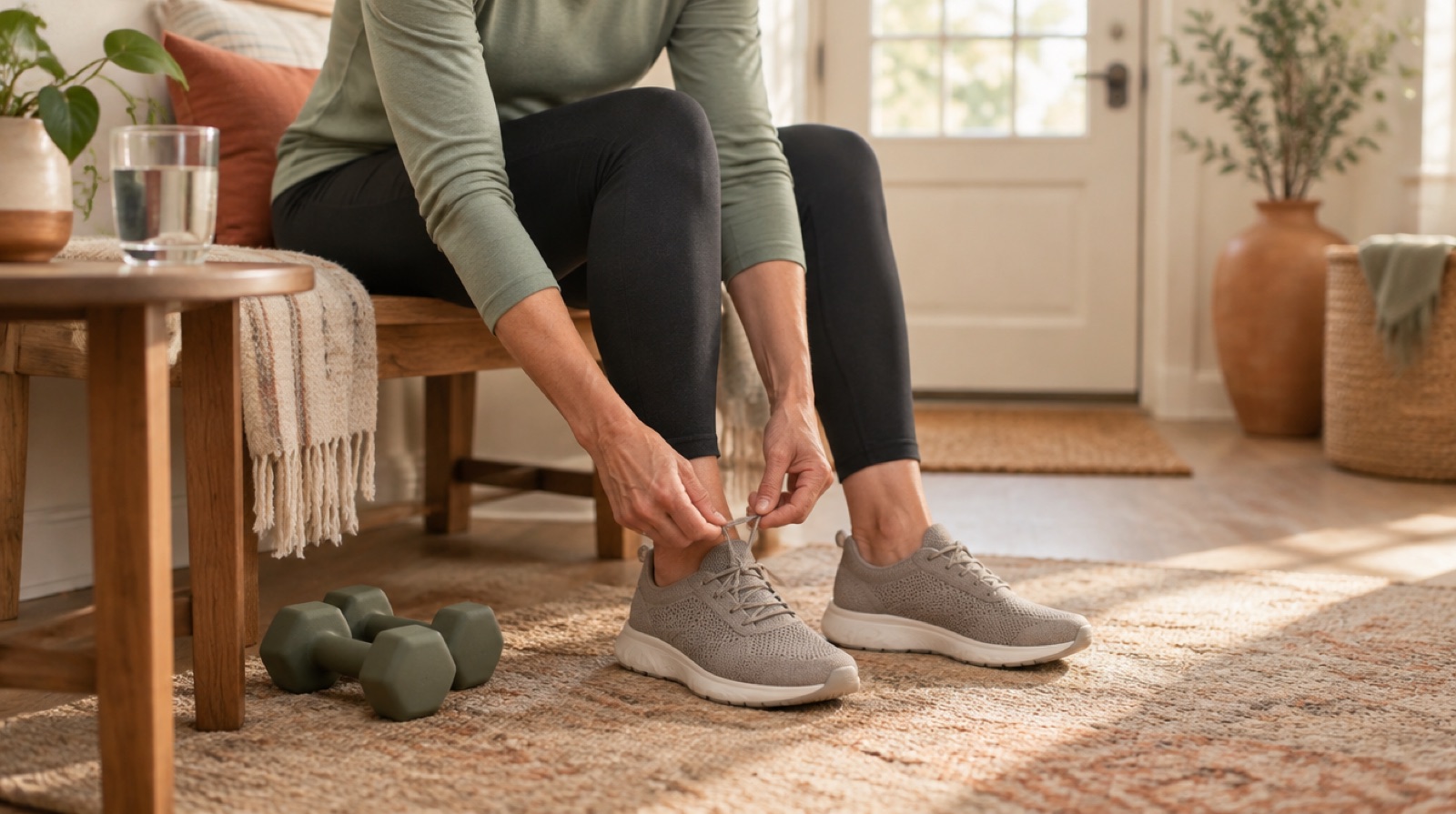
Weight loss for women over 40 works best with a modest calorie cut, protein at every meal, strength training and enough sleep. Your metabolism has not broken: in a pooled study of more than 6,400 people, daily energy burn held steady from about age 20 to 60 once body size and muscle were counted (Pontzer, 2021). What does shift is where your body stores fat and how much muscle it keeps, and that change starts in the years before menopause (Greendale, 2019). A plan built around that shift tends to hold up better than one built around eating as little as you can.
Why is it harder to lose weight after 40?
Losing weight after 40 feels harder mainly because body composition starts to change, not because your metabolism stops working. The Study of Women's Health Across the Nation tracked women with body scans through midlife. Weight rose at a steady pace through the premenopausal years, and at the start of the menopause transition the rate of fat gain doubled while lean mass began to fall (Greendale, 2019). The number on the scale did not speed up. What sat behind that number changed.
That is why your jeans can fit differently at the same weight. The same study found both trends continued until about two years after the final period, then leveled off. For more on the hormone side, see our guide to what changes in your metabolism during perimenopause.
Does your metabolism slow down at 40?
Your metabolism does not slow down at 40 in the way most ads claim. Researchers measured real daily energy burn with doubly labeled water, the gold standard method, in people aged 8 days to 95 years. After adjusting for fat-free mass, energy use stayed stable from 20 to 60, even during pregnancy, and only declined after that (Pontzer, 2021).
This does not mean nothing changes. If you lose muscle, your total daily burn can drift down, because muscle is part of what the study adjusted for. It does mean a so-called slow metabolism is rarely the whole story, and a product that promises to fix it is selling you the wrong problem.
What is the best diet for women over 40 to lose weight?
The best diet for women over 40 is the one you can keep eating at a small calorie deficit, because head-to-head trials find little difference between the popular options. The DIETFITS trial is a useful test, since its 609 adults had an average age of 40 and 57% were women. After 12 months, people on a healthy low-fat diet lost 5.3 kg and people on a healthy low-carb diet lost 6.0 kg, a gap too small to count as a real difference (Gardner, 2018). Neither genes nor insulin levels predicted who would do better on which plan.
Both groups were coached to eat good-quality food, and that may matter as much as the fat or carb split. Fasting follows the same pattern: our review of what the trials show on intermittent fasting after 40 found it is one more way of eating less, no better and no worse.
How much protein do women over 40 need to lose weight?
Women over 40 who are trying to lose weight do well with about 1.2 to 1.6 g of protein per kilogram of body weight each day, which a research review linked to better appetite and weight control. The same review suggested at least 25 to 30 g at a meal (Leidy, 2015). For a woman who weighs 70 kg (154 pounds), that works out to about 84 to 112 g a day.
A meta-analysis of 24 trials with 1,063 people compared higher-protein and standard-protein diets with the same calories. The higher-protein groups lost slightly more fat (about 0.9 kg) and kept slightly more lean mass (about 0.4 kg) over an average of 12 weeks (Wycherley, 2012). Those are modest numbers, but they point the right way for a body that is starting to lose muscle. Our guide to how much protein women need at every age has easy ways to get there.
What is the best exercise for weight loss for women over 40?
Strength training is the most useful exercise for women over 40 because it changes what your body is made of, even when the scale moves slowly. In a two-year trial of 164 overweight women aged 25 to 44, those who lifted twice a week lowered their percentage of body fat by 3.7%, compared with almost no change in the group given brochures on aerobic exercise (Schmitz, 2007). Deep belly fat rose in both groups, by about 7% with strength training and 21% without it.
Two sessions a week was enough in that study, and our sample weight loss exercise plan for women shows how to fit them around your walks. Keep up the walking or cardio you enjoy as well: in the Women's Healthy Lifestyle Project below, sticking with physical activity went along with better weight maintenance (Simkin-Silverman, 2003).
Does sleep affect weight loss after 40?
Sleep affects weight loss after 40 because short nights raise how much you eat and change what you lose on a diet. In a trial of 80 adults aged 21 to 40 who usually slept under 6.5 hours, one counseling session added about 1.2 hours of sleep a night. They ate about 270 fewer calories a day than the control group, with no diet prescribed (Tasali, 2022). These were younger adults, so treat it as a strong hint rather than proof for your age group.
A much smaller study points the same way. Ten adults with a mean age of 41, three of them women, spent 14 days on a reduced-calorie diet with either 8.5 or 5.5 hours in bed. On less sleep they lost less fat (0.6 kg versus 1.4 kg) and more lean mass (Nedeltcheva, 2010). Our guide to sleep, cortisol and midlife weight goes deeper, including what to do when perimenopause wakes you at 3 a.m.
How much weight can a woman over 40 lose in a month?
A realistic pace for women over 40 is around one pound a month over a full year, based on what people in a year-long trial lost on average. Participants in DIETFITS lost 5.3 to 6.0 kg (about 12 to 13 pounds) over 12 months on average, with 22 group coaching sessions (Gardner, 2018). Many people lose faster in the first few months and slow down later, and some lose more or less than the average.
Slow can still be a win. In the Women's Healthy Lifestyle Project, 535 women aged 44 to 50 were followed through midlife. After four and a half years, 55% of those in a diet and activity program were at or below their starting weight, compared with 26% of the control group, who gained 2.4 kg on average (Simkin-Silverman, 2003). That program asked for a strict 1,300 calories a day, which is lower than many women need or can keep up, so ask a dietitian what fits you. Stopping the yearly creep counts as success.
Weight loss for women over 40 in perimenopause
Weight loss in perimenopause uses the same tools, with more attention on muscle and sleep. Fat gain speeds up and lean mass falls at the start of the transition (Greendale, 2019), and night waking can cut into sleep, so strength work and protein earn their place during these years. Do not wait until after menopause to begin.
If you are already past the transition, our guides to weight loss for women over 50 and what helps with menopause weight pick up where this one leaves off. You can find more in our hormone guides for women.
When to talk to your doctor
Talk to your doctor if your weight changes quickly without a clear reason, or if it comes with heavy fatigue, feeling cold, missed periods or new hair loss. A simple blood test can check for an underactive thyroid, and our guide to hypothyroidism and weight loss explains what treatment can and cannot do. PCOS, some medicines and insulin resistance can also play a part. If you have tried for a long time without progress, ask whether prescription options fit your health history.
The bottom line
Weight loss for women over 40 comes from a small calorie deficit you can live with, plus the habits that protect muscle: protein at each meal, strength training twice a week and more sleep. Pick the eating style you like, since the trials do not crown a winner, and expect slow progress measured in months.
This article is general information, not medical advice. Talk to your doctor before starting a new diet or exercise plan, especially if you have a health condition or take medicine.
References
- Pontzer H, Yamada Y, Sagayama H, et al. Daily energy expenditure through the human life course. Science. 2021;373(6556):808-812. PMID: 34385400
- Greendale GA, Sternfeld B, Huang M, et al. Changes in body composition and weight during the menopause transition. JCI Insight. 2019;4(5). PMID: 30843880
- Gardner CD, Trepanowski JF, Del Gobbo LC, et al. Effect of low-fat vs low-carbohydrate diet on 12-month weight loss in overweight adults and the association with genotype pattern or insulin secretion: the DIETFITS randomized clinical trial. JAMA. 2018;319(7):667-679. PMID: 29466592
- Leidy HJ, Clifton PM, Astrup A, et al. The role of protein in weight loss and maintenance. American Journal of Clinical Nutrition. 2015;101(6):1320S-1329S. PMID: 25926512
- Wycherley TP, Moran LJ, Clifton PM, et al. Effects of energy-restricted high-protein, low-fat compared with standard-protein, low-fat diets: a meta-analysis of randomized controlled trials. American Journal of Clinical Nutrition. 2012;96(6):1281-1298. PMID: 23097268
- Schmitz KH, Hannan PJ, Stovitz SD, et al. Strength training and adiposity in premenopausal women: strong, healthy, and empowered study. American Journal of Clinical Nutrition. 2007;86(3):566-572. PMID: 17823418
- Tasali E, Wroblewski K, Kahn E, et al. Effect of sleep extension on objectively assessed energy intake among adults with overweight in real-life settings: a randomized clinical trial. JAMA Internal Medicine. 2022;182(4):365-374. PMID: 35129580
- Nedeltcheva AV, Kilkus JM, Imperial J, et al. Insufficient sleep undermines dietary efforts to reduce adiposity. Annals of Internal Medicine. 2010;153(7):435-441. PMID: 20921542
- Simkin-Silverman LR, Wing RR, Boraz MA, et al. Lifestyle intervention can prevent weight gain during menopause: results from a 5-year randomized clinical trial. Annals of Behavioral Medicine. 2003;26(3):212-220. PMID: 14644697
Common questions
Why can't I lose weight after 40 even though I eat less?
Weight loss after 40 can stall on fewer calories because fat gain speeds up and lean mass falls as the menopause transition begins, and very low intakes are hard to keep up. Enough protein, strength training and better sleep usually help more than cutting further.
What is the fastest way for a woman over 40 to lose weight?
A fast crash diet is not the best route for women over 40 because it costs muscle. In year-long trial data, adults lost about 12 to 13 pounds over 12 months on average, and a steady pace with protein and strength training protects the muscle you want to keep.
How many calories should a woman over 40 eat to lose weight?
Calorie needs for women over 40 vary with height, weight and activity, so no single number fits everyone. A small deficit you can keep up is the goal, and a registered dietitian can set a personal target. One long midlife trial used 1,300 calories a day, which is too low for many women.
Is walking enough to lose weight after 40?
Walking alone is a good habit but is unlikely to protect muscle the way strength training does. In a two-year trial of women aged 25 to 44, lifting twice a week lowered body fat percentage and slowed the rise in deep belly fat.
Do hormones stop women over 40 from losing weight?
Hormone changes do not stop women over 40 from losing weight, though they do change where fat goes and how much muscle stays. Trials in midlife women show diet and activity programs can still limit or reverse weight gain through the menopause years.
Should women over 40 try low carb or low fat?
Low carb and low fat diets worked about equally well for weight loss in the DIETFITS trial of 609 adults with an average age of 40. Choose the one that fits your tastes and that you can keep up, and focus on good-quality food.