Supplements
Protein for Women: How Much You Really Need at Every Age
Protein is on every label and in every feed right now. Here is the calm, cited version for women: how much you really need, why it climbs with age, and simple ways to get there.
Protein is everywhere right now. It is stamped on cereal boxes, pancake mixes, and candy bars, and every other post seems to be about hitting a protein goal. It is easy to roll your eyes and assume it is just marketing. But underneath the hype is a real and important story, and it is one that matters more for women than most of us were ever told.
Protein is the raw material your body uses to build and keep muscle, and muscle is about far more than looking toned. It helps you stay strong, steady, and independent as you age, and it plays a role in your metabolism and blood sugar. The tricky part is that many women eat less protein than they need, especially as they get older, right when their bodies need it most. Let's clear up how much you actually need and how to get there without turning every meal into a math problem.
How much protein do you really need?
You may have heard the official number: about 0.8 grams of protein per kilogram of body weight per day. Here is the key thing almost no one explains. That figure is the minimum to prevent a deficiency, not the amount that helps you thrive. It is a floor, not a goal.
Research on healthy aging and muscle points to a higher target. A detailed review found that intakes in the range of about 1.2 to 1.6 grams per kilogram per day support better weight management, muscle, and appetite control than the bare minimum (Leidy 2015). For many women that lands somewhere around 80 to 110 grams a day, though the right number depends on your size and activity. You do not need to hit it perfectly. Just know that the floor and the goal are two different things.
Why protein matters more for women with age
Starting in your 30s and 40s, the body slowly begins to lose muscle, and that loss speeds up around menopause as estrogen declines. On top of that, older muscle is a bit harder to stimulate, so it takes more protein to get the same building signal. This is exactly why the minimum is often not enough as you get older.
There is a modern twist too. With more women using GLP-1 medications and other approaches for weight loss, protecting muscle during weight loss has become a real concern. When you lose weight, some of it can come from muscle unless you take steps to protect it. A review of this issue found that eating protein above the old 0.8 gram minimum, paired with strength exercise, helps preserve muscle while you lose fat, and that older and postmenopausal women benefit most from this approach (McCarthy 2021). Protein is not just for building. It is for holding onto what you have. (We wrote a full guide to eating well on GLP-1 medications.)
Spread it across the day
Most of us eat almost no protein at breakfast, a little at lunch, and then a big pile at dinner. It turns out that is not the most useful pattern. Your body can only use so much protein for muscle building at one sitting, so spreading it out works better than saving it all for the evening.
In one carefully controlled study, adults who ate an even amount of protein at each of their three meals, roughly 30 grams each, built about 25 percent more muscle protein over the day than people who ate the same total but skewed it toward dinner (Mamerow 2014). A practical target many researchers point to is about 25 to 30 grams of protein per meal (Leidy 2015). The easiest win for most women is simply adding protein to breakfast.
Protein plus strength training is the real magic
Protein works best when you give your muscles a reason to use it. Pairing it with strength training is where the biggest benefits show up. A large review found that adding protein to a resistance training program meaningfully increased gains in muscle size and strength, with the benefit leveling off at around 1.6 grams per kilogram per day (Morton 2018).
This pairing is especially clear for women after menopause. A review focused on postmenopausal women found that a protein supplement improved strength and lean muscle only when it was combined with resistance training. On its own, without the exercise, it did not do much (Kuo 2022). The honest takeaway: a protein shake alone is not a shortcut. Protein plus lifting something heavy is the combination that pays off. (If you already lift, creatine for women is the other supplement with real evidence behind it.)
Does protein really keep you fuller?
You have probably heard that protein keeps you full, and there is truth to it, with a caveat. Reviews find that protein-rich meals do tend to increase feelings of fullness and can support weight management, though the effect on how much you eat at your very next meal is modest (Leidy 2015). So protein is a genuinely helpful tool for feeling satisfied, just not a magic appetite switch. Combined with fiber, it is one of the most reliable ways to build a meal that holds you, and that same pairing is the fix for the 3 p.m. energy slump.
Easy ways to hit your target
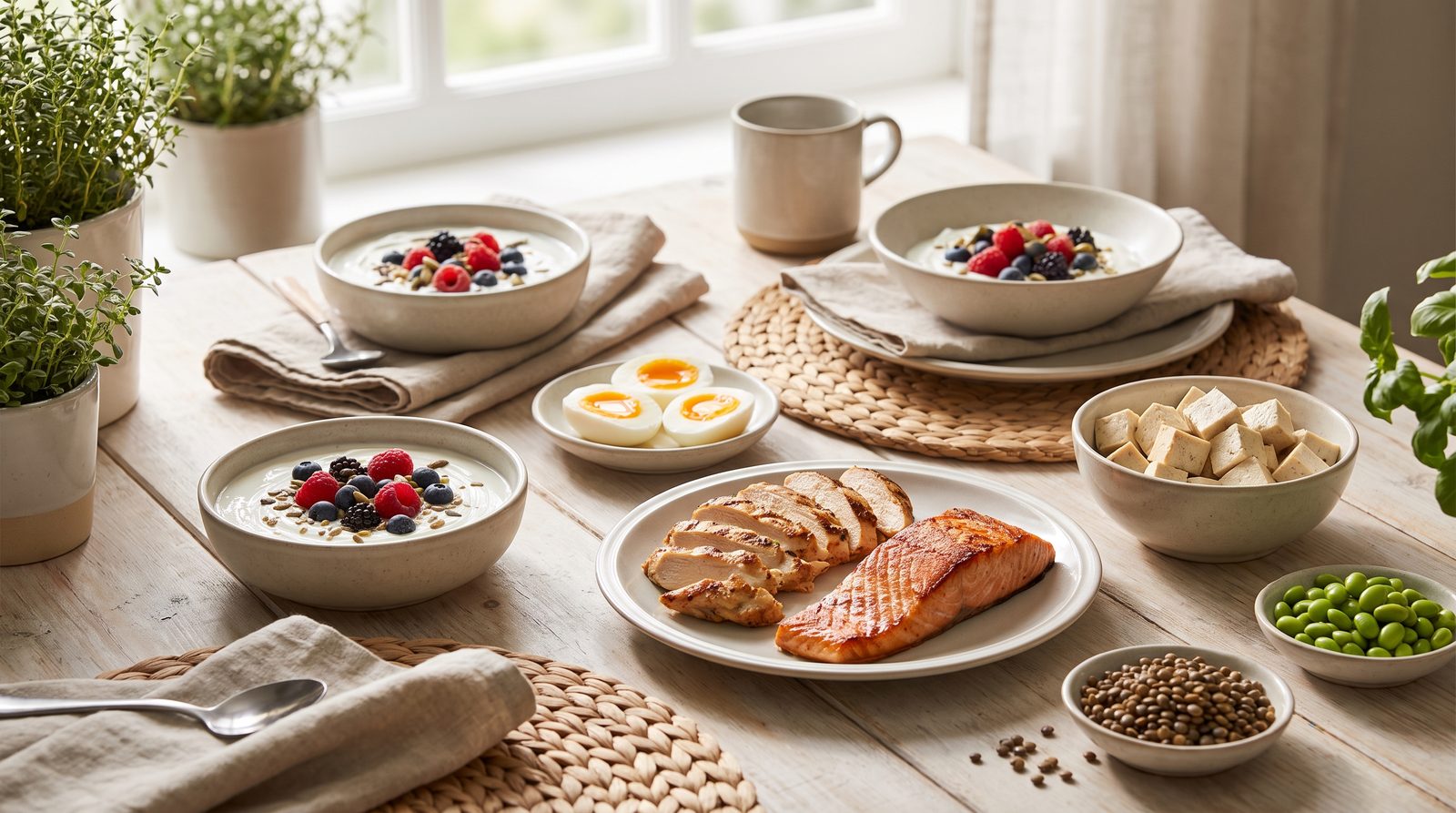
You do not need powders or bars, though they can help. Whole-food sources do the job well: eggs, Greek yogurt, cottage cheese, chicken, fish, tofu, tempeh, beans, lentils, and edamame. A few simple moves make a big difference. Add eggs or Greek yogurt to breakfast. Keep a protein at lunch instead of just a salad. Toss beans or lentils into soups and bowls. Keep easy options on hand for busy days. Small, steady upgrades beat one giant protein dinner.
When to talk to your doctor
Higher protein is safe for most healthy people, but there are exceptions. If you have kidney disease or another medical condition that affects how your body handles protein, talk to your doctor before increasing your intake. And if you are on a GLP-1 medication or another weight-loss plan, ask your care team about protein and strength training so you protect your muscle along the way. As always, this is general information, not personal medical advice.
The bottom line
Protein really does deserve some of the attention it is getting, especially for women. The official minimum is a floor, not a goal, and most women do well aiming higher, somewhere around 1.2 to 1.6 grams per kilogram a day. Spread it across your meals, aim for roughly 25 to 30 grams at each one, and pair it with strength training to protect the muscle that keeps you strong for decades. No powder required, just a little more protein and a lot more consistency. (More no-hype guides live in our supplements section.)
This article is for general education and is not medical advice. Talk to your doctor about your own needs, especially if you have kidney disease or another health condition.
References
- Leidy HJ, et al. The role of protein in weight loss and maintenance. American Journal of Clinical Nutrition. 2015. PMID: 25926512
- McCarthy D, Berg A. Weight Loss Strategies and the Risk of Skeletal Muscle Mass Loss. Nutrients. 2021. PMID: 34371981
- Mamerow MM, et al. Dietary protein distribution positively influences 24-h muscle protein synthesis in healthy adults. Journal of Nutrition. 2014. PMID: 24477298
- Morton RW, et al. A systematic review, meta-analysis and meta-regression of the effect of protein supplementation on resistance training-induced gains in muscle mass and strength in healthy adults. British Journal of Sports Medicine. 2018. PMID: 28698222
- Kuo YY, et al. Effect of Whey Protein Supplementation in Postmenopausal Women: A Systematic Review and Meta-Analysis. Nutrients. 2022. PMID: 36235862
Common questions
How much protein does a woman actually need per day?
Most women need more protein per day than the official minimum. The 0.8 grams per kilogram figure is the floor to prevent deficiency, not the goal. Research points to roughly 1.2 to 1.6 grams per kilogram per day to support muscle, weight management, and appetite. For many women that is around 80 to 110 grams a day, though it depends on your size and activity.
Why do women need more protein as they get older?
The body slowly loses muscle starting in your 30s and 40s, and that loss speeds up around menopause as estrogen drops. Older muscle also needs a stronger protein signal to rebuild. Eating a bit more protein, and pairing it with strength training, helps you hold onto the muscle that keeps you strong and steady with age.
Is it better to spread protein across meals or eat it all at dinner?
Spread your protein out across your meals. Your body can only use so much protein for muscle building at once, so an even amount across the day works better than one big dinner. In one study, people who ate about 30 grams at each of three meals built roughly 25 percent more muscle protein than those who saved it for the evening. The easiest fix is adding protein to breakfast.
Will a protein shake alone build muscle?
A protein shake alone will not really build muscle. Protein works best when you give your muscles a reason to use it. In postmenopausal women, a protein supplement improved strength and lean muscle only when combined with resistance training, and did little on its own. Protein plus lifting something heavy is the combination that pays off.