Gut Health
Best Fiber Supplement for Women: 5 Types Compared Honestly
Psyllium, PHGG, inulin, glucomannan, and acacia compared on the same five criteria. One clear winner, with every downside stated.
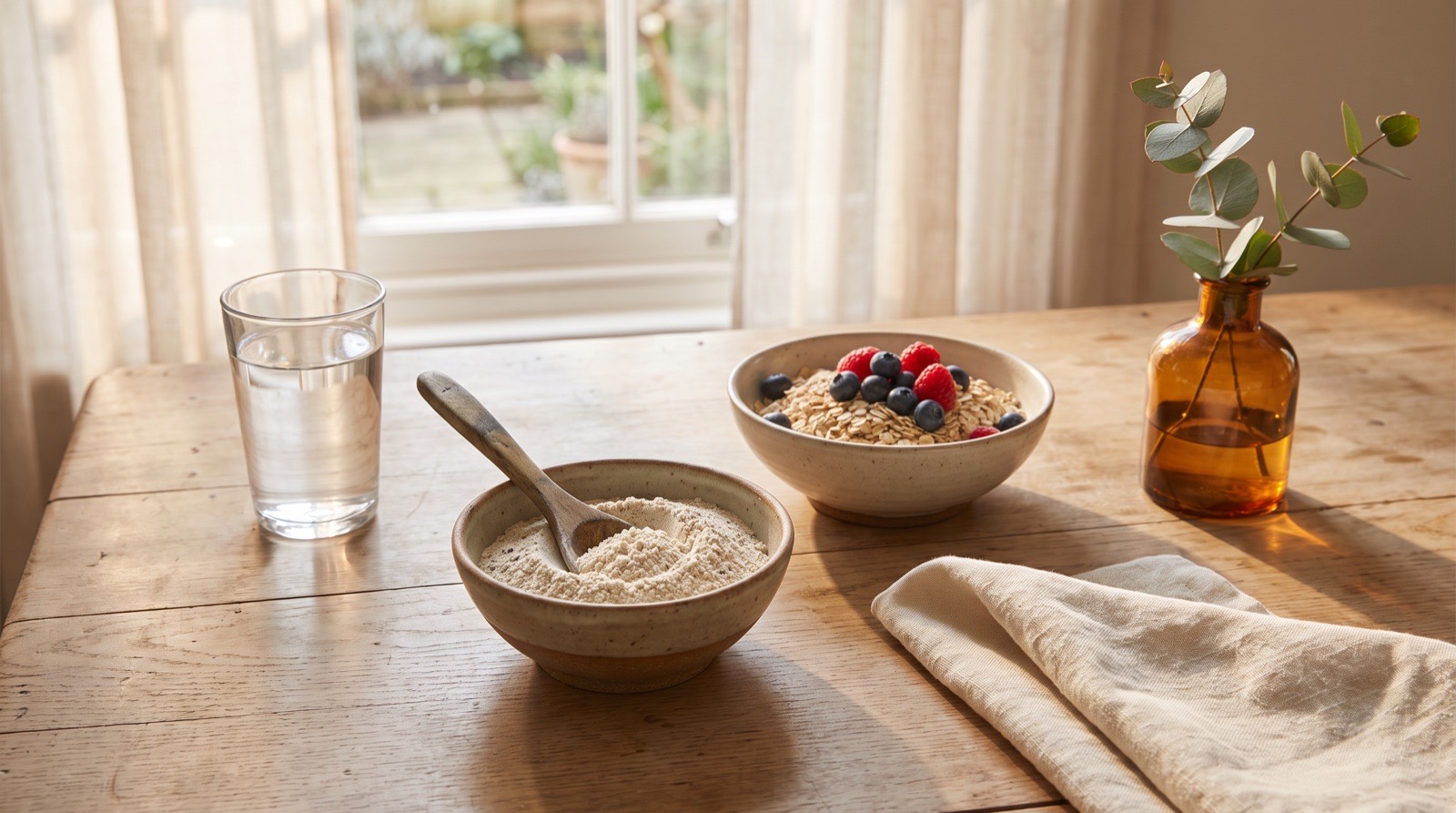
If you are looking for the best fiber supplement for women, here is the short answer: plain psyllium husk is the best choice for most women. It has the most research, it helps with constipation and loose stools, and it lowers LDL cholesterol as a bonus. If psyllium makes you bloated or you have IBS, partially hydrolyzed guar gum (PHGG) is the gentler runner-up. This guide compares five common fibers on the same criteria and states the downsides of each, including the winner.
There is nothing about fiber that has to be made differently for women. What is different is the need. Most women eat well short of the 25 grams a day they are advised to get, and constipation and IBS are both more common in women. If you want the food-first version of this story, start with how much fiber women really need and easy ways to get it. This post is for when food is not getting you there.
How we compared them
We looked at each fiber on five things you can check yourself.
- Evidence. Randomized trials in people, and how many there are.
- What it helps. Regularity, IBS symptoms, cholesterol, blood sugar, or fullness. These are different jobs, and one fiber rarely does all of them.
- Dose on the label. Can you tell exactly how many grams of fiber you get per serving?
- Tolerability. Gas, bloating, and whether you can take it every day for months.
- Cost per serving. Fiber is taken daily, so price adds up.
A fairness note. A fiber with fewer trials is not proven useless. It simply has less to show you. We rank on what has been measured and say plainly what has not.
The winner: psyllium husk
Psyllium is the fiber in Metamucil, Konsyl, and many store brands. It forms a thick gel in water, and that gel is what makes it useful. It holds water in hard stool, and it firms up stool that is too loose.
For constipation, the largest review pooled 16 trials with 1,251 adults. Fiber supplements helped, and psyllium was one of only two fibers with clear effects on their own. The best results came at doses above 10 grams a day, taken for at least four weeks (van der Schoot, 2022). An earlier review found the same pattern: about 77 percent of people on fiber responded, compared with 44 percent on placebo (Christodoulides, 2016).
Psyllium also does something most fibers cannot. A review of 28 trials in 1,924 people found about 10 grams a day lowered LDL cholesterol, non-HDL cholesterol, and apolipoprotein B (Jovanovski, 2018). That matters for women in midlife, when LDL tends to climb around menopause.
The downsides, stated plainly. Psyllium causes gas and bloating for some women, especially if you start with a full dose. Both constipation reviews found more flatulence on fiber than on placebo. It needs a full glass of water every time. Flavored, sweetened versions cost more and add sugar or sweeteners, so plain powder or capsules are the better buy. Capsules hold very little fiber each, so reaching 5 to 10 grams can mean a handful of them.
Verdict: the best first fiber supplement for most women, especially if constipation or cholesterol is on your mind.
Runner-up for IBS and bloating: PHGG
Partially hydrolyzed guar gum is guar fiber that has been cut into smaller pieces. That makes it dissolve clear, with no gel and no taste, and it is gentler on sensitive guts. Sunfiber is the best-known brand.
In a 12-week trial of 121 people with IBS, 6 grams a day of PHGG reduced bloating and gas scores more than placebo, and the effect lasted at least four weeks after stopping. It did not change overall IBS severity or quality of life scores. People on PHGG were also less likely to drop out (Niv, 2016).
That fits the wider picture. A review of 14 trials in 906 people found soluble fiber helped IBS, while wheat bran did not (Moayyedi, 2014). If IBS is part of your story, our guide to why IBS is more common in women and what actually helps covers the rest of the plan.
The downsides: fewer trials than psyllium, it usually costs more per gram, and it does not have psyllium's cholesterol data.
Verdict: the pick for women with IBS or a gut that reacts to everything.
Inulin: cheap and common, but gassy
Inulin, often from chicory root, shows up in fiber gummies, bars, and "prebiotic" drinks. It feeds gut bacteria, which is the upside and the problem. Those bacteria make gas as they ferment it quickly.
In the big constipation review, inulin was not one of the fibers with a clear effect on its own (van der Schoot, 2022). Inulin is also a fructan, which is one of the high-FODMAP carbohydrates that commonly trigger IBS symptoms.
Verdict: fine as a small part of a food or gummy, but not our pick as your main fiber. If you already struggle with gas, it is the one to skip.
Glucomannan: the "weight loss fiber," with a catch
Glucomannan comes from the konjac root and swells a lot in water. That is why it is sold for fullness and weight loss.
The results are underwhelming. A review of eight trials found no meaningful difference in weight loss between glucomannan and placebo, about a quarter of a kilogram, which was not statistically significant (Onakpoya, 2014). Side effects included stomach discomfort, diarrhea, and constipation.
The safety note. Because it swells so much, glucomannan tablets have caused choking and throat blockages when swallowed without enough water. If you try it, use powder or capsules with a full glass of water, and skip it if you have any trouble swallowing.
Verdict: not worth it for weight loss on the current evidence.
Acacia fiber: the gentle, easy-mix option
Acacia fiber, also called gum arabic, is a soluble fiber that mixes into drinks without thickening them. In a trial of 48 healthy adults, 40 grams with breakfast made people feel fuller for up to four hours. GI symptoms stayed low overall, though the high dose caused more bloating and gas than no fiber (Larson, 2021).
The downsides: that was a single-meal trial with doses far higher than most labels, so it tells us about tolerance more than long-term results. There is little trial data for constipation or IBS.
Verdict: a reasonable option if psyllium's texture is a dealbreaker, but it has much less evidence behind it.
The quick comparison
- Psyllium: strongest evidence; helps constipation, loose stools, and LDL cholesterol; some gas early on; low cost for plain powder. Best overall.
- PHGG: good trial for IBS bloating; very gentle; dissolves clear; costs more.
- Inulin: cheap and common; weak constipation data; the gassiest of the five.
- Glucomannan: sold for weight loss, but trials show little effect; choking risk with tablets.
- Acacia: gentle and easy to mix; thin evidence.
You will also see wheat dextrin (Benefiber) and methylcellulose (Citrucel). Both are gentle and dissolve easily, but neither has the depth of trial data that psyllium has.
Best fiber supplement for constipation
Psyllium. It has the clearest trial results, and the dose that works is known: more than 10 grams a day for at least four weeks (van der Schoot, 2022). Build up to it slowly. If you have tried fiber and water and still struggle, read our look at why constipation is more common in women and what actually helps, because fiber is not always the missing piece.
Best fiber supplement for weight loss
Here is the honest number. When people added viscous fiber (the gel-forming kind, like psyllium or glucomannan) to a calorie-reduced diet, they lost about 0.8 kilograms more, roughly 1.8 pounds, than people on the diet alone. Body fat dropped a little too (Jovanovski, 2021).
That is real but small. Fiber helps you feel full, and it makes a lower-calorie way of eating easier to stick with. It does not melt weight off on its own. If weight is your main goal, what actually changes with weight loss for women over 50 covers the bigger levers, like protein, strength training, and sleep.
Best fiber supplement for women over 40 and 50
Psyllium again, and the reason is heart and blood sugar health. LDL cholesterol often rises around menopause, and psyllium is the fiber with the best data for lowering it (Jovanovski, 2018). A review of 35 trials also found psyllium improved fasting blood sugar and HbA1c in people with type 2 diabetes, with a smaller effect in people with prediabetes and no drop in people with normal blood sugar (Gibb, 2015). That review was written by researchers at Procter and Gamble, which makes Metamucil, so weigh it with that in mind. For the bigger picture, see what changes with blood sugar in perimenopause and what helps.
How much fiber supplement per day?
- Start low: about 3 to 5 grams of fiber a day for the first week.
- Build up: add a few grams each week. The constipation benefit showed up above 10 grams a day (van der Schoot, 2022), and the cholesterol benefit at about 10 grams (Jovanovski, 2018).
- PHGG: the IBS trial used 6 grams a day (Niv, 2016).
- Water: take every dose with a full glass of water, at least 8 ounces.
Check the label for grams of fiber per serving, not grams of powder. They are often different.
When to take it, and what to watch for
Any time of day works. Many women take it before a meal because it helps with fullness. Fiber can slow the absorption of some medicines, so take medicines at least two hours before or after your fiber. This matters most for thyroid medicine and some diabetes medicines, so ask your pharmacist.
Talk to your doctor first if you have trouble swallowing, a history of bowel blockage, or new constipation along with weight loss, bleeding, or severe pain. Those need checking, not fiber.
For more on gut health, browse our gut health guides.
The bottom line
The best fiber supplement for most women is plain psyllium husk. It has the most trials, it helps with regularity in both directions, and it lowers LDL cholesterol. Start small, drink water with it, and give it four weeks. If psyllium upsets your stomach or you have IBS, try PHGG. Skip glucomannan for weight loss, and do not expect any fiber to do the work of a whole diet.
References
- van der Schoot A, Drysdale C, Whelan K, Dimidi E. The effect of fiber supplementation on chronic constipation in adults: an updated systematic review and meta-analysis of randomized controlled trials. American Journal of Clinical Nutrition. 2022. PMID: 35816465
- Christodoulides S, Dimidi E, Fragkos KC, et al. Systematic review with meta-analysis: effect of fibre supplementation on chronic idiopathic constipation in adults. Alimentary Pharmacology and Therapeutics. 2016. PMID: 27170558
- Jovanovski E, Yashpal S, Komishon A, et al. Effect of psyllium (Plantago ovata) fiber on LDL cholesterol and alternative lipid targets, non-HDL cholesterol and apolipoprotein B: a systematic review and meta-analysis of randomized controlled trials. American Journal of Clinical Nutrition. 2018. PMID: 30239559
- Niv E, Halak A, Tiommny E, et al. Randomized clinical study: partially hydrolyzed guar gum (PHGG) versus placebo in the treatment of patients with irritable bowel syndrome. Nutrition and Metabolism. 2016. PMID: 26855665
- Moayyedi P, Quigley EM, Lacy BE, et al. The effect of fiber supplementation on irritable bowel syndrome: a systematic review and meta-analysis. American Journal of Gastroenterology. 2014. PMID: 25070054
- Onakpoya I, Posadzki P, Ernst E. The efficacy of glucomannan supplementation in overweight and obesity: a systematic review and meta-analysis of randomized clinical trials. Journal of the American College of Nutrition. 2014. PMID: 24533610
- Larson R, Nelson C, Korczak R, et al. Acacia gum is well tolerated while increasing satiety and lowering peak blood glucose response in healthy human subjects. Nutrients. 2021. PMID: 33672963
- Jovanovski E, Mazhar N, Komishon A, et al. Effect of viscous fiber supplementation on obesity indicators in individuals consuming calorie-restricted diets: a systematic review and meta-analysis of randomized controlled trials. European Journal of Nutrition. 2021. PMID: 32198674
- Gibb RD, McRorie JW, Russell DA, Hasselblad V, D'Alessio DA. Psyllium fiber improves glycemic control proportional to loss of glycemic control: a meta-analysis of data in euglycemic subjects, patients at risk of type 2 diabetes mellitus, and patients being treated for type 2 diabetes mellitus. American Journal of Clinical Nutrition. 2015. PMID: 26561625
Common questions
What is the best fiber supplement for women?
Plain psyllium husk is the best choice for most women. It has the most trials behind it, it helps with both constipation and loose stools, and about 10 grams a day lowers LDL cholesterol. If psyllium causes too much bloating, or you have IBS, partially hydrolyzed guar gum (PHGG) is a gentler option.
Is it OK to take a fiber supplement every day?
For most healthy adults, it is OK to take a fiber supplement every day. Psyllium and PHGG were both studied as daily supplements for weeks to months. Start with a small dose, build up slowly, drink a full glass of water with each dose, and keep medicines at least two hours apart from your fiber.
Which fiber supplement is best for weight loss?
None of them does much on its own. Adding gel-forming fiber like psyllium to a calorie-reduced diet led to about 0.8 kilograms, or roughly 1.8 pounds, of extra weight loss in trials. Glucomannan, often sold for weight loss, showed no meaningful difference from placebo in a review of eight trials.
Is psyllium or Benefiber better?
Psyllium has more research behind it, especially for constipation and cholesterol. Benefiber is wheat dextrin, which dissolves clear and is gentle, but it does not have the same depth of trial evidence. If you cannot tolerate psyllium, PHGG is the better-studied gentle option for IBS and bloating.
How long does it take for a fiber supplement to work?
Some women notice a change in a few days, but the constipation trials found the clearest results after at least four weeks at more than 10 grams a day. Give it a month at a steady dose before deciding whether it works for you.
Can a fiber supplement cause bloating?
A fiber supplement can cause bloating, especially at first. Both big constipation reviews found more gas on fiber than on placebo. Starting with 3 to 5 grams a day, raising the dose slowly, and choosing a gentler fiber like PHGG over inulin usually helps.