Hormones
Weight Loss Foods for Women: The 7 Groups the Research Backs
Yogurt, seafood, berries, beans and nuts lead the list. Here is what the long-term studies and trials found, and what to eat after 40 and 50.
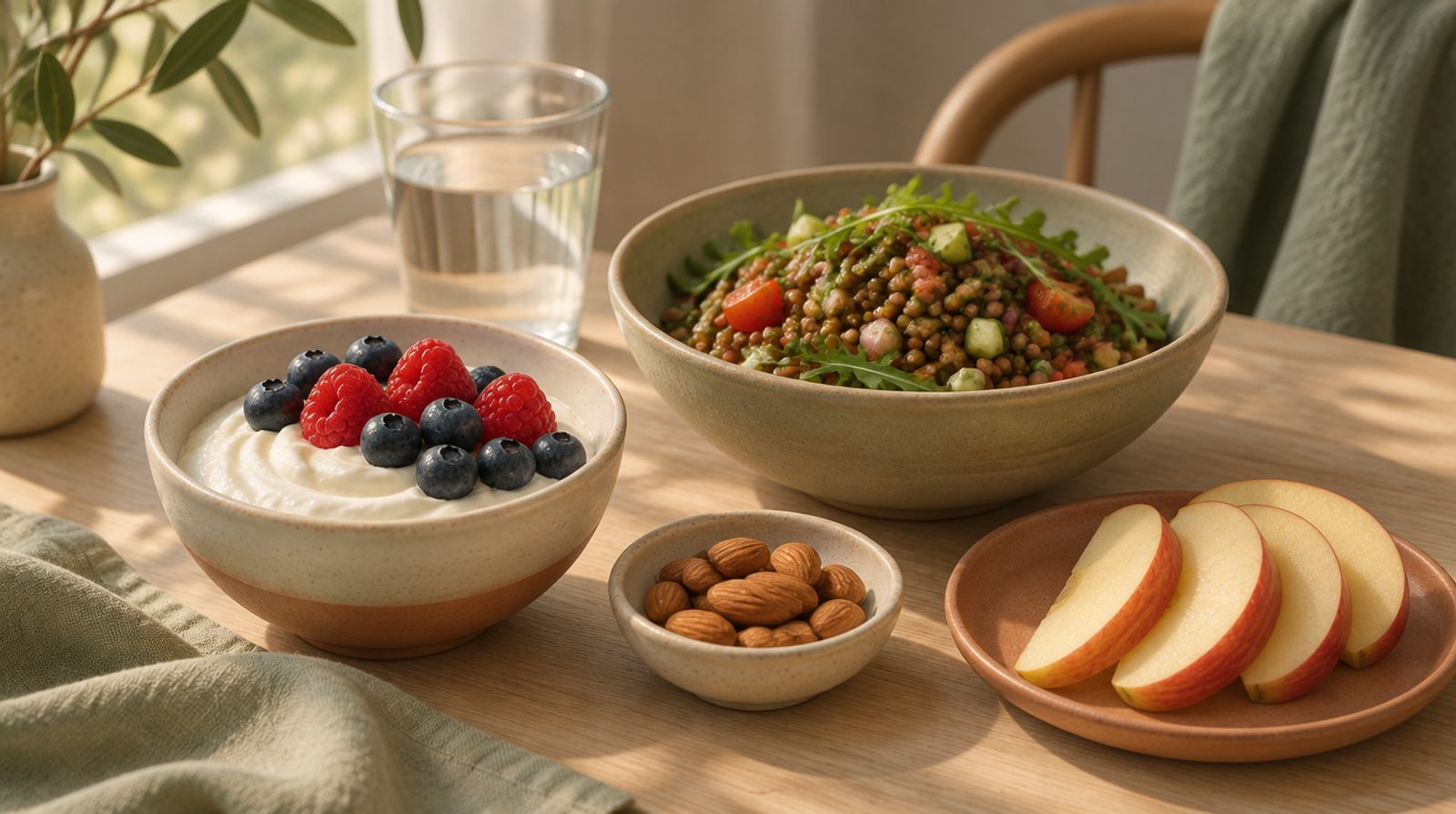
The best weight loss foods for women are high-protein foods like seafood, skinless chicken and yogurt, plus fruits, non-starchy vegetables, beans, lentils and nuts. In studies that followed more than 120,000 U.S. adults, mostly women, for up to 24 years, eating more of these foods went with less weight gain, while chips, potatoes, sugary drinks and red and processed meats went with more (Mozaffarian, 2011). No food burns fat on its own. These weight loss foods for women work because they fill you up for fewer calories, which makes a calorie deficit easier to keep.
The 7 weight loss foods for women with the best evidence
Seven food groups have the most consistent research behind them for weight loss in women:
- Yogurt. The food most strongly tied to less weight gain in the large Harvard cohorts (Mozaffarian, 2011).
- Seafood and skinless chicken. Lean protein linked with relative weight loss over time (Smith, 2015).
- Berries, apples and pears. The fruits with the strongest links to weight loss (Bertoia, 2015).
- Non-starchy vegetables. Cauliflower, broccoli, leafy greens and other high-fiber, low-sugar vegetables (Bertoia, 2015).
- Beans, lentils and chickpeas. Tested in randomized trials, not just observed (Kim, 2016).
- Nuts and peanut butter. Linked with less weight gain despite being calorie-dense (Smith, 2015).
- Tofu and soy. The single food with the largest link to weight loss in one analysis (Bertoia, 2015).
Most of this evidence comes from observational studies. They show which foods went with weight change, not proof that the food caused it. Where randomized trials exist, they point the same way.
Protein foods for weight loss: seafood, chicken, yogurt and eggs
Protein foods help women lose weight by keeping you full and protecting muscle while calories are cut. Across 24 trials with 1,063 adults, higher-protein diets at the same calories took off 0.87 kg more fat and kept 0.43 kg more lean mass than standard-protein diets (Wycherley, 2012). Not every protein food behaved the same over time. In 120,784 adults, yogurt, seafood, skinless chicken and low-fat cheese went with relative weight loss, while red meat, chicken with skin and regular cheese went with weight gain (Smith, 2015). Eggs, milk and beans showed no link either way, so eggs are a neutral, easy protein rather than a weight loss food in their own right. Our guide on how much protein a day women need to lose weight turns this into a daily number.
Fruits and vegetables for weight loss
Berries, apples, pears and non-starchy vegetables are the produce most linked with weight loss in women. In 133,468 adults followed for up to 24 years, each extra daily serving of berries went with 1.11 lb less weight over 4 years, apples and pears with 1.24 lb less, and cauliflower with 1.37 lb less (Bertoia, 2015). Starchy vegetables such as corn, peas and potatoes went the other way. A randomized trial backs up the idea: 97 women with obesity who cut fat and ate more water-rich fruits and vegetables lost 7.9 kg in a year, compared with 6.4 kg for women who only cut fat, and they reported less hunger (Ello-Martin, 2007). Neither group was told to count calories.
Beans and lentils for weight loss
Beans, lentils, chickpeas and peas are the weight loss foods with randomized trial support. A review of 21 trials with 940 people found that about one serving a day, about 2/3 cup cooked, led to 0.34 kg more weight loss over a median of 6 weeks, even in diets not designed to cut calories (Kim, 2016). That is a small effect, but beans also bring fiber, and fiber was the strongest single diet predictor of weight loss in a 6-month study of 345 adults on calorie-cut diets (Miketinas, 2019). Our fiber guide for women lists more easy sources.
Nuts and peanut butter for weight loss
Nuts and peanut butter are linked with less weight gain over time, even though they are high in calories. In the Harvard cohorts, each extra daily serving of nuts went with 0.57 lb less weight over 4 years (Mozaffarian, 2011), and walnuts, other nuts and peanut butter each went with relative weight loss (Smith, 2015). The likely reason is fullness: nuts tend to replace chips and sweets rather than add to them. A small handful, about one ounce, is a sensible portion.
Foods linked with weight gain in women
Potato chips, potatoes, sugar-sweetened drinks, and red and processed meats are the foods most linked with weight gain. Each extra daily serving of potato chips went with 1.69 lb more weight over 4 years, potatoes with 1.28 lb, and sugary drinks with 1.00 lb (Mozaffarian, 2011). You do not need to ban any of them. Swapping the most frequent one for a food from the list above is a simple first step, and the swap matters: the same studies found that trading refined carbs for protein foods was linked with better weight results than adding protein on top (Smith, 2015).
Weight loss foods for women over 40 and over 50
Women over 40 and over 50 should put protein foods first, because muscle gets harder to keep with age and is easier to lose during a diet. Aim for a palm-sized portion of seafood, chicken, tofu, yogurt or eggs at every meal, then fill half the plate with vegetables. After menopause, calorie needs drop, so the fullness these foods bring matters even more. Our guide on setting your weight loss macros shows how to fit them into a daily target, and high-protein breakfast ideas for weight loss over 50 covers the meal most women under-eat. If evening hunger undoes a good day, read why you get so hungry at night. More on how hormones change the picture is in our hormones hub.
This article is general information, not medical advice. Talk with your doctor before changing your diet, especially if you have diabetes, kidney disease or a history of disordered eating.
References
- Mozaffarian D, Hao T, Rimm EB, Willett WC, Hu FB. Changes in diet and lifestyle and long-term weight gain in women and men. New England Journal of Medicine. 2011;364(25):2392-2404. PMID: 21696306
- Bertoia ML, Mukamal KJ, Cahill LE, et al. Changes in intake of fruits and vegetables and weight change in United States men and women followed for up to 24 years: analysis from three prospective cohort studies. PLoS Medicine. 2015;12(9):e1001878. PMID: 26394033
- Smith JD, Hou T, Ludwig DS, et al. Changes in intake of protein foods, carbohydrate amount and quality, and long-term weight change: results from 3 prospective cohorts. American Journal of Clinical Nutrition. 2015;101(6):1216-1224. PMID: 25854882
- Kim SJ, de Souza RJ, Choo VL, et al. Effects of dietary pulse consumption on body weight: a systematic review and meta-analysis of randomized controlled trials. American Journal of Clinical Nutrition. 2016;103(5):1213-1223. PMID: 27030531
- Ello-Martin JA, Roe LS, Ledikwe JH, Beach AM, Rolls BJ. Dietary energy density in the treatment of obesity: a year-long trial comparing 2 weight-loss diets. American Journal of Clinical Nutrition. 2007;85(6):1465-1477. PMID: 17556681
- Wycherley TP, Moran LJ, Clifton PM, Noakes M, Brinkworth GD. Effects of energy-restricted high-protein, low-fat compared with standard-protein, low-fat diets: a meta-analysis of randomized controlled trials. American Journal of Clinical Nutrition. 2012;96(6):1281-1298. PMID: 23097268
- Miketinas DC, Bray GA, Beyl RA, et al. Fiber intake predicts weight loss and dietary adherence in adults consuming calorie-restricted diets: the POUNDS Lost study. Journal of Nutrition. 2019;149(10):1742-1748. PMID: 31174214
Common questions
What should a woman eat in a day to lose weight?
A woman trying to lose weight can build each meal from a protein food, a fruit or non-starchy vegetable, and a fiber-rich carb such as beans, oats or whole grains. A sample day is Greek yogurt with berries, a lentil and salmon salad, an apple with peanut butter, and chicken with roasted vegetables. Portions still need to fit a calorie target.
What foods help women lose belly fat?
Specific foods do not target belly fat. Belly fat comes off with overall fat loss, and the same foods that help with weight loss, protein, vegetables, fruit, beans and nuts, support it. Higher-protein diets also helped people keep more muscle while losing fat in trials.
Is fruit bad for weight loss because of the sugar?
Whole fruit is linked with weight loss, not weight gain, despite its natural sugar. In a study of 133,468 adults, each extra daily serving of fruit went with about half a pound less weight over 4 years, and berries, apples and pears showed the strongest links. Fruit juice is a different case and is easy to overdrink.