Hormones
Weight Loss Macros for Women: How to Set Yours in 4 Steps
Protein first, a fat floor, carbs for the rest: a worked example for a 150 lb woman, plus what changes after 40 and 50.
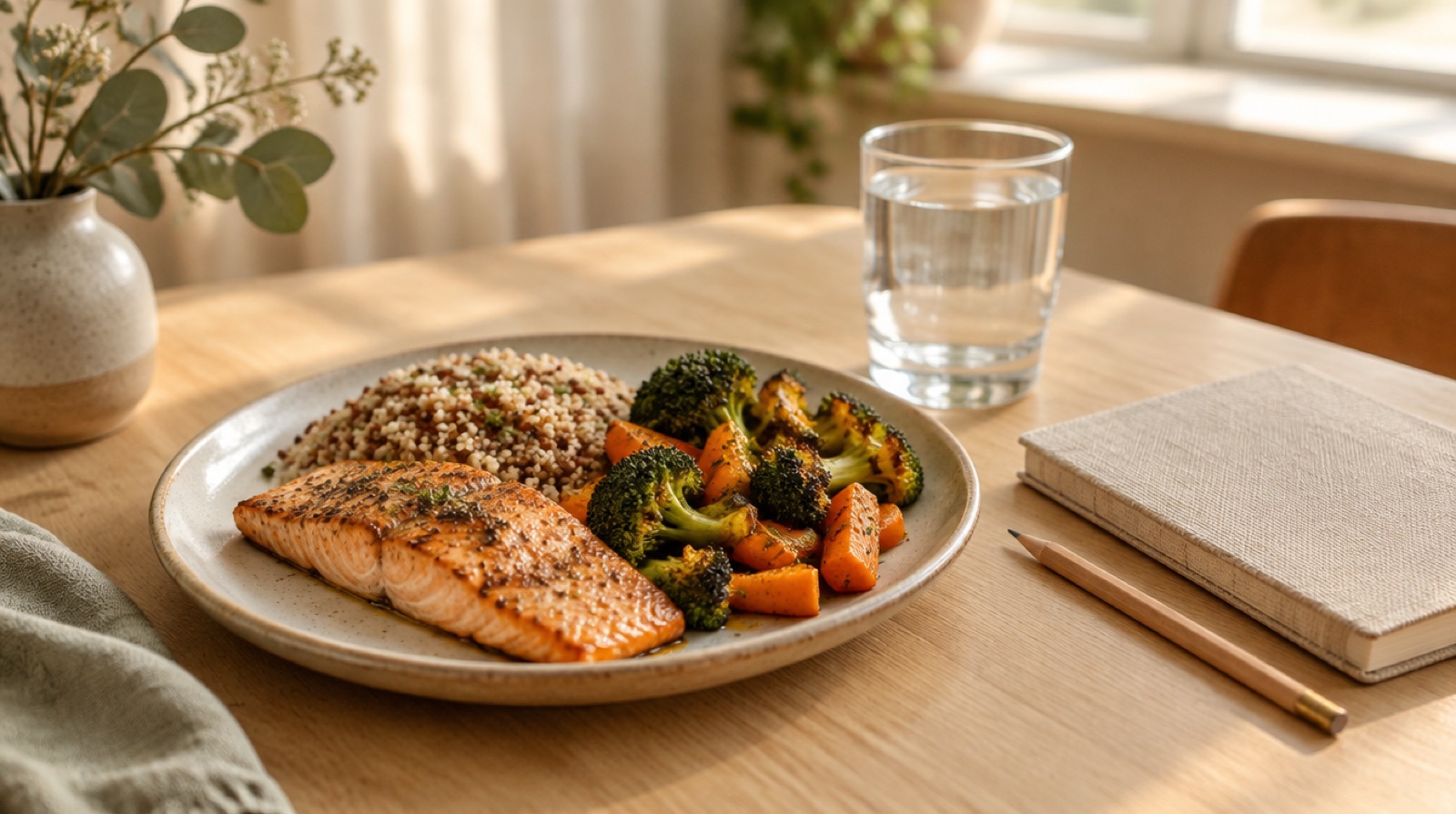
Weight loss macros for women start with protein, not a fixed ratio: about 1.2 to 1.6 grams of protein per kilogram of body weight, at least 20% of calories from fat, and carbohydrates filling the rest, all inside a calorie deficit. For a 150 lb woman eating 1,600 calories, that works out to roughly 100 grams of protein, 55 grams of fat and 175 grams of carbs. Trials comparing very different macro splits found similar weight loss when calories matched (Sacks, 2009), so the best weight loss macros for a female body are the ones that keep you full and that you can stick with.
How to set your weight loss macros in 4 steps
Setting weight loss macros takes four steps: pick a calorie target, set protein, set a fat floor, then let carbs fill the gap.
- Calories. Start about 500 to 750 calories below what you eat to hold your weight steady. The largest macro trial used a 750 calorie daily deficit (Sacks, 2009). Many women land between 1,400 and 1,800 calories; our guide to how many calories a woman should eat to lose weight shows how to work out your own number.
- Protein. Multiply your weight in kilograms by 1.2 to 1.6. That is about 0.55 to 0.7 grams per pound.
- Fat. Keep fat at 20 to 35% of calories, the range set in the U.S. dietary reference intakes (Trumbo, 2002). At 1,600 calories, that is about 35 to 60 grams.
- Carbs. Whatever calories are left go to carbohydrates. Divide those calories by 4 to get grams.
| Example: 150 lb woman, 1,600 calories | Grams | Calories | Share |
|---|---|---|---|
| Protein (1.47 g/kg) | 100 g | 400 | 25% |
| Fat | 55 g | 495 | 31% |
| Carbohydrates | 176 g | 705 | 44% |
Our protein chart for weight loss by body weight gives the protein number for other sizes.
Why protein comes first in weight loss macros for women
Protein comes first because it decides how much of the weight you lose is fat rather than muscle. Across 24 trials with 1,063 adults, higher-protein, calorie-cut diets produced 0.87 kg more fat loss and kept 0.43 kg more lean mass than standard-protein diets at the same calories (Wycherley, 2012). A review of weight loss trials linked about 25 to 30 grams of protein per meal with better fullness and weight results (Leidy, 2015). If breakfast is your low-protein meal, our ranking of the best protein shakes for weight loss for women shows easy 30 gram options.
Is 40/30/30 the best macro ratio for weight loss?
The 40/30/30 split (40% carbs, 30% protein, 30% fat) is a reasonable ratio for weight loss, but trials do not show it beats other ratios. In a 2-year trial of 811 adults, four diets ranging from 35% to 65% carbs and 20% to 40% fat all produced similar weight loss, and hunger and satisfaction were similar too (Sacks, 2009). Attendance at support sessions predicted results better than the ratio did. A 12-month trial of 609 adults, 57% of them women, found a healthy low-fat diet and a healthy low-carb diet lost 5.3 kg and 6.0 kg, a difference too small to be meaningful (Gardner, 2018). An analysis of 48 trials with 7,286 adults reached the same conclusion for named diets: the one you stick to is the one that works (Johnston, 2014).
How many carbs should a woman eat to lose weight?
Most women losing weight end up with roughly 140 to 200 grams of carbs a day, which is what is left after protein and fat at 1,400 to 1,800 calories. Cutting carbs lower is a choice, not a requirement. In a metabolic ward study of 19 adults with obesity, cutting fat took off more body fat over 6 days than cutting the same calories from carbs, though the researchers' model predicted the gap would shrink over months (Hall, 2015). If you have insulin resistance or PCOS and feel better with fewer carbs, our guide to insulin resistance in women explains why some women prefer the lower end.
Fiber: the number most macro calculators skip
Fiber was the strongest single diet predictor of weight loss in a 6-month analysis of 345 adults on calorie-cut diets, independent of their macros and calories (Miketinas, 2019). Higher fiber intake also went with sticking to the assigned diet. Aim for about 25 grams a day, the adequate intake for women under 51 (Trumbo, 2002), from beans, oats, berries and vegetables, which fit inside your carb grams. Our list of the weight loss foods for women with the best evidence shows which ones to reach for first. Our fiber guide for women lists easy sources.
Weight loss macros for women over 40
Women over 40 should keep protein near the top of the range, about 1.4 to 1.6 grams per kg, and add strength training, because muscle gets harder to keep with age. Fat and carbs follow the same rules as above. A lower calorie target is often needed after 40, and protein is the macro to protect when calories come down.
Weight loss macros for women over 50
Women over 50 need at least 1.0 to 1.2 grams of protein per kg a day, and 1.2 grams or more if they exercise, according to an expert group on protein for older adults (Bauer, 2013). A review of 20 trials in adults over 50 found that higher-protein diets during weight loss kept more lean mass and took off more fat (Kim, 2016). Our 7-day meal plan for weight loss over 50 puts these numbers on a plate. For more on how hormones shift this picture, browse the hormones hub.
This article is general information, not medical advice. Talk with your doctor before changing your diet, especially if you have kidney disease, diabetes or a history of disordered eating.
References
- Sacks FM, Bray GA, Carey VJ, et al. Comparison of weight-loss diets with different compositions of fat, protein, and carbohydrates. New England Journal of Medicine. 2009;360(9):859-873. PMID: 19246357
- Trumbo P, Schlicker S, Yates AA, Poos M. Dietary reference intakes for energy, carbohydrate, fiber, fat, fatty acids, cholesterol, protein and amino acids. Journal of the American Dietetic Association. 2002;102(11):1621-1630. PMID: 12449285
- Wycherley TP, Moran LJ, Clifton PM, et al. Effects of energy-restricted high-protein, low-fat compared with standard-protein, low-fat diets: a meta-analysis of randomized controlled trials. American Journal of Clinical Nutrition. 2012;96(6):1281-1298. PMID: 23097268
- Leidy HJ, Clifton PM, Astrup A, et al. The role of protein in weight loss and maintenance. American Journal of Clinical Nutrition. 2015;101(6):1320S-1329S. PMID: 25926512
- Gardner CD, Trepanowski JF, Del Gobbo LC, et al. Effect of low-fat vs low-carbohydrate diet on 12-month weight loss in overweight adults and the association with genotype pattern or insulin secretion: the DIETFITS randomized clinical trial. JAMA. 2018;319(7):667-679. PMID: 29466592
- Johnston BC, Kanters S, Bandayrel K, et al. Comparison of weight loss among named diet programs in overweight and obese adults: a meta-analysis. JAMA. 2014;312(9):923-933. PMID: 25182101
- Hall KD, Bemis T, Brychta R, et al. Calorie for calorie, dietary fat restriction results in more body fat loss than carbohydrate restriction in people with obesity. Cell Metabolism. 2015;22(3):427-436. PMID: 26278052
- Miketinas DC, Bray GA, Beyl RA, et al. Fiber intake predicts weight loss and dietary adherence in adults consuming calorie-restricted diets: the POUNDS Lost study. Journal of Nutrition. 2019;149(10):1742-1748. PMID: 31174214
- Bauer J, Biolo G, Cederholm T, et al. Evidence-based recommendations for optimal dietary protein intake in older people: a position paper from the PROT-AGE Study Group. Journal of the American Medical Directors Association. 2013;14(8):542-559. PMID: 23867520
- Kim JE, O'Connor LE, Sands LP, et al. Effects of dietary protein intake on body composition changes after weight loss in older adults: a systematic review and meta-analysis. Nutrition Reviews. 2016;74(3):210-224. PMID: 26883880
Common questions
Do macros matter more than calories for weight loss?
Calories matter more than macros for how much weight you lose. In a 2-year trial of 811 adults, diets with very different carb, fat and protein splits produced similar weight loss when calories were cut by the same amount. Macros, mainly protein, shape how much of that loss is fat rather than muscle.
Should women count macros or calories to lose weight?
Counting calories and tracking protein is enough for most women. Hitting a protein target and a calorie target covers the parts of macros the trials support, while exact fat and carb grams can stay flexible.
How much fat should a woman eat to lose weight?
Women losing weight should get about 20 to 35% of calories from fat, which is about 35 to 60 grams a day at 1,600 calories. That range comes from the U.S. dietary reference intakes, and fat also helps the body absorb vitamins A, D, E and K.