Gut Health
Best Probiotic to Take With Antibiotics: 4 Options Compared Honestly
Saccharomyces boulardii, Lactobacillus rhamnosus GG, a two-strain Lactobacillus blend, and generic multi-strain mixes, compared on the same five criteria. One clear winner, with every downside stated.
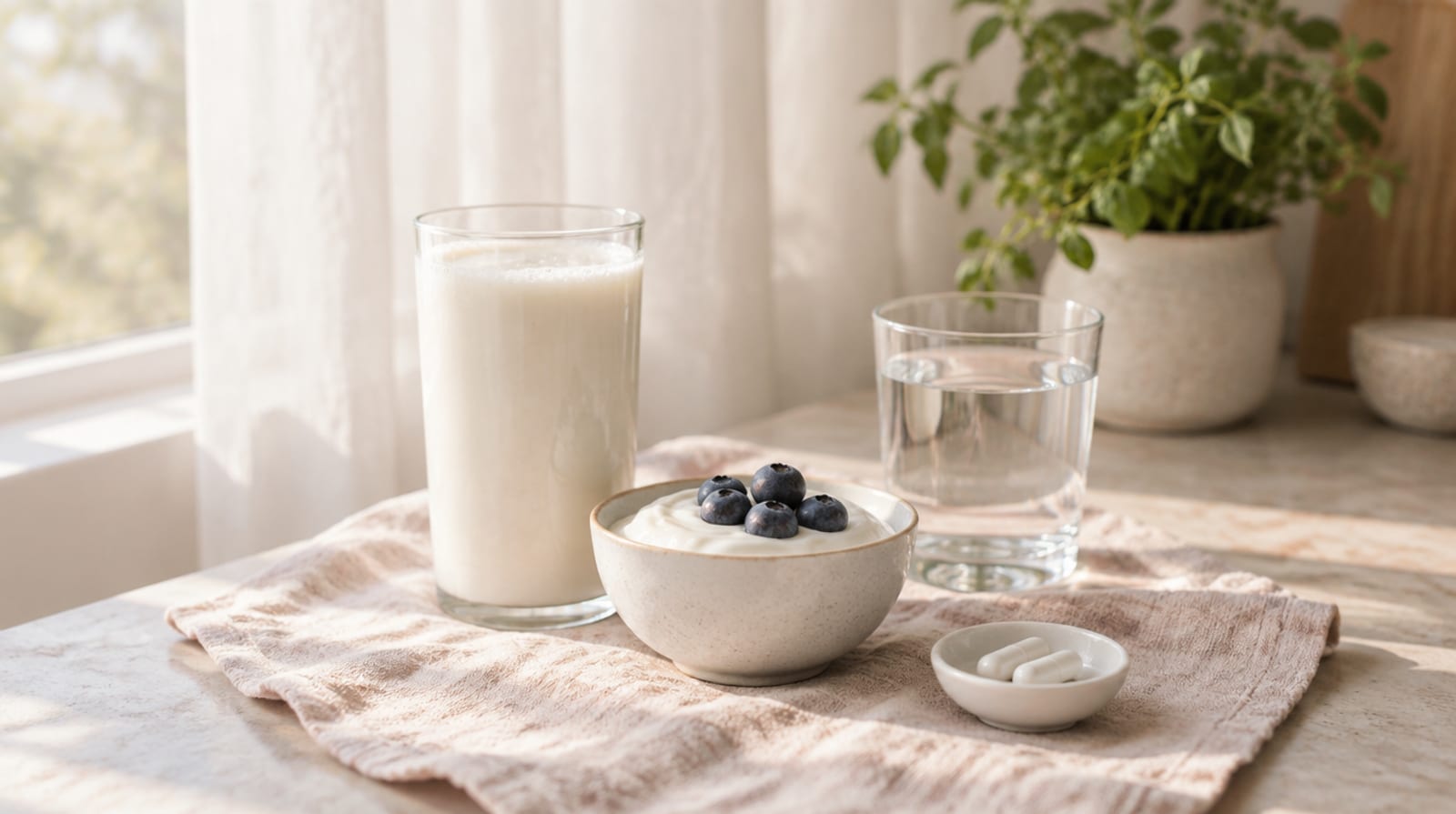
If you want the best probiotic to take with antibiotics, here is the short answer: for most women, Saccharomyces boulardii is the best choice. It has the most trials behind it, it is a yeast so your antibiotic does not kill it, and you can take it at the same time as your pill. The runner-up is Lactobacillus rhamnosus GG, which has good evidence but works best in children and needs to be spaced two hours from the antibiotic. This guide compares four real options on the same five criteria, tells you when to start, how far apart, and how long to keep going, and states the downsides of each, including the winner.
One thing first. Antibiotics are important medicine, and if your doctor prescribed one, take it as directed. Nothing here is a reason to skip or shorten a course. A probiotic is a side step to make the course easier on your gut. If you are already past your antibiotics and your stomach is still off, our calm, food-first guide to how to rebuild your gut after antibiotics is the better place to start.
What a probiotic can and cannot do during antibiotics
About one in five adults gets loose stools on antibiotics. That is the problem probiotics have actually been tested against, and it is the one they help with. In a pooled analysis of 63 trials with 11,811 people, taking a probiotic alongside antibiotics cut the risk of antibiotic-associated diarrhea by about 42 percent. Roughly 13 people needed to take one for one of them to avoid diarrhea (Hempel, 2012).
Probiotics have also been tested for preventing C. difficile, a serious gut infection that can follow antibiotics. A Cochrane review of 31 trials found a lower rate with probiotics, but the benefit showed up only in people whose starting risk was already high, usually hospital patients on strong antibiotics. In people at low risk, there was no difference (Goldenberg, 2017).
What probiotics have not been shown to do is speed up the return of your own gut bacteria. We cover that honestly below, because one well-known study found the opposite.
How we compared them
- Evidence. Randomized trials in adults, and how many there are.
- Dose disclosed. Does the label name the exact strain and the amount that was tested?
- Timing. Can you take it with your antibiotic, or do you have to space it out?
- Tolerability. Gas, bloating, and any safety flags.
- Cost per day. You take it for two to three weeks, so price matters less than it does for a daily supplement, but it still counts.
A fairness note. Probiotic effects are strain specific. A product with a famous species name on the label but a different strain, or no strain listed at all, has not earned the trial results of the strain that was studied (McFarland, 2018). We rank on what has been measured and say plainly what has not.
The winner: Saccharomyces boulardii
S. boulardii is a probiotic yeast, not a bacterium. That one fact is why it wins here. Antibiotics kill bacteria. They do not touch yeast. So the probiotic stays alive in your gut no matter when you take your pill, which means no clock-watching (Waitzberg, 2024).
The evidence is the largest for any single probiotic in this category. A meta-analysis pooled 21 randomized trials with 4,780 people. Taking S. boulardii with antibiotics lowered the rate of antibiotic-associated diarrhea from 18.7 percent to 8.5 percent. In adults alone, 15 trials with 3,114 people, the rate fell from 17.4 percent to 8.2 percent. About 10 people needed to take it for one to avoid diarrhea (Szajewska, 2015). The strain used in nearly all of those trials is CNCM I-745, sold as Florastor in the United States.
Dose. Most adult trials used 250 to 500 mg twice a day, which is about 5 to 10 billion live cells. Look for the strain name CNCM I-745 on the label.
The downsides, stated plainly. It did not lower C. difficile in adults; that benefit showed up only in children (Szajewska, 2015). It is a live yeast, so people with a weakened immune system, a central line, or a serious illness should not take it without a doctor's say-so, because rare bloodstream infections have been reported in those groups. It can cause mild gas or constipation in some people. And it is one of the pricier options, usually about a dollar a day.
Runner-up: Lactobacillus rhamnosus GG
LGG is the most studied probiotic bacterium in the world, and it is the strain in Culturelle. A meta-analysis of 12 trials with 1,499 people found it cut antibiotic-associated diarrhea from 22.4 percent to 12.3 percent overall. The honest catch: when adults were looked at separately, the result was no longer statistically clear. It was clear in children, and in one group of adults taking antibiotics to treat H. pylori, but not in adults in general (Szajewska, 2015).
Dose. Trials used about 10 billion live cells a day. Timing. LGG is a bacterium, so the antibiotic can kill it. Take it about two hours away from your antibiotic dose.
Downsides. Weaker adult evidence than S. boulardii, and the spacing rule is easy to forget when you are already taking a pill two or three times a day. It is usually a little cheaper. If you want a probiotic you will keep taking after the course for other reasons, our guide to the best probiotic for women over 40 by strain evidence covers where LGG and other strains do and do not have data.
Strong but hard to find: the Bio-K+ Lactobacillus blend
A two-strain blend of Lactobacillus acidophilus CL1285 and Lactobacillus casei LBC80R, sold as Bio-K+, has the single most striking adult trial. In 255 hospital patients on antibiotics, two capsules a day (100 billion live cells) dropped antibiotic-associated diarrhea from 44 percent on placebo to 15.5 percent, and C. difficile from 23.8 percent to 1.2 percent. One capsule a day helped less than two, so the dose mattered (Gao, 2010).
Downsides. That is one trial, in hospital patients who were much sicker than a woman taking a week of antibiotics for a sinus infection, so the numbers will not transfer directly to you. The product is sold mainly in Canada and is harder to find in the United States. It is a bacterial blend, so space it two hours from the antibiotic. A broader review of strain-specific evidence did list this blend among the few with clear results for adult antibiotic-associated diarrhea (McFarland, 2018), which is why it is on this list at all.
Not recommended for this job: generic multi-strain blends
The "50 billion CFU, 15 strains" products that fill the shelf are the ones most people grab. For taking alongside antibiotics, we would not. Here is why.
First, the big pooled analyses that look positive mostly rest on a handful of well-studied strains. When researchers sorted trials by the exact strain, most multi-strain products either had no trials for antibiotic-associated diarrhea or had trials that did not show a benefit (McFarland, 2018). A long strain list is not evidence; a trial of that exact product is.
Second, the one study that looked closely at gut recovery used an 11-strain blend. Healthy adults took antibiotics for a week, then either the probiotic, nothing, or a transplant of their own pre-antibiotic stool. The people on the probiotic had a markedly slower and less complete return of their own native gut bacteria over the following months than the people who took nothing (Suez, 2018). That study measured bacterial recovery, not symptoms, and it was small. But it is a real reason not to take a random blend for weeks after the course on the theory that more bugs must be better.
When to start, how far apart, and how long
Start on day one. In the trials that worked, the probiotic began with the first antibiotic dose or within about 48 hours of it, and continued through the whole course (Waitzberg, 2024). Antibiotic-associated diarrhea often starts in the first few days, so waiting until you finish the antibiotics misses most of the point.
Spacing. For S. boulardii, none needed. For any bacterial probiotic, take it about two hours away from the antibiotic.
How long. Trials ran the probiotic for the full course plus about one to two weeks. The Bio-K+ trial continued for five days after the last antibiotic dose (Gao, 2010). There is no good evidence for months of use after a short course, and the recovery study above is a reason not to.
Dose. For antibiotic-associated diarrhea, higher doses did a little better than lower ones across the trials, which is one of the few places in probiotic research where a dose-response shows up (Ouwehand, 2017). Match the dose on the label to the dose in the trial for that strain.
What to eat while you are on antibiotics
A capsule is one tool. Food is the other, and it is the one that helps your own bacteria come back. Your gut recovers mostly on its own; in one careful study, healthy adults were close to their starting point about six weeks after a strong course, though a few species had not returned at six months (Palleja, 2018). Fiber feeds the bacteria you want back, so keep up the vegetables, beans, oats, and fruit, and go slowly if your gut is sensitive. Our guide to how much fiber women really need has the targets. Yogurt and kefir are good additions, and if you are weighing a daily fermented food against a daily pill for the long run, we compare fermented foods and probiotic pills head to head.
If antibiotics are a repeat visitor because of UTIs, it is worth reading what actually prevents UTIs, since fewer infections means fewer courses.
Who should talk to a doctor first
- You have a weakened immune system, are on chemotherapy, or take drugs that suppress immunity.
- You have a central line, a port, or a feeding tube.
- You are in the hospital with a serious illness.
- You have severe or bloody diarrhea, a fever, or belly pain on antibiotics. That needs a call, not a capsule.
The honest summary
For most women on a short course of antibiotics, Saccharomyces boulardii CNCM I-745 is the best probiotic to take: 21 trials, about a 50 percent lower chance of diarrhea, and no need to space it from your pill. Start it on day one, take it through the course and for a week or two after, then stop. Lactobacillus rhamnosus GG is a fair second choice, with its best evidence in children and a two-hour spacing rule. Skip the generic multi-strain blends for this job. And whatever you take, let food and time do the real rebuilding. More plain-English guides live in our gut health coverage.
This article contains no affiliate links. Where our articles do link to products, we may earn a commission. See our disclosure page. This is general information, not medical advice. Always take antibiotics as prescribed, and talk to your doctor before starting a probiotic if you have a weakened immune system or a serious illness. Research cited was retrieved from PubMed.
References
- Szajewska H, Kołodziej M. Systematic review with meta-analysis: Saccharomyces boulardii in the prevention of antibiotic-associated diarrhoea. Alimentary Pharmacology and Therapeutics. 2015. PMID: 26216624
- Szajewska H, Kołodziej M. Systematic review with meta-analysis: Lactobacillus rhamnosus GG in the prevention of antibiotic-associated diarrhoea in children and adults. Alimentary Pharmacology and Therapeutics. 2015. PMID: 26365389
- Gao XW, Mubasher M, Fang CY, Reifer C, Miller LE. Dose-response efficacy of a proprietary probiotic formula of Lactobacillus acidophilus CL1285 and Lactobacillus casei LBC80R for antibiotic-associated diarrhea and Clostridium difficile-associated diarrhea prophylaxis in adult patients. American Journal of Gastroenterology. 2010. PMID: 20145608
- Hempel S, Newberry SJ, Maher AR, et al. Probiotics for the prevention and treatment of antibiotic-associated diarrhea: a systematic review and meta-analysis. JAMA. 2012. PMID: 22570464
- Goldenberg JZ, Yap C, Lytvyn L, et al. Probiotics for the prevention of Clostridium difficile-associated diarrhea in adults and children. Cochrane Database of Systematic Reviews. 2017. PMID: 29257353
- McFarland LV, Evans CT, Goldstein EJC. Strain-specificity and disease-specificity of probiotic efficacy: a systematic review and meta-analysis. Frontiers in Medicine. 2018. PMID: 29868585
- Suez J, Zmora N, Zilberman-Schapira G, et al. Post-antibiotic gut mucosal microbiome reconstitution is impaired by probiotics and improved by autologous FMT. Cell. 2018. PMID: 30193113
- Waitzberg D, Guarner F, Hojsak I, Ianiro G, Polk DB, Sokol H. Can the evidence-based use of probiotics (notably Saccharomyces boulardii CNCM I-745 and Lactobacillus rhamnosus GG) mitigate the clinical effects of antibiotic-associated dysbiosis? Advances in Therapy. 2024. PMID: 38286962
- Ouwehand AC. A review of dose-responses of probiotics in human studies. Beneficial Microbes. 2017. PMID: 28008787
- Palleja A, Mikkelsen KH, Forslund SK, et al. Recovery of gut microbiota of healthy adults following antibiotic exposure. Nature Microbiology. 2018. PMID: 30349083
Common questions
What is the best probiotic to take with antibiotics?
For most women, Saccharomyces boulardii is the best probiotic to take with antibiotics. It has 21 randomized trials behind it for preventing antibiotic-associated diarrhea, it is a yeast so the antibiotic does not kill it, and you can take it at the same time as your pill (Szajewska, 2015). Lactobacillus rhamnosus GG is the runner-up, with its best results in children.
Should you take probiotics with antibiotics or after?
Take probiotics with antibiotics, not after. In the trials that worked, the probiotic started on the same day as the antibiotic or within about two days of it, and continued through the course (Waitzberg, 2024). Starting only after you finish misses most of the window when diarrhea begins.
How many hours apart should you take probiotics and antibiotics?
For a bacterial probiotic such as Lactobacillus rhamnosus GG, leave about two hours between the antibiotic and the probiotic so the antibiotic has less chance to kill the live bacteria. Saccharomyces boulardii is a yeast, so antibiotics do not affect it and spacing is not needed.
How long should you take probiotics after antibiotics?
The trials usually ran the probiotic for the whole antibiotic course plus about one to two weeks. In the largest adult trial of a Lactobacillus blend, people continued for five days after the last antibiotic dose (Gao, 2010). Beyond two weeks there is little evidence for or against.
Can probiotics slow gut recovery after antibiotics?
One small study found that a multi-strain bacterial probiotic taken after antibiotics delayed the return of people's own native gut bacteria compared with taking nothing (Suez, 2018). It measured bacterial recovery, not how people felt. It is a reason to take a probiotic for a clear purpose and a set time, not forever.
Does yogurt count as a probiotic with antibiotics?
Yogurt and kefir are good foods during and after antibiotics, but the trials that showed fewer cases of diarrhea used specific strains at specific doses in capsules or sachets. Eat the yogurt, and if you want the trial-level effect, take the trial-level product too.
Who should not take a probiotic with antibiotics?
Anyone with a weakened immune system, a central line or port, a serious illness, or who is in intensive care should ask a doctor first. Rare bloodstream infections with probiotic yeast and bacteria have been reported in these groups.