Gut health
Constipation in Women: Why It Is More Common, and What Actually Helps
More than twice the odds of men, and a gut that slows by half every luteal phase. Here is what the research actually supports, past the usual advice to drink more water.
It is one of the most common complaints women bring to a doctor, and one of the least likely to get a real conversation. You get told to drink more water and eat more fiber, and you leave with the same problem you walked in with.
The frustrating part is that there is good research here. It just rarely makes it into the three minutes you get.
You are not imagining the gap
A systematic review and meta-analysis pooled 45 population studies covering 261,040 adults. Chronic idiopathic constipation showed up in about 14 percent of people overall. Women had more than twice the odds of men, with an odds ratio of 2.22 (Suares, 2011).
The same analysis found rates climbed with age and were higher in people with lower socioeconomic status. And if you also have IBS, the odds jump dramatically, with an odds ratio of 7.98, which suggests the two conditions share machinery.
So this is not a matter of women complaining more. It is a measured, consistent difference.
Your cycle changes your transit time
Here is something most women notice and almost never hear explained.
Researchers measured colonic transit time in 42 healthy adults using radio-opaque markers. Overall there was no significant difference between men and women. But within the women, the phase of the cycle mattered a great deal. Transit time in the luteal phase, the stretch after ovulation and before your period, averaged 40.9 hours. In the follicular phase it averaged 20.6 hours (Jung, 2003).
That is roughly double. Same women, same diet, different week.
Which means if things slow down predictably in the second half of your cycle, that is normal physiology, not a personal failing. It also means judging your gut by one bad week is not a fair test. Bloating often rides along with the slowdown, and what actually helps bloating starts in the same place.
What actually works, ranked by evidence
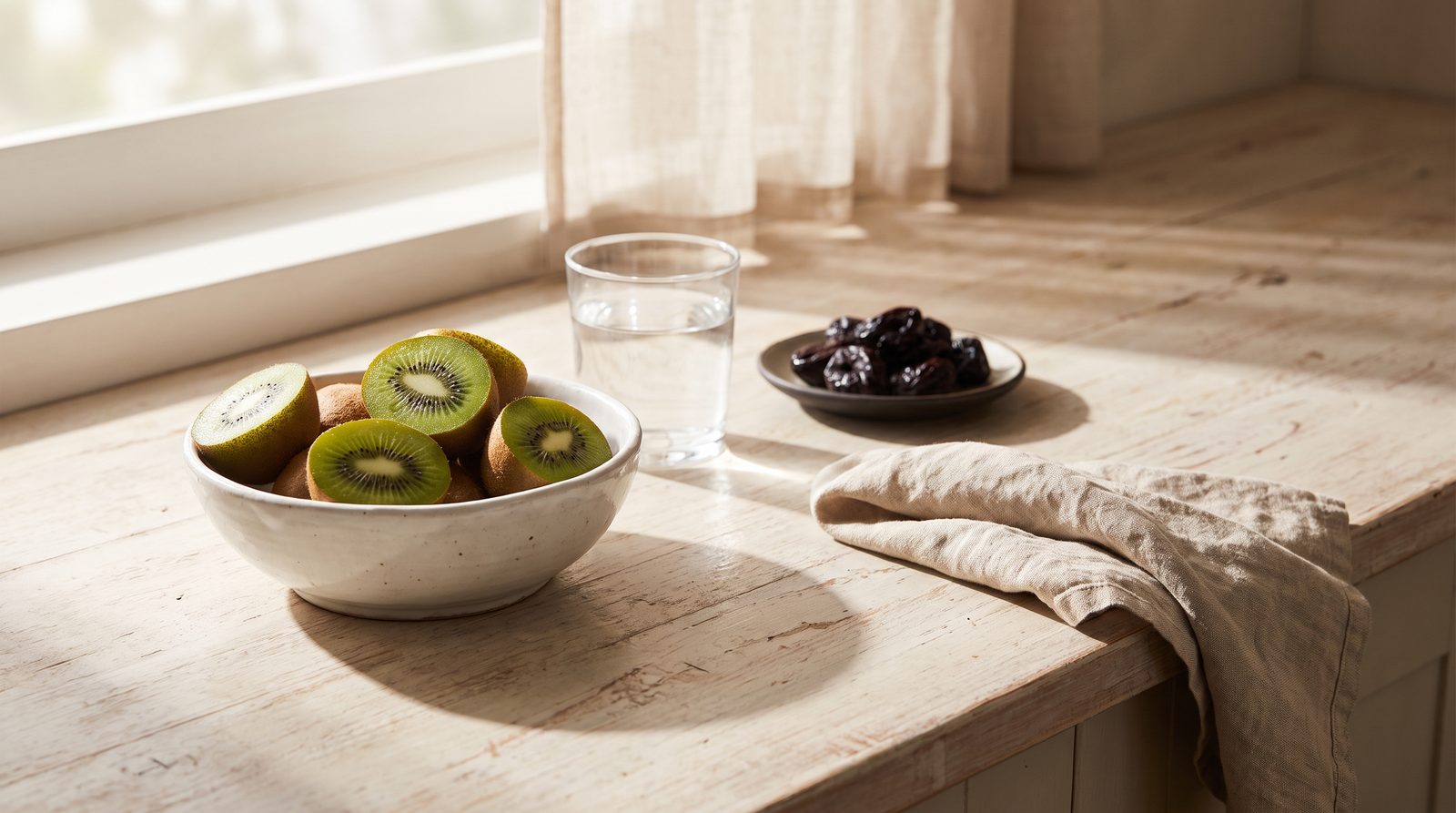
A comparative effectiveness trial at a US medical center took 79 adults with chronic constipation, 87 percent of them women, and assigned them to one of three natural treatments for four weeks: two green kiwifruit a day, 100 grams of prunes a day, or 12 grams of psyllium a day (Chey, 2021).
All three increased the number of complete spontaneous bowel movements per week. All three reduced straining. Kiwifruit and prunes both improved stool consistency.
The interesting result was in the side effects. Adverse events were most common with psyllium and least common with kiwifruit. Kiwifruit was also the only one that significantly improved bloating scores, and fewer people were dissatisfied with it at the end.
A larger meta-analysis of 23 studies in 1,714 people backs this up. Fruits produced higher stool frequency than psyllium, by about 0.36 extra bowel movements per week, with kiwifruit showing the same margin. Rye bread beat white bread. And high-mineral water outperformed low-mineral water, with a risk ratio of 1.47 for treatment response (Van Der Schoot, 2023).
The practical version: two kiwifruit a day is a genuinely evidence-backed first move, and it is gentler than the fiber supplement most people reach for first.
Why fiber sometimes makes it worse
If you have ever added a big fiber supplement and ended up more bloated and more stuck, there is a reason.
Fiber works by adding bulk. Bulk only helps if the plumbing can move it. If your transit is very slow, or if the problem is at the exit rather than in the pipe, more bulk just means more stuck material and more gas.
That is worth knowing before you double your psyllium and conclude that your body is broken. If you do want more fiber, our guide to adding fiber without the bloat shows the slow ramp that works.
The problem most women are never checked for
This is the part that changes lives when someone finally mentions it.
A sizeable share of people with chronic constipation do not have a slow gut at all. They have dyssynergic defecation, which means the pelvic floor muscles contract when they should relax. The stool arrives, the body pushes, and the exit closes instead of opening. One clinical paper describes it as affecting more than half of patients with chronic constipation (Xu, 2021).
No amount of fiber fixes a coordination problem. What fixes it is biofeedback therapy, which retrains the muscles, and the trial evidence for it is strong. Pelvic floor physical therapy is the usual route.
If you have been doing everything right for years and it has never worked, ask your doctor about anorectal testing. Women who have given birth are at higher risk, and it is chronically underdiagnosed.
Small mechanics that matter more than they should
A footstool that raises your knees above your hips changes the angle of the rectum and makes passage easier. Cheap, harmless, worth trying.
Give yourself unhurried time after breakfast. The urge to go is strongest in the morning and after eating, and repeatedly ignoring it because you are late trains the signal to fade.
Move after meals. Walking helps motility, and it is the least demanding intervention on this list.
When to get it checked
See a doctor rather than self-treating if you notice blood in your stool, unexplained weight loss, a new and persistent change in your bowel pattern after age 45, constipation that wakes you at night, ongoing pain, or a family history of colon cancer or inflammatory bowel disease.
Also worth checking: thyroid function, iron levels, and any medication you take. Constipation is a common side effect of iron supplements, some antidepressants, and many blood pressure drugs.
The calm takeaway
Constipation in women is more common, more cyclical, and more treatable than the standard advice suggests. You will find more honest answers like this in our gut health section.
Start with two kiwifruit a day rather than a scoop of psyllium, since it works about as well and causes fewer problems. Expect your second cycle week to be slower and stop treating that as a crisis. And if nothing has ever worked, the missing piece may not be diet at all, but a pelvic floor that needs retraining.
References
- Suares NC, Ford AC. Prevalence of, and risk factors for, chronic idiopathic constipation in the community: systematic review and meta-analysis. The American Journal of Gastroenterology. 2011. PMID: 21606976
- Jung HK, Kim DY, Moon IH. Effects of gender and menstrual cycle on colonic transit time in healthy subjects. The Korean Journal of Internal Medicine. 2003. PMID: 14619388
- Chey SW, et al. Exploratory comparative effectiveness trial of green kiwifruit, psyllium, or prunes in US patients with chronic constipation. The American Journal of Gastroenterology. 2021. PMID: 34074830
- Van Der Schoot A, et al. Systematic review and meta-analysis: foods, drinks and diets and their effect on chronic constipation in adults. Alimentary Pharmacology & Therapeutics. 2023. PMID: 37905980
- Xu Y, et al. Efficacy of a modified training program of adaptive biofeedback therapy for dyssynergic defecation in patients with chronic constipation. Digestive Diseases and Sciences. 2021. PMID: 34129127
Common questions
Why is constipation so much more common in women?
The gap is measured, not anecdotal. A meta-analysis pooling 45 studies and 261,040 adults found chronic idiopathic constipation in about 14 percent of people, with women having more than twice the odds of men. Sex hormones are part of the picture, since transit time slows noticeably in the second half of the menstrual cycle. Pregnancy and childbirth affect the pelvic floor, and rates climb with age. Having IBS raises the odds sharply as well, which suggests the two conditions overlap.
Is it normal to get more constipated before my period?
Getting more constipated before your period is normal, and the difference is larger than most women expect. When researchers measured colonic transit time with radio-opaque markers, women in the luteal phase, meaning after ovulation and before their period, averaged 40.9 hours. Women in the follicular phase averaged 20.6 hours. That is roughly double, in healthy people eating normally. If you slow down predictably in the second half of your cycle, that is physiology doing what it does, and it is worth planning for rather than fighting.
Should I take psyllium or eat kiwifruit?
The evidence leans toward kiwifruit for most people starting out. A trial of 79 adults with chronic constipation, 87 percent of them women, compared two green kiwifruit a day with 100 grams of prunes and 12 grams of psyllium. All three increased bowel movements and reduced straining, but side effects were most common with psyllium and least common with kiwifruit, and only kiwifruit significantly improved bloating. A larger meta-analysis also found fruits produced about 0.36 more bowel movements per week than psyllium. Psyllium still works, so if it suits you there is no reason to stop.
What if fiber and water have never helped me?
Then the problem may not be what you are eating. A large share of people with chronic constipation have dyssynergic defecation, where the pelvic floor muscles tighten when they should relax, so the stool cannot pass no matter how well formed it is. One clinical paper puts it at more than half of chronic constipation patients. Fiber cannot fix a muscle coordination problem, but biofeedback therapy can, and the trial evidence supports it. Ask your doctor about anorectal testing, especially if you have given birth.