Hormones
Weight Loss for Women Over 60: What the Trials Show
After 60, the goal is to lose fat and keep your muscle and bones. Here is how much to lose, how much protein to eat, and which exercise matters most.
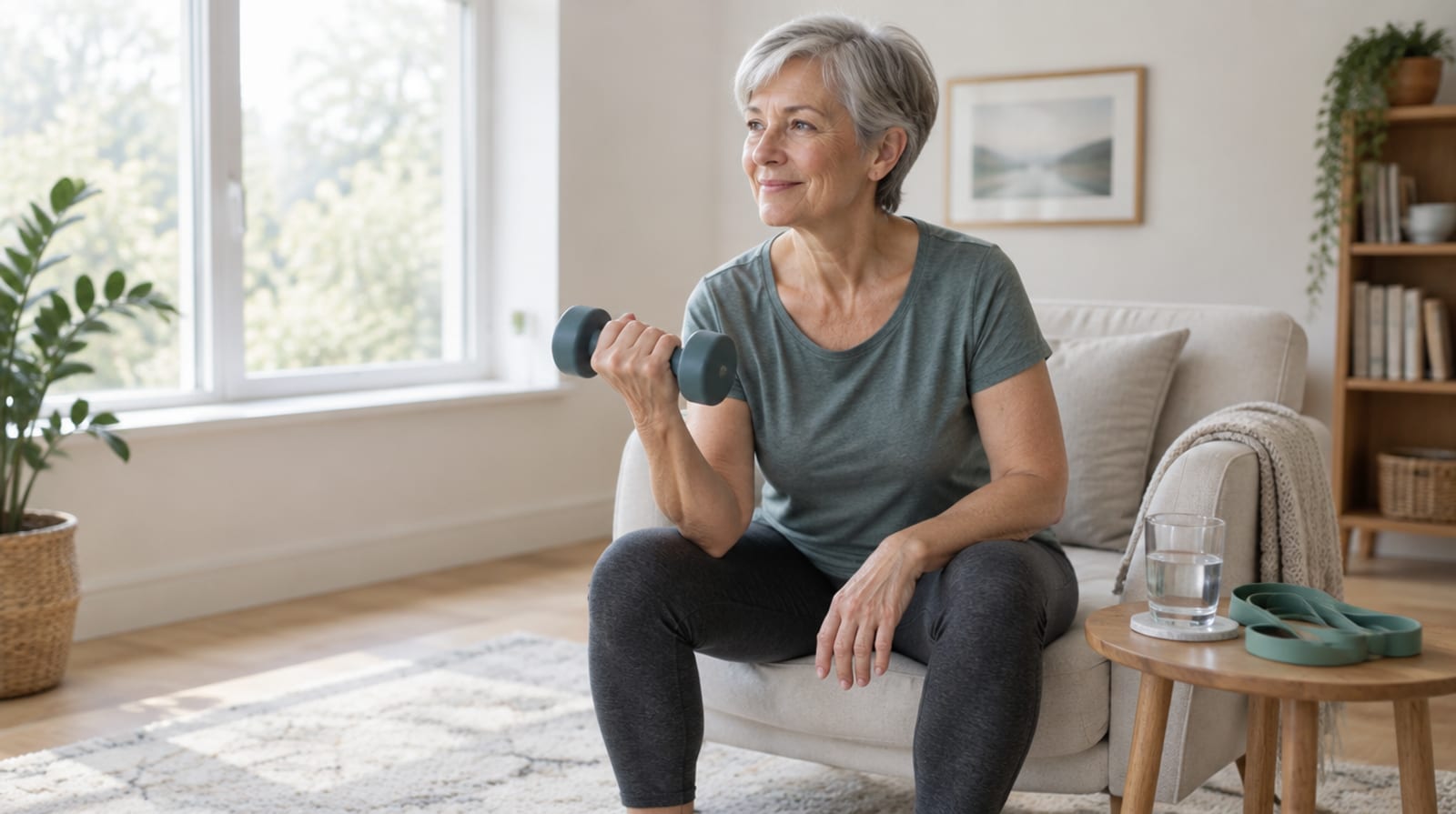
Weight loss for women over 60 works best when it is slow, high in protein and paired with strength training, because the goal after 60 is to lose fat while keeping muscle and bone. In a six month trial of 160 adults with obesity aged 65 and older, a weight loss program plus exercise cut body weight by about 9 percent. The people who lifted weights kept more muscle than those who only did aerobic exercise (Villareal, 2017). A modest loss of 5 to 10 percent is a realistic and useful target.
Below are the questions women over 60 ask most: whether it is harder now, how much to lose, how much protein to eat, which exercise matters, and how to protect your bones on the way down. If you are a little younger, our guide to what really changes about weight loss for women over 50 covers the menopause years.
Is it harder to lose weight after 60?
Losing weight after 60 is a little harder, mainly because your body burns slightly fewer calories and holds less muscle than it did. The largest study of daily energy use, which pooled measurements from thousands of people aged 8 days to 95 years, found that calorie burn adjusted for body size stays steady from about age 20 to 60 and then starts to decline in older adults (Pontzer, 2021).
That decline is slow, not a cliff. It means the same plate of food goes a bit further than it used to, so your portions may need a small trim to create a deficit. It also means muscle matters more than ever, since muscle is a big part of what keeps your daily burn up.
The good news is that older adults do respond to weight loss programs. In a one year trial of 107 adults aged 65 and older with obesity, the diet groups lost about 9 to 10 percent of their body weight (Villareal, 2011). Age did not stop the scale from moving.
How much weight should a woman over 60 lose?
A loss of about 5 to 10 percent of your starting weight is a sensible goal for most women over 60 with extra weight. That is 8 to 16 pounds for a woman who weighs 160. The best trials in older adults aimed for roughly 10 percent and landed close to it (Villareal, 2011; Villareal, 2017).
Intentional weight loss also appears to be safe for life span, not only for blood pressure and blood sugar. A review of 15 randomized trials with 17,186 adults found that people assigned to lifestyle weight loss had a 15 percent lower risk of dying during follow-up than those who were not (Kritchevsky, 2015). The average age in those trials was 52, so the result is not specific to women over 60, and the confidence range only just excluded no effect. It is still reassuring, because older studies that only watched people over time often linked weight loss with worse outcomes.
Aim for about half a pound to one pound a week. Faster loss tends to take more muscle with it.
Is losing weight after 60 safe for muscle and bone?
Losing weight after 60 costs some muscle and some hip bone, which is why the way you lose it matters as much as the amount. In the 2011 trial, adults over 65 who dieted without exercise lost about 5 percent of their lean mass and 3 percent of hip bone density in a year. Those who dieted and exercised lost about 3 percent of lean mass and 1 percent of hip bone density, and their strength, balance and walking improved (Villareal, 2011).
A review of 41 diet studies found that weight loss led to a small drop in hip bone density, but no significant change at the spine. The authors judged the hip loss to be small compared with the health benefits of losing excess weight (Zibellini, 2015).
Exercise does not always erase that bone loss. In a 2025 trial of 150 adults with an average age of 66, three quarters of them women, every group lost 9 to 11 percent of their weight over a year. Hip bone density fell 1.2 to 1.9 percent in all groups, and neither wearing a weighted vest nor supervised strength training prevented it (Beavers, 2025). So protect your bones on purpose, with enough calcium, vitamin D and protein, and ask your doctor whether you need a bone density scan before you start. Our guide to eating to protect your bones after menopause covers the food side.
How much protein does a woman over 60 need to lose weight?
Women over 60 who are losing weight need about 1.0 to 1.2 grams of protein per kilogram of body weight a day, and more if they are active. That is the range an international group of geriatric experts set for adults over 65, with 1.2 grams or more for those who exercise. People with severe kidney disease are the exception and may need less (Bauer, 2013).
For a woman who weighs 150 pounds, which is about 68 kilograms, that works out to roughly 68 to 82 grams of protein a day. A simple way to get there is 25 to 30 grams at each meal.
Protein helps the scale go the right way, too. In a six month trial, 31 postmenopausal women with an average age of 65 ate 1,400 calories a day and took either 25 grams of whey protein twice a day or a carbohydrate powder. The whey group lost 8 percent of their weight compared with 4 percent in the carbohydrate group, a difference that fell just short of statistical significance, and they kept more muscle relative to the weight they lost (Mojtahedi, 2011). A broader review agreed that high protein helps preserve muscle during weight loss, though it does not build strength on its own (Cava, 2017).
Our guide to how much protein women need at every age has food examples and daily targets.
What is the best exercise for weight loss for women over 60?
The best exercise for weight loss for women over 60 is a mix of strength training and aerobic exercise, done alongside a modest calorie cut. In the 2017 trial of 160 adults over 65, all three exercise groups lost about 9 percent of their body weight. The group that did both strength and aerobic training improved physical function the most, with a 21 percent gain on a standard performance test. The strength and combined groups lost less lean mass and less hip bone density than the aerobic only group (Villareal, 2017).
In practice, that means two or three strength sessions a week, using weights, machines or bands, plus walking, cycling or swimming on most other days. Start light and build slowly. Muscle and joint injuries were the main side effects in these trials, so a trainer or physical therapist is worth it for the first few sessions.
If you want to give your muscles more support while you train, creatine is the supplement with the clearest record for this. See what the creatine trials found in women over 50.
How many steps a day should a woman over 60 walk?
About 6,000 to 8,000 steps a day is the range where the health benefit of walking appears to level off for adults over 60. A pooled analysis of 15 studies with 47,471 adults found that the risk of dying during follow-up kept falling as daily steps rose, until about 6,000 to 8,000 steps for people 60 and older. Younger adults kept benefiting up to 8,000 to 10,000 steps (Paluch, 2022).
That study tracked people over time rather than assigning steps, so it shows a link, not proof that walking caused the difference. Walking also burns fewer calories than most people expect. Think of steps as a way to protect your heart and joints while the calorie cut does most of the weight work.
A simple weight loss plan for women over 60
A simple weight loss plan for women over 60 has four parts: a small calorie cut, protein at every meal, strength training twice a week, and enough sleep.
- Trim, do not starve. Cut your usual intake by about 300 to 500 calories a day. Very low calorie diets speed up muscle loss.
- Build each meal around protein. Eggs or Greek yogurt at breakfast, chicken, fish, beans or tofu at lunch and dinner. A protein shake can fill the gap on busy days. We compare the options in the best weight loss supplements for women over 50.
- Lift twice a week, walk most days. Strength work protects muscle. Walking protects your heart.
- Protect your sleep. Short sleep makes hunger harder to manage. Our article on sleep, cortisol and weight in midlife explains why.
- Weigh weekly, not daily. Look at the trend over a month.
When to talk to your doctor
Talk to your doctor before you start a weight loss plan after 60 if you take medicine for blood pressure, blood sugar or your heart, or if you have kidney disease or osteoporosis. Some medicines need adjusting as weight comes off. And if you are losing weight without trying, that is not a win. Unplanned weight loss in older adults needs a checkup.
For more on weight and hormones across midlife, browse our hormones coverage.
This article is for general education and is not medical advice. Talk with your doctor or a registered dietitian before starting a new diet or exercise program, especially if you have a medical condition or take medication. Research cited was retrieved from PubMed.
References
- Villareal DT, et al. Aerobic or resistance exercise, or both, in dieting obese older adults. New England Journal of Medicine. 2017. PMID: 28514618
- Villareal DT, et al. Weight loss, exercise, or both and physical function in obese older adults. New England Journal of Medicine. 2011. PMID: 21449785
- Pontzer H, et al. Daily energy expenditure through the human life course. Science. 2021. PMID: 34385400
- Kritchevsky SB, et al. Intentional weight loss and all-cause mortality: a meta-analysis of randomized clinical trials. PLoS One. 2015. PMID: 25794148
- Zibellini J, et al. Does diet-induced weight loss lead to bone loss in overweight or obese adults? A systematic review and meta-analysis of clinical trials. Journal of Bone and Mineral Research. 2015. PMID: 26012544
- Beavers KM, et al. Weighted vest use or resistance exercise to offset weight loss-associated bone loss in older adults: a randomized clinical trial. JAMA Network Open. 2025. PMID: 40540267
- Bauer J, et al. Evidence-based recommendations for optimal dietary protein intake in older people: a position paper from the PROT-AGE Study Group. Journal of the American Medical Directors Association. 2013. PMID: 23867520
- Mojtahedi MC, et al. The effects of a higher protein intake during energy restriction on changes in body composition and physical function in older women. Journals of Gerontology Series A. 2011. PMID: 21798863
- Cava E, et al. Preserving healthy muscle during weight loss. Advances in Nutrition. 2017. PMID: 28507015
- Paluch AE, et al. Daily steps and all-cause mortality: a meta-analysis of 15 international cohorts. Lancet Public Health. 2022. PMID: 35247352
Common questions
Is it harder for a woman to lose weight after 60?
Weight loss after 60 is a little harder because calorie burn, adjusted for body size, starts to decline slowly after about age 60, and most women carry less muscle than they did (Pontzer, 2021). Older adults still respond well to weight loss programs. In a one year trial of adults over 65 with obesity, the diet groups lost about 9 to 10 percent of their body weight (Villareal, 2011).
How much weight can a woman over 60 lose in a month?
A woman over 60 can safely aim to lose about 2 to 4 pounds a month, which is half a pound to one pound a week. The best trials in older adults reached about a 9 to 10 percent loss over six months to a year (Villareal, 2011; Villareal, 2017). Faster loss tends to take more muscle with it, and muscle is hard to win back after 60.
How many calories should a woman over 60 eat to lose weight?
A woman over 60 usually loses weight by eating about 300 to 500 calories less than her current daily intake, rather than following one fixed number. Needs vary with size and activity. In one trial of postmenopausal women with an average age of 65, a 1,400 calorie diet with added protein led to about 8 percent weight loss over six months (Mojtahedi, 2011). Very low calorie diets are not advised because they speed up muscle loss.
How much protein should a woman over 60 eat to lose weight?
Women over 60 who are losing weight should aim for about 1.0 to 1.2 grams of protein per kilogram of body weight a day, or 1.2 grams or more if they exercise, according to the PROT-AGE expert group (Bauer, 2013). For a 150 pound woman, that is roughly 68 to 82 grams a day, or 25 to 30 grams at each meal. Women with severe kidney disease may need less and should ask their doctor.
What is the best exercise for a woman over 60 to lose belly fat?
The best exercise plan for a woman over 60 combines strength training two or three times a week with aerobic exercise such as walking, paired with a modest calorie cut. In a trial of 160 adults over 65, combined training improved physical function the most, and strength training protected muscle and hip bone better than aerobic exercise alone (Villareal, 2017). No exercise burns fat from one spot, so belly fat shrinks as overall fat drops.
Does losing weight after 60 weaken your bones?
Losing weight after 60 does cause a small drop in hip bone density. A review of 41 diet studies found a small decrease at the hip but no significant change at the spine (Zibellini, 2015). In a 2025 trial of adults with an average age of 66, hip bone density fell 1.2 to 1.9 percent in a year, and neither strength training nor a weighted vest prevented it (Beavers, 2025). Enough calcium, vitamin D and protein, plus a talk with your doctor about bone health, are worth it before you start.