Gut Health
Best Probiotic for Weight Loss for Women: 5 Strains Compared
Most bottles promise a flatter belly. Only a few strains have trials behind them, and the effect is smaller than the labels suggest.
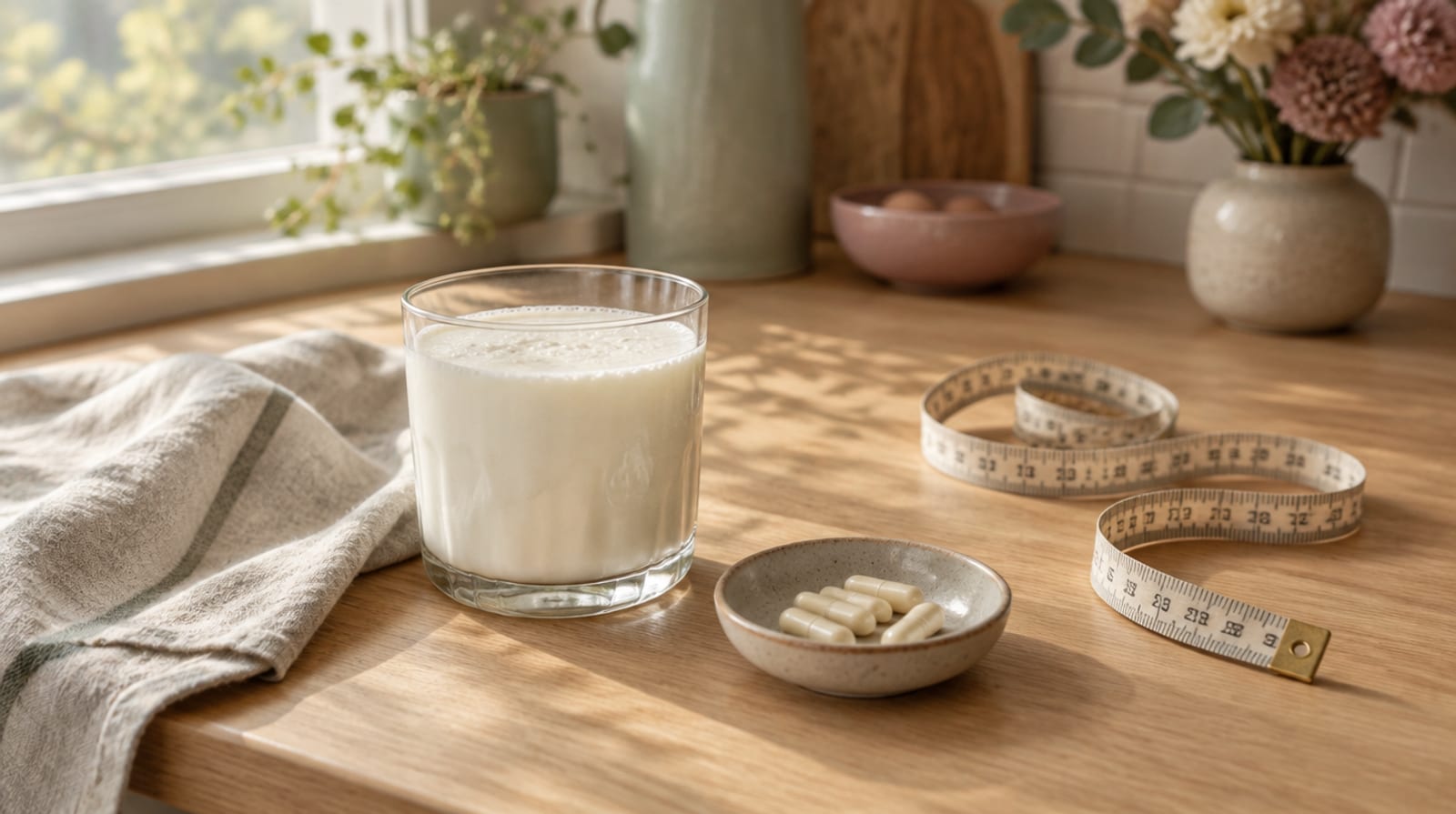
The best probiotic for weight loss for women, based on the trials so far, is one that names the strain Lactobacillus rhamnosus CGMCC1.3724 on the label, because it is the only strain with a trial result that held up in women specifically. Expect a small effect. Across 15 trials in adults with overweight, probiotics changed weight by about 0.6 kg, a little over a pound, compared with placebo (Borgeraas, 2018). This guide compares five strains with human weight data on the same criteria, and states each one's downsides, including the winner's.
One thing comes before any bottle: a probiotic is a strain decision, not a brand decision. A label without the strain code after the species name tells you nothing about whether the weight research applies. Our guide to choosing a probiotic for women over 40 by strain and symptom explains why the code matters.
How we compared them
Each strain below is judged on five things you can check yourself.
- Evidence. Randomized, placebo-controlled trials in people with overweight, and whether women were in them.
- Dose disclosed. Does the trial dose (in CFU, colony-forming units) match what a product label states for that strain?
- Form. Capsule, powder or fermented milk, and whether you can buy it in that form.
- Tolerability. Gas and bloating in the first week or two are the most common complaints with any probiotic.
- Cost per serving. Compare the daily price, not the bottle price; strain-named products usually cost more.
Best probiotic for weight loss for women, compared
1. Lactobacillus rhamnosus CGMCC1.3724 (winner for women)
Lactobacillus rhamnosus CGMCC1.3724 is the strain with the clearest result in women. In a 24-week trial, obese men and women took two capsules a day of the strain with oligofructose and inulin, or a placebo, alongside a moderate calorie cut for 12 weeks and then 12 weeks of weight maintenance (Sanchez, 2014). Across everyone, weight loss did not differ between groups. Women on the probiotic, though, lost significantly more weight than women on placebo in the first 12 weeks, and kept losing weight and fat during the maintenance phase while the placebo women drifted the other way. Men saw no difference.
Downsides: the women's result came from splitting the group by sex, which is a weaker kind of finding than a main result. It is one trial, funded and run with the strain's owner. The dose was modest, about 320 million CFU a day, but the capsules also held fiber, so the strain alone was not tested. It can be hard to find by its exact code; check the label for CGMCC1.3724 (sometimes listed as LPR).
2. Lactobacillus gasseri SBT2055 (best evidence for belly fat)
Lactobacillus gasseri SBT2055 has the strongest data on belly fat, measured by CT scan in two trials. In 87 adults with extra belly fat, a daily fermented milk with the strain lowered visceral fat by 4.6% and body weight by 1.4% over 12 weeks, while the control milk changed nothing (Kadooka, 2010). A follow-up in 210 adults found visceral fat fell about 8% at lower doses too, and the benefit faded within four weeks of stopping (Kadooka, 2013).
Downsides: both trials used a Japanese fermented milk, not a capsule, and the study population was Japanese adults with modest extra weight. It is mostly sold in Japan, and the effect seems to need daily, ongoing use.
3. Bifidobacterium animalis subsp. lactis B420 (biggest and longest trial)
Bifidobacterium lactis B420 was tested in the largest and longest trial on this list: 225 adults for six months, with body fat measured by DEXA scan (Stenman, 2016). In everyone who started, there was no difference in fat mass. Among the people who took at least 80% of their doses, B420 with a polydextrose fiber cut body fat by 4.5% (1.4 kg) compared with placebo, and both B420 groups ate less and lost more waist.
Downsides: the positive result depends on excluding people who did not stick with it, which can flatter a product. B420 alone, without the fiber, was not significantly different from placebo in the main comparison. The trial was funded by the strain's maker. The trial dose was 10 billion CFU a day, so check that a product discloses at least that much B420.
4. Lactobacillus gasseri BNR17 (a capsule option for visceral fat)
Lactobacillus gasseri BNR17 lowered visceral fat in a 12-week trial of 90 Korean adults aged 20 to 75 with a BMI of 25 to 35 (Kim, 2018). The higher of two doses reduced visceral fat area by 21.6 square centimeters more than placebo, and waist size shrank at both doses.
Downsides: it is one small, short trial, and body weight and blood markers did not differ between groups. The result is about where fat sits, not how much you weigh.
5. Akkermansia muciniphila (interesting, not ready)
Akkermansia muciniphila improved insulin sensitivity by about 28% compared with placebo in a three-month pilot trial of 32 adults with overweight and insulin resistance (Depommier, 2019). The pasteurized form, not the live one, did best. Weight fell by about 2.3 kg compared with placebo, but that difference was not statistically significant.
Downsides: a pilot study this small cannot tell you what it will do for weight. Products on the shelf may not match the form or dose tested, and they tend to be the priciest on this list. If insulin resistance is part of your picture, our guide to what insulin resistance is and what lowers it covers the steps with more evidence behind them.
The winner, and who should skip it
Lactobacillus rhamnosus CGMCC1.3724 wins for women because it is the only strain where a trial found a weight benefit in women and not in men, and that benefit kept going after the diet phase ended. It is not proof. If belly fat is your main concern and you can find it, L. gasseri SBT2055 has more consistent data. Skip all of them if you are immunocompromised, critically ill or have a central line, unless your doctor says otherwise.
Do probiotics help women lose weight?
Probiotics help women lose a small amount of weight on average, about 0.6 kg in pooled trials that ran 3 to 12 weeks and included 957 people, 63% of them women (Borgeraas, 2018). The same analysis found no clear change in fat mass. It is an add-on, not a plan. The habits that move the scale more are covered in our guide to what the trials show on weight loss for women over 40: a modest calorie cut, protein at every meal, strength training and sleep.
Best probiotic for weight loss for women over 40 and 50
The best probiotic for weight loss for women over 40 or 50 is the same strain-first pick, because none of these trials tested women by age group. The SBT2055, BNR17 and Akkermansia trials included adults well into midlife, but none studied menopause directly. Fiber may matter as much as the bacteria after 40, since gut microbes feed on it; our plain guide to how much fiber women need is a cheaper first step than any capsule.
How to try one
Pick one strain-named product, take it daily at the dose its trial used, and give it 12 weeks, which is how long most of these trials ran. Measure your waist at the start and the end, since several strains changed waist size more than weight. Stop if gas or bloating has not settled after two weeks. If you are not sure a probiotic is worth it at all, read our honest take on whether you need a probiotic supplement first. More gut guides are in our gut health hub.
This article is general information, not medical advice. Talk to your doctor before starting a supplement, especially if you are pregnant, take medicine or have a health condition. Some links on this site may be affiliate links; see our disclosure.
References
- Borgeraas H, Johnson LK, Skattebu J, Hertel JK, Hjelmesaeth J. Effects of probiotics on body weight, body mass index, fat mass and fat percentage in subjects with overweight or obesity: a systematic review and meta-analysis of randomized controlled trials. Obesity Reviews. 2018;19(2):219-232. PMID: 29047207
- Sanchez M, Darimont C, Drapeau V, et al. Effect of Lactobacillus rhamnosus CGMCC1.3724 supplementation on weight loss and maintenance in obese men and women. British Journal of Nutrition. 2014;111(8):1507-1519. PMID: 24299712
- Kadooka Y, Sato M, Imaizumi K, et al. Regulation of abdominal adiposity by probiotics (Lactobacillus gasseri SBT2055) in adults with obese tendencies in a randomized controlled trial. European Journal of Clinical Nutrition. 2010;64(6):636-643. PMID: 20216555
- Kadooka Y, Sato M, Ogawa A, et al. Effect of Lactobacillus gasseri SBT2055 in fermented milk on abdominal adiposity in adults in a randomised controlled trial. British Journal of Nutrition. 2013;110(9):1696-1703. PMID: 23614897
- Stenman LK, Lehtinen MJ, Meland N, et al. Probiotic with or without fiber controls body fat mass, associated with serum zonulin, in overweight and obese adults: randomized controlled trial. EBioMedicine. 2016;13:190-200. PMID: 27810310
- Kim J, Yun JM, Kim MK, Kwon O, Cho B. Lactobacillus gasseri BNR17 supplementation reduces the visceral fat accumulation and waist circumference in obese adults: a randomized, double-blind, placebo-controlled trial. Journal of Medicinal Food. 2018;21(5):454-461. PMID: 29688793
- Depommier C, Everard A, Druart C, et al. Supplementation with Akkermansia muciniphila in overweight and obese human volunteers: a proof-of-concept exploratory study. Nature Medicine. 2019;25(7):1096-1103. PMID: 31263284
Common questions
How long does a probiotic take to work for weight loss?
Probiotic weight trials usually ran 12 weeks to six months before measuring results, so give a strain at least 12 weeks. In one Lactobacillus gasseri SBT2055 trial, the drop in belly fat faded within four weeks of stopping, which suggests the effect lasts only as long as you keep taking it.
Do probiotics work for weight loss without dieting?
Some probiotic strains changed belly fat without a diet. People in the Lactobacillus gasseri SBT2055 trials were not asked to cut calories and still lost a little visceral fat. The Lactobacillus rhamnosus CGMCC1.3724 benefit in women came alongside a calorie cut, so pairing a strain with diet changes is the safer bet.
Is a women's probiotic the same as a weight loss probiotic?
A probiotic sold for women usually targets vaginal or urinary health, not weight. Those products often use strains such as L. rhamnosus GR-1 and L. reuteri RC-14, which were not tested for weight. Check the strain code against the weight trials before you buy.