Gut Health
How to Increase Butyrate Naturally: Foods That Help Your Gut Make More
Butyrate is made in your colon, not eaten. Here are the foods that have been tested in people, how big the change was, and what lowers it.
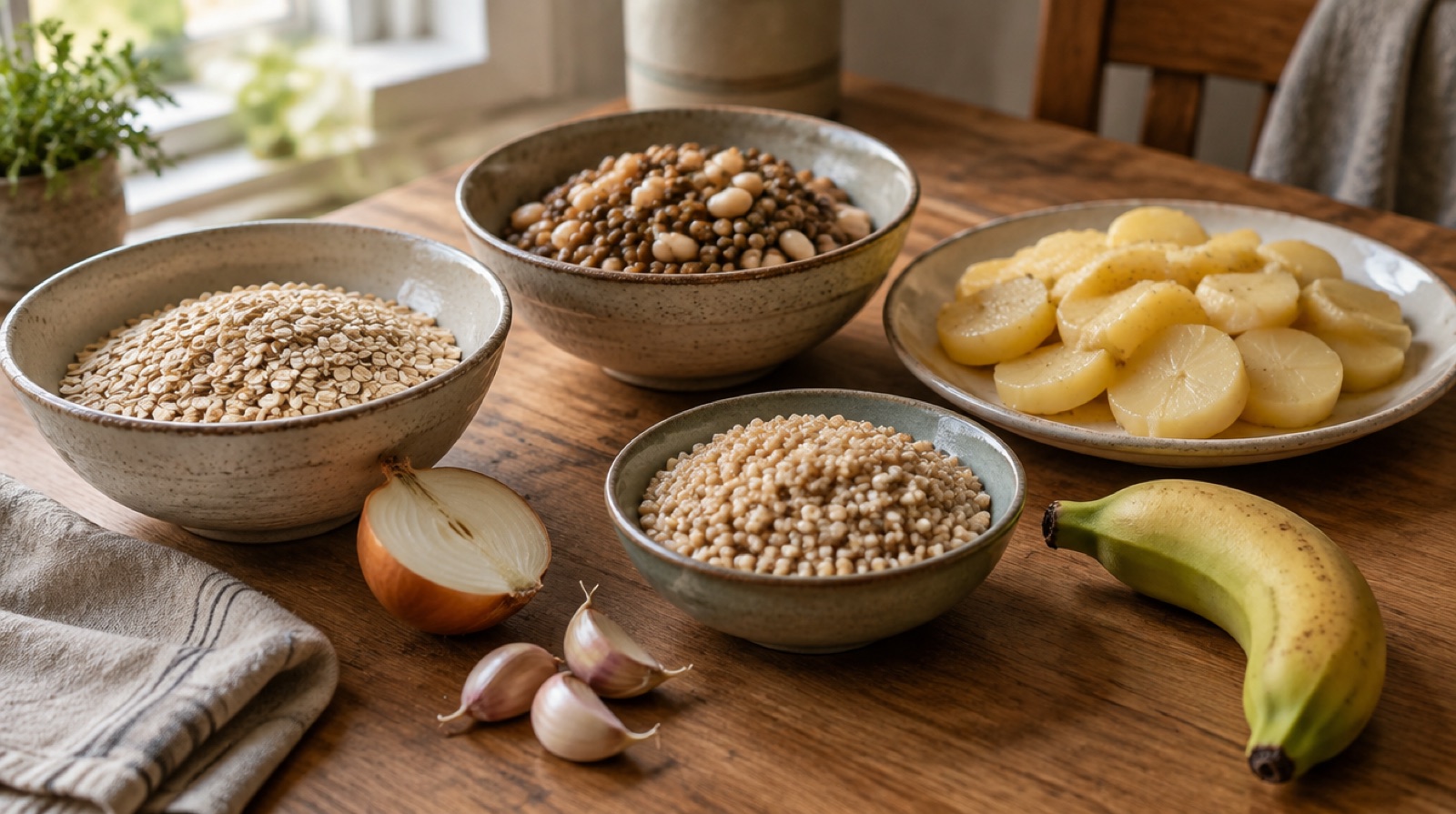
If you want to know how to increase butyrate naturally, the answer is to feed the gut bacteria that make it. Butyrate is not something you mostly eat. Your colon bacteria produce it when they ferment fiber and resistant starch that you cannot digest yourself. So the foods that raise butyrate are the ones that reach your colon intact: beans, lentils, oats, barley, and potatoes or rice that have been cooked and then cooled. In human trials the effect is real but modest, and it differs a lot from one person to the next.
For the bigger picture on fiber, start with our guide to how much fiber women need and where to get it.
What butyrate is and where it comes from
Butyrate is a short chain fatty acid. It is the main fuel for the cells that line your colon (Hajjar, 2021). You do not make it. Your gut bacteria do, as a by-product of breaking down carbohydrates that your own enzymes leave untouched.
Foods that increase butyrate
No food list has been tested head to head for butyrate. What we have are trials of fiber in general and of resistant starch in particular.
Fiber of almost any kind, a little
A 2018 review pooled 64 trials with 2,099 healthy adults. Compared with a placebo or a low fiber diet, adding fiber raised the amount of butyrate in stool. The effect was small and only just reached statistical significance (So, 2018). In plain words, more fiber nudges butyrate up on average, and the nudge is not large.
Resistant starch from potatoes
Resistant starch is starch that escapes digestion and arrives in the colon. In one trial, 174 healthy young adults added one of three fibers, or a plain corn starch control, to their diet for two weeks. Resistant starch from potatoes gave the biggest rise in short chain fatty acids, including butyrate. Resistant starch from corn and inulin from chicory root changed the gut bacteria but did not raise stool butyrate by a significant amount (Baxter, 2019).
That trial used a purified potato starch powder, not a plate of potatoes. And it only worked well in some people. Those whose gut bacteria included the right starch-degrading species were more likely to see their butyrate go up.
Whole foods with resistant starch
Food is gentler than a concentrated powder, and the results show it. In a study of 50 adults, about two thirds of them women with an average age of 40, eating one potato side dish a day increased a group of butyrate-producing bacteria. The amount of butyrate in stool did not change (DeMartino, 2022). A week of rolls made from a high resistant starch wheat gave a similar picture: more signs of fermentation, no significant change in stool butyrate (Hughes, 2021).
Butyrate rich foods versus foods that help you make butyrate
Foods that contain butyrate: butter, ghee, cream, and hard aged cheeses such as parmesan. Butyric acid is named after butter. The amounts are small, and fat from food is digested and absorbed in the small intestine, well before it reaches the colon where butyrate does most of its work.
Foods that help your gut bacteria make butyrate:
- Beans, lentils, and chickpeas
- Oats and barley
- Potatoes, rice, or pasta that have been cooked and then cooled
- Bananas that are still slightly green
- Onions, garlic, leeks, and asparagus
- Whole grains, nuts, and seeds
The second list is the one to build meals around. It is also the list most likely to cause gas if you add it all at once. If that is you, our guide to what causes bloating and what eases it will help you go at a pace your gut can handle.
Is butter a good source of butyrate?
Butter does contain butyrate, and it is the best known food source. But eating more butter is not a practical way to feed your colon, for the reason above: it is absorbed early. None of the trials in this article tested butter. Enjoy butter if you like it. Count on fiber for butyrate.
How much fiber does it take?
There is no butyrate target to aim for, and no official dose. The trials used anything from a single food serving a day to concentrated fiber powders. A sensible goal is the general one for women, about 25 grams of fiber a day from a mix of sources. Most women eat well under that.
How long does it take to increase butyrate?
The changes show up fast. The trials above measured a difference after one to three weeks. They also fade fast. Your gut bacteria respond to what you fed them this week, so this is a habit, not a course you finish.
What lowers butyrate
Very low carb diets
This is the clearest finding in the research. Nineteen adults with obesity ate three diets in a row. As their carbohydrate intake dropped from 399 grams a day to 164 and then to 24, the butyrate in their stool fell from 18 to 9 to 4 millimoles. The bacteria that make butyrate fell with it (Duncan, 2007).
The two lower carb diets ran four weeks each, in a small group, and the study measured stool rather than health. It does not prove low carb eating harms the gut. It does show that when you remove the foods butyrate is made from, you get less butyrate. If you eat low carb, keep the non-starchy vegetables, nuts, and seeds generous.
Antibiotics
Antibiotics reduce many gut bacteria for a while. If you have just finished a course, our guide on how to rebuild your gut after antibiotics walks through the recovery timeline.
Butyrate-producing bacteria: can you take them as a probiotic?
The best known butyrate producers belong to groups such as Roseburia and Eubacterium rectale (Duncan, 2007). They live without oxygen and are hard to put in a capsule, so they are not in standard probiotic products. The Lactobacillus and Bifidobacterium strains on most labels do not make butyrate themselves. In the potato starch trial, most people's bifidobacteria increased, but the rise in butyrate was tied to other species (Baxter, 2019). Our explainer on the difference between probiotics, prebiotics, and postbiotics covers where each one fits.
Do you need a butyrate supplement instead?
Food and supplements do different jobs. Fiber leads to butyrate being made in the colon, right beside the cells that use it. Most swallowed butyrate is absorbed higher up. If you are weighing a supplement, read our comparison of which form of butyrate supplement reaches your blood, and check the side effects found in human butyrate trials first, especially if your blood pressure runs high.
A simple week to raise butyrate with food
- Add one fiber food a day, not five. Give your gut a week before the next step.
- Cook once, cool, and reuse. Cold potato salad, yesterday's rice, or overnight oats all carry more resistant starch than the same food eaten hot and fresh.
- Put beans or lentils on the menu three times a week. Half a cup is enough to start.
- Rotate your plants. Different fibers feed different bacteria.
- Move most days. A brisk walk counts.
- Drink water as the fiber goes up.
When to talk to your doctor
See your doctor before a big fiber increase if you have inflammatory bowel disease, a history of bowel blockage, or IBS that flares with beans, onions, or garlic. Blood in your stool, weight loss you cannot explain, or a lasting change in bowel habits always deserves a visit.
This is general information, not medical advice. Talk to your doctor before making big changes to your diet if you have a digestive condition. Research cited was retrieved from PubMed.
References
- So D, Whelan K, Rossi M, et al. Dietary fiber intervention on gut microbiota composition in healthy adults: a systematic review and meta-analysis. The American Journal of Clinical Nutrition. 2018;107(6):965-983. PMID: 29757343
- Baxter NT, Schmidt AW, Venkataraman A, et al. Dynamics of human gut microbiota and short-chain fatty acids in response to dietary interventions with three fermentable fibers. mBio. 2019;10(1):e02566-18. PMID: 30696735
- DeMartino P, Johnston EA, Petersen KS, et al. Additional resistant starch from one potato side dish per day alters the gut microbiota but not fecal short-chain fatty acid concentrations. Nutrients. 2022;14(3):721. PMID: 35277080
- Hughes RL, Horn WH, Finnegan P, et al. Resistant starch type 2 from wheat reduces postprandial glycemic response with concurrent alterations in gut microbiota composition. Nutrients. 2021;13(2):645. PMID: 33671147
- Duncan SH, Belenguer A, Holtrop G, et al. Reduced dietary intake of carbohydrates by obese subjects results in decreased concentrations of butyrate and butyrate-producing bacteria in feces. Applied and Environmental Microbiology. 2007;73(4):1073-1078. PMID: 17189447
- Allen JM, Mailing LJ, Niemiro GM, et al. Exercise alters gut microbiota composition and function in lean and obese humans. Medicine and Science in Sports and Exercise. 2018;50(4):747-757. PMID: 29166320
- Hajjar R, Richard CS, Santos MM. The role of butyrate in surgical and oncological outcomes in colorectal cancer. American Journal of Physiology. Gastrointestinal and Liver Physiology. 2021;320(4):G601-G608. PMID: 33404375
Common questions
Does resistant starch increase butyrate?
Resistant starch can increase butyrate. In a two week trial of 174 healthy young adults, resistant starch from potatoes gave the largest rise in stool butyrate, while resistant starch from corn and inulin did not raise it significantly. The response depended on which gut bacteria each person already had.
Does exercise increase butyrate?
Exercise possibly increases butyrate. In one study, six weeks of supervised cardio raised short chain fatty acids in the stool of lean adults but not adults with obesity, and the change faded after they stopped. The study had no control group, so it is a promising signal and not proof.