SUPPLEMENTS
Do Seed Cycling Capsules Work? What the Labels Leave Out
The seeds have some real research behind them. The capsules have a dose problem, and the rotation schedule has never been tested against anything at all.
Do seed cycling capsules work? Here is the honest short answer: the seeds themselves have some early research behind them, the rotation schedule has never been tested against anything, and the amounts used in the studies that found effects were food sized, not capsule sized. That last part is the whole problem. A tablespoon of ground flaxseed is about 7 grams. Two capsules is closer to 1 gram. Until a label tells you how many grams of seed you are getting, you cannot tell whether you are taking the studied dose or a rounding error.
That is not the same as saying capsules are useless. It is saying nobody, including the brands, can currently tell you what dose you are getting and whether it matches anything that has been tested.
What is actually in a seed cycling capsule
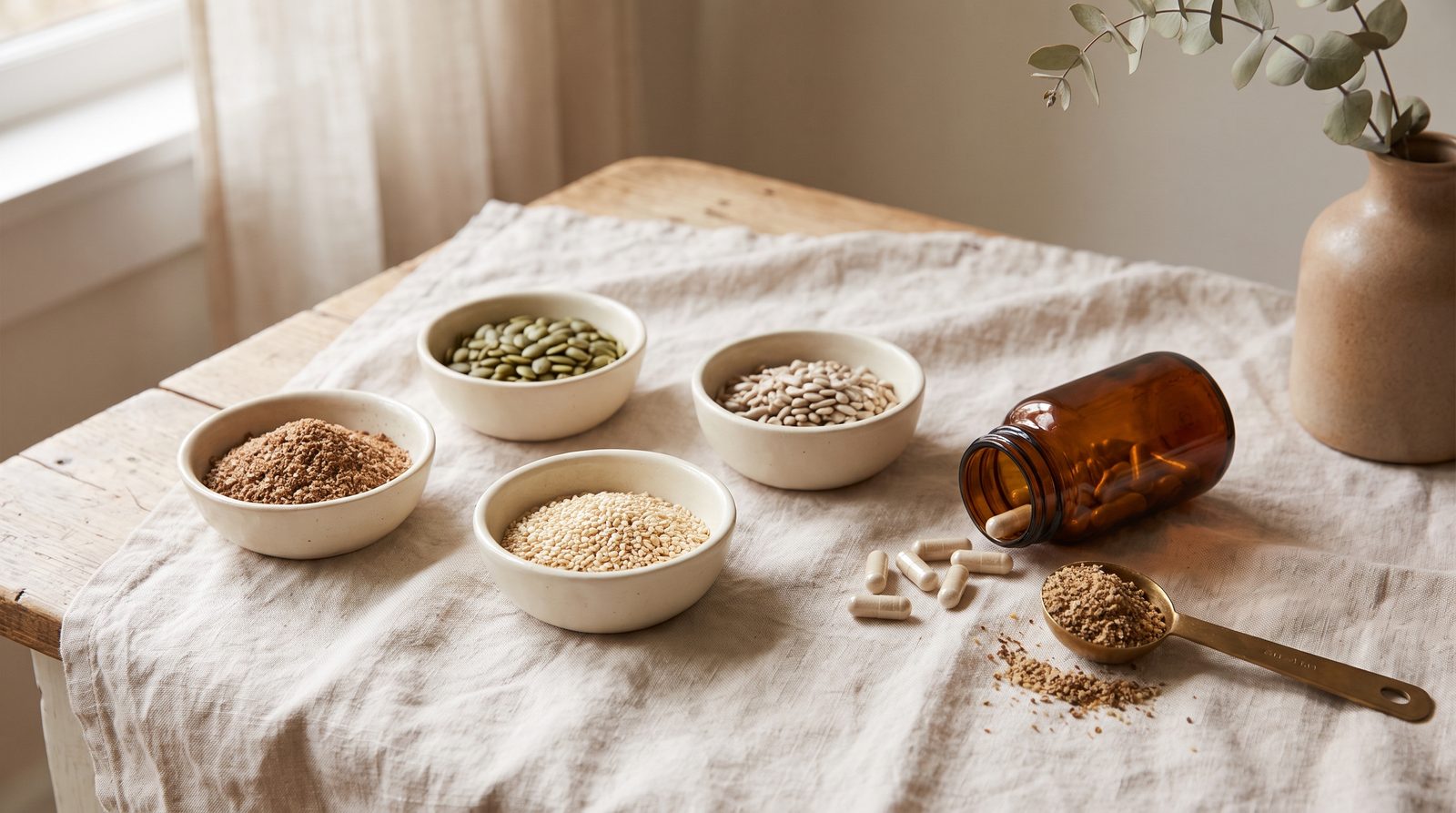
Seed cycling is a routine, not a product. You eat flax and pumpkin seeds in the first half of your cycle, then switch to sunflower and sesame in the second half. Our plain explainer on whether seed cycling really balances your hormones covers the theory and where it came from.
Capsules repackage that routine into two bottles, one for each phase. What goes inside varies a lot. Some hold milled seed powder. Some hold pressed seed oils. Some add extracts of the seed rather than the seed itself. Those are not interchangeable. Seed oil carries the fats and the vitamin E. Milled seed carries the lignans and the fiber. The lignans are the part most of the hormone research is actually about.
So the first thing to look for is not a certification badge. It is a line on the label that says how many grams or milligrams of each seed you get per serving, and in what form.
Do seed cycling capsules work? What the evidence shows
Start with the whole category, because the capsule question sits on top of it.
The most complete look so far is a 2025 systematic review that pulled ten studies covering 635 women with PMS or PCOS, published between 2015 and 2025. It found seed cycling, and flax and sesame in particular, was linked to more regular cycles, milder PMS, and some favorable shifts in hormone markers. The reviewers were also direct about the limits: small samples and moderate quality evidence, with a clear need for larger randomized trials and a standard protocol before anyone calls this proven (Nagarajan, 2025).
Underneath that review, the studies used seeds. Food. Not capsules.
The oldest and most specific evidence is for flax on its own. In a randomized crossover study, 18 normally cycling women ate their usual diet for three cycles and their usual diet plus flaxseed powder for three others. On flax, luteal phases ran longer, 12.6 days versus 11.4, and there were no anovulatory cycles across the 36 flax cycles compared with three across the 36 control cycles. Estradiol and estrone did not budge (Phipps, 1993). That is a real signal about cycle mechanics, from a real food amount.
For sesame, the trial people cite used 50 grams of sesame seed powder daily for five weeks in postmenopausal women, against a rice powder placebo. It lowered LDL cholesterol by 10 percent, raised sex hormone binding globulin by 15 percent, and lowered DHEA sulfate by 18 percent (Wu, 2006). Fifty grams. That is more than three tablespoons, every day. No capsule on the market comes near it.
There is also a small single center trial in women with PCOS where adding seed cycling to a portion controlled diet over 12 weeks shifted FSH and LH in a favorable direction, with 20 women per group (Rasheed, 2023). Encouraging, and still a starting point rather than a verdict. If PCOS is your reason for looking at this, the better studied option is worth reading first: here is what the inositol trials actually found for cycles and ovulation, and how your gut fits into the PCOS picture.
The dose problem nobody mentions
Put the numbers side by side and the gap is obvious.
- Trials that found something: a tablespoon or more of seed per day, up to 50 grams for sesame.
- A typical capsule: a standard capsule shell holds roughly half a gram of powder, so a two capsule serving is around a gram of material total, split across two seeds.
- The current academic protocol: the seed cycling trial running at Loma Linda University hands participants a tablespoon each of two whole seeds per day, which tells you what researchers think a real dose looks like (NCT07052500).
A gram of seed powder is not nothing. It is also not the amount anything was tested at. Some brands get around this by concentrating extracts, which can be legitimate, but then you need the extract ratio on the label to work out what you are getting. If the bottle lists a proprietary blend with no per ingredient amounts, you cannot do that math, and neither can anyone else.
This is the same trap as the rest of the supplement aisle. We walked through it in detail for another format: why most gut health gummies fall short of the studied dose and how to read the label. The logic transfers exactly.
Where capsules might actually have an edge
Here is the fair counterpoint, and it matters.
Whole seeds mostly pass straight through you. In a crossover study, 12 people took whole, crushed, or ground flaxseed, and the researchers measured the lignan breakdown products in plasma. Whole flaxseed delivered only 28 percent of what ground flaxseed did. Crushed managed 43 percent (Kuijsten, 2005). So if you have been sprinkling whole flax on yogurt, you have been getting roughly a quarter of the benefit you thought.
A capsule filled with milled seed powder has already solved that problem. It is ground, it is sealed against the light and air that turn flax oil rancid, and it does not need refrigerating or a coffee grinder. If grinding seeds every few days is the reason your seed cycling attempt lasted nine days, a capsule that discloses a real dose is a reasonable answer.
What you give up is the fiber and the volume. A tablespoon of ground flaxseed brings a couple of grams of fiber and some genuine fullness to a meal. A capsule brings neither. For most women that fiber is the more reliable benefit of the whole exercise, which is why we keep pointing people back to how much fiber women actually need and the easiest places to get it.
What about the study on the capsules themselves
There is one, and it is worth understanding rather than dismissing.
A seed cycling capsule product was tested in 40 women aged 18 to 45 over two menstrual cycles, with cramps, bloating, fatigue, mood, sleep, acne, breast tenderness, and libido all tracked by questionnaire. The study completed in September 2025 and was run by the brand with a testing partner (NCT07655466).
The design is single arm. Everyone got the product and there was no placebo group. For self reported symptom scores over two cycles, that is a real limitation, because simply enrolling in a study, taking something daily, and paying attention to your cycle tends to improve how people rate their symptoms. Without a control group you cannot separate the capsules from that effect.
The Loma Linda trial has the same structure, single arm with 20 participants. So the honest state of play is that both current trials are designed to see whether the idea is worth testing properly, not to prove it works. Neither has posted results yet.
Worth being clear about what this does and does not mean. A missing placebo group is not evidence the product fails. It just means nobody has run the study that could tell you either way.
How long do seed cycling capsules take to work?
Brands generally say give it three months, and to be fair, that is roughly the window the studies used. Phipps looked at cycle changes across three cycles, the PCOS trial ran 12 weeks, and the sesame trial ran five weeks. So three months is a reasonable trial period rather than a stalling tactic.
Set the expectation properly, though. The measurable outcomes in these studies were cycle length, luteal phase length, cholesterol, and hormone markers on a blood test. Not how you feel by week two. If you are going to give it three months, track something concrete, like cycle length and cramp severity, on a calendar. That way you have a before and after that is not just memory.
How many capsules a day, and when
Most products land on two capsules daily, taken after a meal, switched between the follicular bottle and the luteal bottle at roughly the midpoint of your cycle. Taking them with food is sensible, since the seed fats absorb better alongside a meal and fewer people get an upset stomach.
One practical catch: the rotation assumes you know where ovulation falls. If your cycles are irregular, which is often exactly why women try this, the switch day is a guess. Nobody has tested whether the timing matters at all, and the rotation rule has never been compared against simply eating all four seeds every day. That comparison is the missing study in this whole field.
Who should skip them
- Sesame or seed allergies. Sesame is a major allergen and appears in the luteal capsule.
- Anyone on hormone sensitive treatment, including for breast cancer. Lignans act weakly on estrogen pathways, so this is a conversation with your oncologist, not a self experiment.
- Pregnant or breastfeeding. No meaningful safety data at these doses, so the default is to wait.
- Anyone whose real problem has not been looked at yet. Cycles that have suddenly changed, bleeding between periods, or periods that have stopped need a diagnosis first. A supplement that takes three months to judge is a bad way to spend that time.
The bottom line
Seed cycling capsules solve one real problem, which is that whole seeds barely get absorbed and grinding them daily is a chore most people abandon. Milled seed in a sealed capsule is a genuinely better delivery format than a bag of whole flax in the cupboard.
What they cannot currently solve is the dose. The trials that moved cycle length or cholesterol used tablespoons, and one used 50 grams a day. If a capsule does not print grams per serving on the label, you have no way to know where you land. And the rotation schedule that gives the practice its name has never been tested against anything, including eating the same seeds on no schedule at all.
If you want to try it, buy the version that discloses the dose, take it for three cycles, and write down your cycle length and cramp severity so you have something real to judge. If you would rather spend the money on the thing with better evidence behind it, ground flaxseed by the tablespoon is cheaper, brings fiber the capsule cannot, and is what the studies actually used. More on this in our supplements coverage.
This is general information, not medical advice. Talk to your doctor before starting a new supplement, especially if you are on hormone sensitive treatment, pregnant, or breastfeeding. Cycles that change suddenly, bleeding between periods, or periods that stop deserve a proper workup.
References
- Nagarajan DR, Mani Jacob D, Munir Mufti M, Rajesh S, Dube R. Efficacy of seed cycling as an integrative therapy for premenstrual syndrome and polycystic ovary syndrome in reproductive-aged women: a systematic review. Cureus. 2025;17(8):e90997. PMID: 41018334
- Phipps WR, Martini MC, Lampe JW, Slavin JL, Kurzer MS. Effect of flax seed ingestion on the menstrual cycle. Journal of Clinical Endocrinology and Metabolism. 1993;77(5):1215-9. PMID: 8077314
- Wu WH, Kang YP, Wang NH, Jou HJ, Wang TA. Sesame ingestion affects sex hormones, antioxidant status, and blood lipids in postmenopausal women. Journal of Nutrition. 2006;136(5):1270-5. PMID: 16614415
- Kuijsten A, Arts IC, van't Veer P, Hollman PC. The relative bioavailability of enterolignans in humans is enhanced by milling and crushing of flaxseed. Journal of Nutrition. 2005;135(12):2812-6. PMID: 16317125
- Rasheed N, Ahmed A, Nosheen F, et al. Effectiveness of combined seeds (pumpkin, sunflower, sesame, flaxseed) as adjacent therapy to treat polycystic ovary syndrome in females. Food Science and Nutrition. 2023;11(6):3385-3393. PMID: 37324929
- Effects of seed cycling capsules on premenstrual syndrome symptoms and menstrual cycle length. ClinicalTrials.gov, 2025. NCT07655466
- Investigating the impact of seed cycling on menstrual regularity, dysmenorrhea, and premenstrual symptoms. Loma Linda University. ClinicalTrials.gov, 2026. NCT07052500
Common questions
Do seed cycling capsules work as well as eating the seeds?
Nobody has compared them head to head, so the honest answer is that it depends on the dose in the capsule. Capsules have one real advantage: whole seeds barely get absorbed. In a crossover study, whole flaxseed delivered only 28 percent of the lignan breakdown products that ground flaxseed did, and crushed managed 43 percent (Kuijsten, 2005). A capsule of milled seed has already solved that. What it usually cannot match is the amount. The trials that found effects used a tablespoon or more per day, and the sesame trial used 50 grams. A two capsule serving is closer to one gram of material. Look for grams per serving on the label, and skip anything that hides behind a proprietary blend.
How long do seed cycling capsules take to work?
Give it three months, which is roughly what the research used. The flaxseed study tracked changes across three menstrual cycles, the PCOS trial ran 12 weeks, and the sesame trial ran five weeks. Just measure something concrete while you wait. Cycle length and cramp severity written on a calendar beat trying to remember how you felt in week two. If nothing has shifted after three cycles, you have a real answer rather than a vague one.
Is there any proof that the rotation schedule matters?
There is no proof that the seed cycling rotation schedule matters. This is the biggest gap in the whole field. The research supports the seeds, mainly flax and sesame, but no study has compared cycling the seeds by phase against simply eating all four every day. Both trials currently registered on ClinicalTrials.gov are single arm with no control group, one in 40 women on a capsule product and one in 20 women on whole seeds at Loma Linda University, and neither has posted results. So the rotation rule that gives seed cycling its name is untested, not disproven. There is a difference, and it is worth knowing which one you are dealing with.
Who should not take seed cycling capsules?
Anyone with a sesame or seed allergy, since sesame is in the luteal capsule and is a major allergen. Anyone on hormone sensitive treatment, including for breast cancer, should ask their oncologist first, because lignans act weakly on estrogen pathways. Pregnancy and breastfeeding are a wait, since there is no meaningful safety data at these doses. And if your cycles have changed suddenly, you are bleeding between periods, or your periods have stopped, get that looked at before spending three months on a supplement.
What should I look for on the label?
Look for three things on the label. First, grams or milligrams of each seed per serving, so you can compare it to the tablespoon amounts used in the studies. Second, the form, since milled seed carries the lignans that most of the hormone research is about while pressed oil mostly carries the fats and vitamin E. Third, independent testing, because seed oils go rancid and you want proof of what is in the bottle. A proprietary blend with no per ingredient amounts fails the first test, which makes the other two beside the point.