HORMONES
Seed Cycling for Hormones: Does It Actually Work?
Swap seeds with the phases of your cycle and your hormones fall into line. That is the promise. The calm, science-backed answer is more interesting, and a lot more honest, than the trend makes it sound.
If you spend any time on wellness social media, you have probably seen seed cycling. The pitch is simple and pretty: eat certain seeds in the first half of your cycle and different seeds in the second half, and your hormones will fall into balance. It sounds natural, gentle, and doable. But does it actually work, or is it just a tidy story? Let's look at what the science really shows, minus the hype and minus the eye-rolling, because the honest answer is more useful than either.
What seed cycling actually is
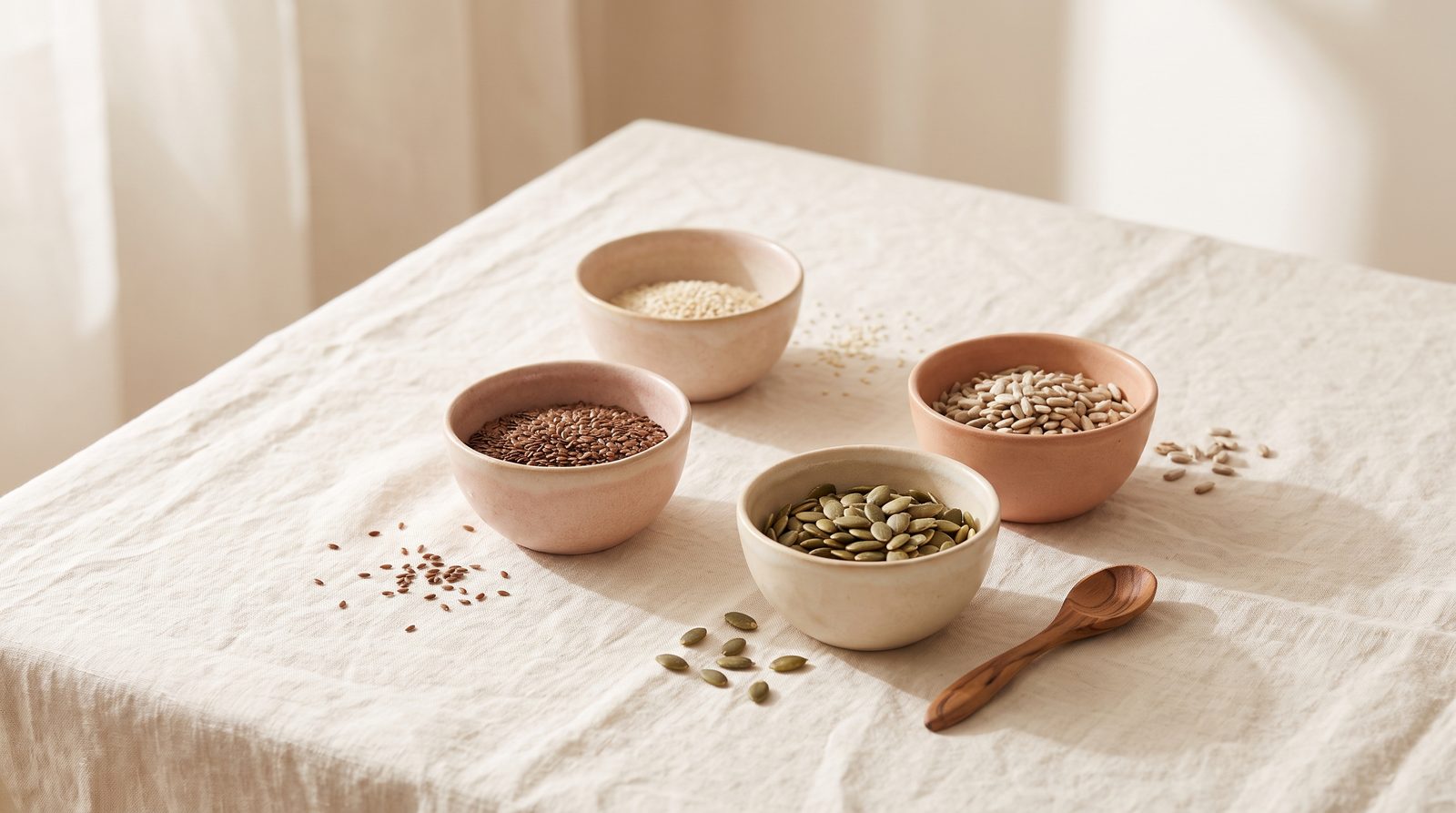
Seed cycling is a routine, not a supplement. In the first half of your cycle, from your period until ovulation, you eat about a tablespoon each of ground flaxseed and pumpkin seeds. In the second half, from ovulation until your next period, you switch to sunflower and sesame seeds. The idea is that the first pair supports estrogen while it should be rising, and the second pair supports progesterone in the back half. Supporters point to the nutrients in these seeds, like the plant compounds called lignans, plus zinc, selenium, and vitamin E, all of which do play real roles in the body.
So the reasoning is not crazy. The question is whether eating seeds on a schedule actually moves your hormones or eases symptoms. That is where you have to look at the studies instead of the infographics.
What the research really shows
Here is the honest headline: the evidence is thin, early, and mostly small. The most complete look so far is a 2025 systematic review that pulled together ten studies on seed cycling for premenstrual syndrome and PCOS. It found that seed cycling was linked to more regular cycles and milder PMS symptoms in some women. But the reviewers were careful to add the part the trend leaves out, that these results rest on small sample sizes and moderate-quality evidence, and that bigger, more rigorous trials are needed before anyone can call it proven (Nagarajan, 2025).
One of the studies feeding that picture was a 2023 trial in women with PCOS. Over twelve weeks, adding seed cycling to a healthy diet was associated with improved hormone markers like FSH and LH. The signal was encouraging, but it was a single, small, single-center study, which is a starting point rather than a verdict (Rasheed, 2023). (For better-studied PCOS options, see what the inositol trials show and how your gut fits into PCOS.)
Interestingly, the seed with the oldest and most direct data is flax, and on its own. Back in 1993, a small crossover study found that women eating flaxseed had no anovulatory cycles, longer luteal phases, and a higher progesterone-to-estradiol ratio compared to their control cycles (Phipps, 1993). That is a real, if small and old, hint that flax can nudge the cycle. Notice, though, that this was flax by itself, not the four-seed calendar, and it is a long way from proving the full seed cycling routine.
The honest bottom line
So does seed cycling work? The fair answer is that we do not have good enough evidence to say it reliably balances hormones, and the confident claims you see online are running well ahead of the science. It is possible some women feel better, and flax in particular has a plausible, lightly supported effect. But it has not been proven the way its fans suggest, and any benefit may come partly from simply eating more whole food and paying closer attention to your cycle. (Your body already has systems for managing estrogen, including gut bacteria that help handle it.)
Here is the reassuring flip side. Seed cycling is harmless, and the seeds themselves are genuinely good for you. Flax, pumpkin, sunflower, and sesame seeds bring fiber, healthy fats, magnesium, and those plant compounds, all of which support your body whether or not the calendar does anything special. (Magnesium in particular earns its keep, and we covered which magnesium type does what.) So if you enjoy the routine, there is no reason to stop. If you are thinking of buying the capsule version instead of grinding seeds, read whether seed cycling capsules deliver the dose the studies used first, because that is where most of them fall down. Just hold the expectations loosely and know what you are actually getting, which is a nutritious habit, not a proven hormone fix.
When to see a doctor instead
This is the most important part. Seed cycling is not a treatment for a medical problem, and irregular or missing periods, heavy bleeding, severe PMS, or symptoms of PCOS all deserve a real evaluation. If your cycle is off or your symptoms are disrupting your life, please talk to your doctor rather than relying on a seed schedule to fix it. Food can support your health, but it does not replace a diagnosis, and some hormone issues need actual medical care.
The calm takeaway: eat the seeds because they are good food and you like them, not because a trend promised they will rebalance your hormones. Keep your expectations honest, keep an eye on your cycle, and bring anything that worries you to your doctor. (More honest looks at hormone trends live in our hormones section.)
This article is for general education and is not medical advice. If you have irregular periods, severe symptoms, or a hormone condition like PCOS, please talk with your doctor. Research cited was retrieved from PubMed.
References
- Nagarajan et al. Efficacy of Seed Cycling as an Integrative Therapy for Premenstrual Syndrome and Polycystic Ovary Syndrome in Reproductive-Aged Women: A Systematic Review. Cureus. 2025. PMID: 41018334
- Rasheed et al. Effectiveness of combined seeds (pumpkin, sunflower, sesame, flaxseed): As adjacent therapy to treat polycystic ovary syndrome in females. Food Sci Nutr. 2023. PMID: 37324929
- Phipps WR, et al. Effect of flax seed ingestion on the menstrual cycle. J Clin Endocrinol Metab. 1993. PMID: 8077314
Common questions
What is seed cycling supposed to do?
Seed cycling is a routine where you eat flax and pumpkin seeds in the first half of your cycle and sunflower and sesame seeds in the second half, with the idea that this supports estrogen while it rises and progesterone later on. Supporters point to nutrients in the seeds like lignans, zinc, selenium, and vitamin E. The theory is reasonable, but whether the schedule actually shifts your hormones is a separate question that comes down to the evidence.
Is there any real science behind seed cycling?
Some, but it is thin and early. A 2025 systematic review of ten studies found seed cycling was linked to more regular cycles and milder PMS in some women, while stressing that the studies were small and of moderate quality and that larger trials are needed. A 2023 PCOS trial showed improved hormone markers, but it was small and single-center. The strongest single-seed signal comes from an older, small flaxseed study.
Does flaxseed affect your cycle?
There is a small, old hint that it might. A 1993 crossover study found women eating flaxseed had no anovulatory cycles, longer luteal phases, and a higher progesterone-to-estradiol ratio than in their control cycles. That is flax on its own, not the four-seed routine, and it is far from proof, but flax has the most direct data of any of the seeds involved.
Is it worth trying seed cycling?
If you enjoy it, there is no harm in it, and that is the honest appeal. The seeds are genuinely nutritious, bringing fiber, healthy fats, magnesium, and plant compounds whether or not the calendar does anything special. Just keep your expectations realistic. Treat it as a healthy habit rather than a proven hormone fix, and do not use it in place of medical care.
When should I see a doctor instead of trying seed cycling?
Any time your cycle points to a real problem. Irregular or missing periods, heavy bleeding, severe PMS, or symptoms of PCOS all deserve a proper evaluation. Seed cycling is not a treatment, so if your symptoms are disrupting your life, talk to your doctor rather than relying on a seed schedule to fix it.