GUT HEALTH
Fermented Foods vs. Probiotic Pills: Which One Actually Helps?
One costs a few dollars at the grocery store. The other costs forty dollars a bottle and promises to fix your gut. The research says they are not doing the same job, and that changes which one you should reach for.
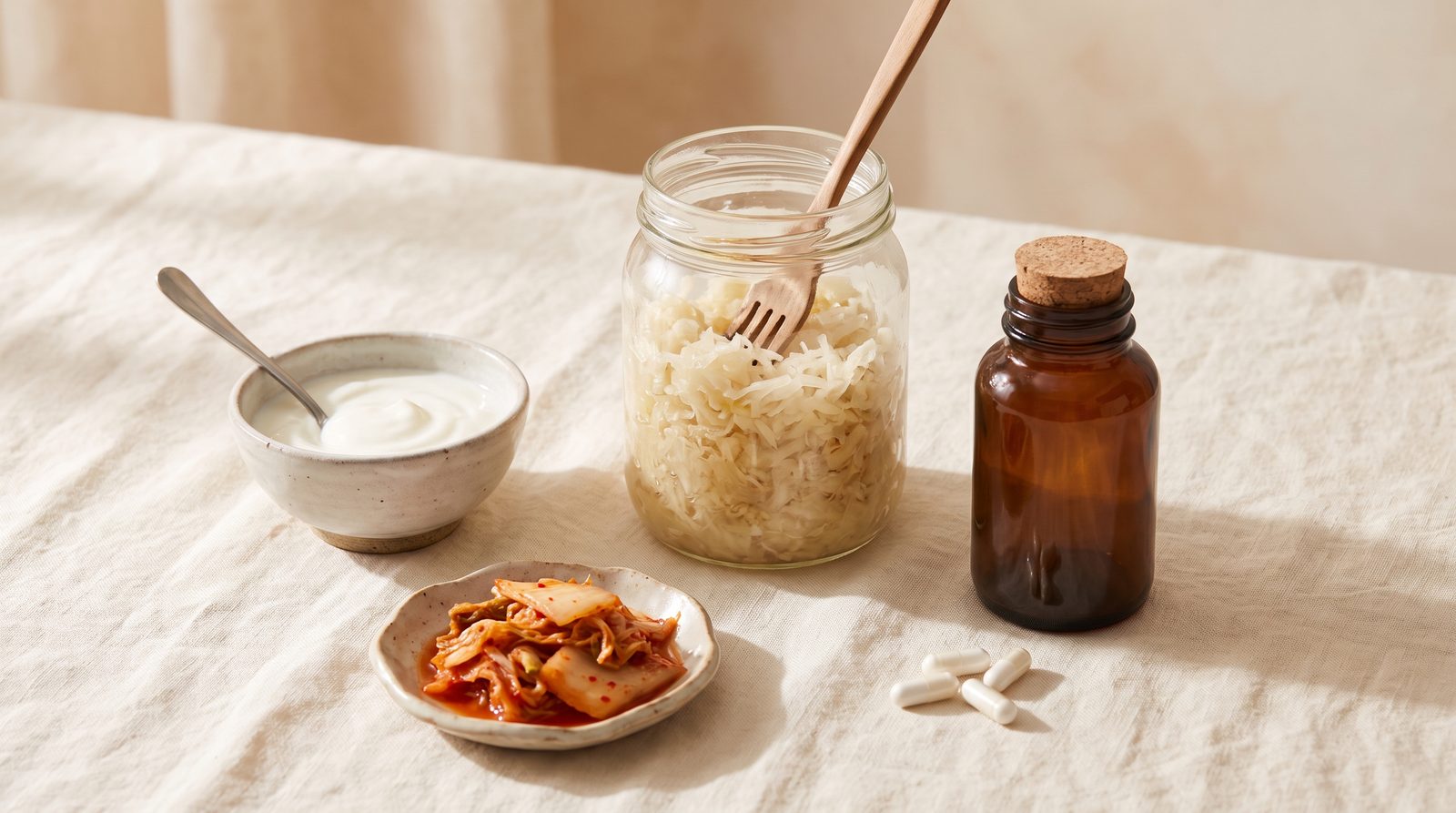
Walk down the supplement aisle and the message is clear. Your gut needs help, and the help comes in a capsule. Meanwhile your grandmother was eating sauerkraut and yogurt without thinking about it. So which one actually does something? The honest answer is that fermented foods and probiotic pills are not two versions of the same thing. They work differently, the evidence behind them is different, and once you see how, it gets much easier to know what to buy.
They are not the same thing
This is the part that gets blurred in marketing, so it is worth being precise. Our guide to probiotics, prebiotics, and postbiotics covers the vocabulary in full. A probiotic is a specific live strain, given in a specific amount, that has been studied for a specific effect. A fermented food is a food made through desired microbial growth, which is the definition an international expert panel settled on in 2021. That same panel went out of its way to clarify the difference between the two, because the terms had been used so loosely (Marco, 2021).
Here is why that matters in practice. Most fermented foods are not probiotics in the technical sense. The microbes in your kimchi have not been identified, counted, and tested in a trial. That does not make them worthless. It just means you are getting something different from a capsule, not a cheaper version of one.
What fermented foods actually did in a trial
The most interesting study here came out of Stanford in 2021. Researchers randomly assigned healthy adults to either a high fiber diet or a high fermented food diet for seventeen weeks, then measured their gut bacteria and their immune markers in detail. The fermented food group steadily increased the diversity of their gut bacteria and showed a drop in inflammatory markers. The high fiber group, interestingly, did not increase diversity (Wastyk, 2021).
That is a genuinely encouraging result, and it is worth knowing the size. There were only about eighteen people per group. It is a small, careful study rather than a large one, so treat it as a strong signal and not a settled fact.
It is also fair to show the other side. A 2025 crossover trial had eighty seven healthy adults eat sauerkraut daily for four weeks. A few individual bacterial species shifted, but the researchers concluded that a healthy gut microbiome is fairly resilient to short term diet changes (Schropp, 2025). One food for one month is not the same as a varied fermented food habit for four months. Both findings can be true at once.
What probiotic pills actually do
Now the capsules. The common assumption is that you swallow the bacteria and they move in and set up house. Researchers tested that directly by looking inside the gut instead of just at stool samples. What they found was that colonization was person specific, region specific, and strain specific. Some people's guts let the strains settle in and others resisted them entirely. And you could not tell which was happening from a stool test (Zmora, 2018).
The same team found something more surprising. In people who had just taken antibiotics, a probiotic supplement actually delayed the return of their own native gut bacteria compared to simply recovering on their own (Suez, 2018). That is the opposite of what most of us were told to do after a course of antibiotics, and it is a good reminder that more intervention is not automatically better. If you are in that spot, our guide to rebuilding your gut after antibiotics lays out the food-first version.
Where probiotics genuinely earn their place
None of that means probiotic supplements are useless. It means they are a targeted tool, not a daily gut tonic. The clearest example is preventing a specific kind of infection. A 2025 Cochrane review pooled forty seven trials with more than fifteen thousand people and found that probiotics may help prevent Clostridioides difficile diarrhea in people taking antibiotics. The effect was real but modest, working out to roughly one case prevented for every sixty five people who took them, and the reviewers rated the certainty of that evidence as low (Esmaeilinezhad, 2025).
Notice how specific that is. A particular problem, a particular population, a measurable outcome. That is what good probiotic evidence looks like. It is very different from a bottle that promises better digestion, more energy, and clearer skin. (We looked at the gut and skin evidence separately, and it is thinner than the labels suggest.)
So which should you choose?
For most women, most of the time, food is the better default. It is cheaper, it comes with fiber and protein and nutrients that a capsule does not have, the safety record is long, and the one randomized trial that compared approaches found the fermented food arm moved the needle. Aim for variety rather than volume. Yogurt with live cultures, kefir, sauerkraut, kimchi, miso, and fermented cottage cheese all count. Start small if you are not used to them, because a sudden pile of fermented food can cause gas while your gut adjusts.
Reach for a supplement when you have a specific reason and ideally a specific strain. (We walk through whether you actually need a probiotic in more detail.) Riding out a course of antibiotics with a doctor's guidance, or managing a diagnosed condition where a particular strain has been studied. Read the label for the actual strain name and the number of live organisms, and be skeptical of any bottle that promises to fix everything at once.
And a note on cost. If you are choosing between forty dollars a month for a capsule and forty dollars a month of good yogurt and vegetables, the food is doing more for you on the current evidence.
When to talk to a doctor
Probiotic supplements are not right for everyone. If your immune system is suppressed, if you are seriously ill or in the hospital, or if you have a central line, talk to your doctor before taking live bacteria. The same goes for ongoing digestive symptoms. Persistent diarrhea, blood in your stool, unexplained weight loss, or pain that keeps waking you up all need a real evaluation, not a supplement.
The calm takeaway: eat the fermented foods because the evidence for them is decent and they are good food anyway. More food-first answers live in our gut health section. Use probiotic pills the way you would use any other targeted product, for a specific reason, with a specific strain, and preferably with your doctor in the loop.
This article is for general education and is not medical advice. If you have ongoing digestive symptoms, a weakened immune system, or a diagnosed gut condition, please talk with your doctor. Research cited was retrieved from PubMed.
References
- Marco ML, et al. The International Scientific Association for Probiotics and Prebiotics (ISAPP) consensus statement on fermented foods. Nat Rev Gastroenterol Hepatol. 2021. PMID: 33398112
- Wastyk HC, et al. Gut-microbiota-targeted diets modulate human immune status. Cell. 2021. PMID: 34256014
- Schropp N, et al. The impact of regular sauerkraut consumption on the human gut microbiota: a crossover intervention trial. Microbiome. 2025. PMID: 39940045
- Zmora N, et al. Personalized Gut Mucosal Colonization Resistance to Empiric Probiotics Is Associated with Unique Host and Microbiome Features. Cell. 2018. PMID: 30193112
- Suez J, et al. Post-Antibiotic Gut Mucosal Microbiome Reconstitution Is Impaired by Probiotics and Improved by Autologous FMT. Cell. 2018. PMID: 30193113
- Esmaeilinezhad Z, et al. Probiotics for the prevention of Clostridioides difficile-associated diarrhea in adults and children. Cochrane Database Syst Rev. 2025. PMID: 40931979
Common questions
Are fermented foods the same as probiotics?
Fermented foods are not the same as probiotics, and the difference is real. A probiotic is a specific live strain, given in a specific dose, that has been studied for a specific effect. A fermented food is simply a food made through desired microbial growth, which is how an international expert panel defined it in 2021. That panel specifically clarified the distinction between the two. Most fermented foods are not probiotics in the technical sense, because their microbes have not been identified, counted, and tested in trials.
Do fermented foods really change your gut bacteria?
There is decent evidence that they can. In a seventeen week randomized study, healthy adults eating a high fermented food diet steadily increased the diversity of their gut bacteria and showed lower inflammatory markers, while a high fiber arm did not increase diversity. It was a small study with about eighteen people per group. A separate four week sauerkraut trial found the healthy gut is fairly resilient to short term changes, so variety over time likely matters more than one food for a few weeks.
Do probiotic supplements actually colonize your gut?
Probiotic supplements do not reliably colonize the gut, and they do not colonize it in everyone. When researchers looked inside the gut rather than just at stool samples, they found colonization was person specific, region specific, and strain specific. Some people's guts let the strains settle in and others resisted them completely, and a stool test could not tell the difference. So the idea that you swallow a capsule and the bacteria simply move in is more marketing than biology.
Should I take a probiotic after antibiotics?
Ask your doctor, because the evidence cuts both ways. One study found that in people who had just taken antibiotics, a probiotic supplement actually delayed the return of their own native gut bacteria compared to recovering on their own. On the other hand, a 2025 Cochrane review found probiotics may help prevent Clostridioides difficile diarrhea in people on antibiotics, at roughly one case prevented per sixty five people treated, with low certainty evidence. It depends on your risk, so make it a conversation.
Which is better value, fermented foods or a probiotic supplement?
Between fermented foods and a probiotic supplement, food wins on value for most women, most of the time. It is cheaper, it brings fiber and protein and nutrients a capsule does not, the safety record is long, and it performed well in the one randomized comparison. Save supplements for a specific reason with a specific studied strain. If you are choosing between forty dollars of capsules and forty dollars of good yogurt and vegetables, the food is doing more for you on the current evidence.
Who should avoid probiotic supplements?
Talk to your doctor first if your immune system is suppressed, if you are seriously ill or in the hospital, or if you have a central line, because live bacteria carry more risk in those situations. Also see a doctor rather than self treating if you have persistent diarrhea, blood in your stool, unexplained weight loss, or pain that wakes you at night. Those symptoms need a proper evaluation.