Gut Health
The Gut-Brain Axis: How Your Gut Shapes Your Mood
That gut feeling is more than a saying. Your gut and brain talk all day long, and what you eat is part of the conversation. Here is what the science really shows, minus the hype.
You have felt it before. Butterflies before a big meeting. A knot in your stomach when you are stressed. A rough day that seems to start in your belly and spread to your mood. We even say we "trust our gut." It turns out that everyday language is pointing at something real. Your gut and your brain are in constant conversation, and scientists have a name for it: the gut-brain axis.
This topic has exploded online, and a lot of it oversells. You will see claims that a single probiotic will fix your anxiety or that your mood is entirely controlled by your microbiome. That is not this. The real science is genuinely fascinating, and it points to a few calm, food-first habits that are worth building. Let's walk through what the gut-brain axis actually is and what you can do with it.
What the gut-brain axis really is
Your gut is lined with millions of nerve cells, so many that researchers sometimes call it your "second brain." It is in near-constant two-way contact with the brain in your head. The trillions of microbes living in your gut, your microbiome, are part of this system too. Together they form the gut-brain axis, a communication network that links digestion, mood, stress, and more. (Stress hormones deserve their own story, and we tell it in our honest look at cortisol and women.)
A major review of this field describes several routes the gut and brain use to talk to each other, including the vagus nerve (a kind of information highway between the two), the immune system, and small molecules made by your gut bacteria as they digest fiber (Cryan 2019). In other words, this is not one wire. It is a whole switchboard.
Your gut helps make your mood chemicals
Here is a fact that surprises people. A large share of your body's serotonin, one of the chemicals tied to mood and well-being, is actually made in your gut, not your brain. And your gut bacteria help control how much gets made. In a landmark study, certain gut microbes were shown to drive serotonin production in the gut (Yano 2015).
Now, an honest caveat, because this is where the internet gets carried away. The serotonin made in your gut mostly works locally, helping things like digestion, and it does not simply travel up and flood your brain. So "eat fiber, make gut serotonin, instantly feel happier" is too simple. The gut still influences the brain, but through the slower, indirect routes above. The point is not magic. It is that your gut is a real player in how you feel, so it is worth caring for.
What actually helps: food first
The most reliable way to support this system is not a pricey supplement. It is the everyday way you eat. These habits feed the helpful microbes and calm the traffic on that gut-brain switchboard.
1. Feed your microbes with fiber and fermented foods
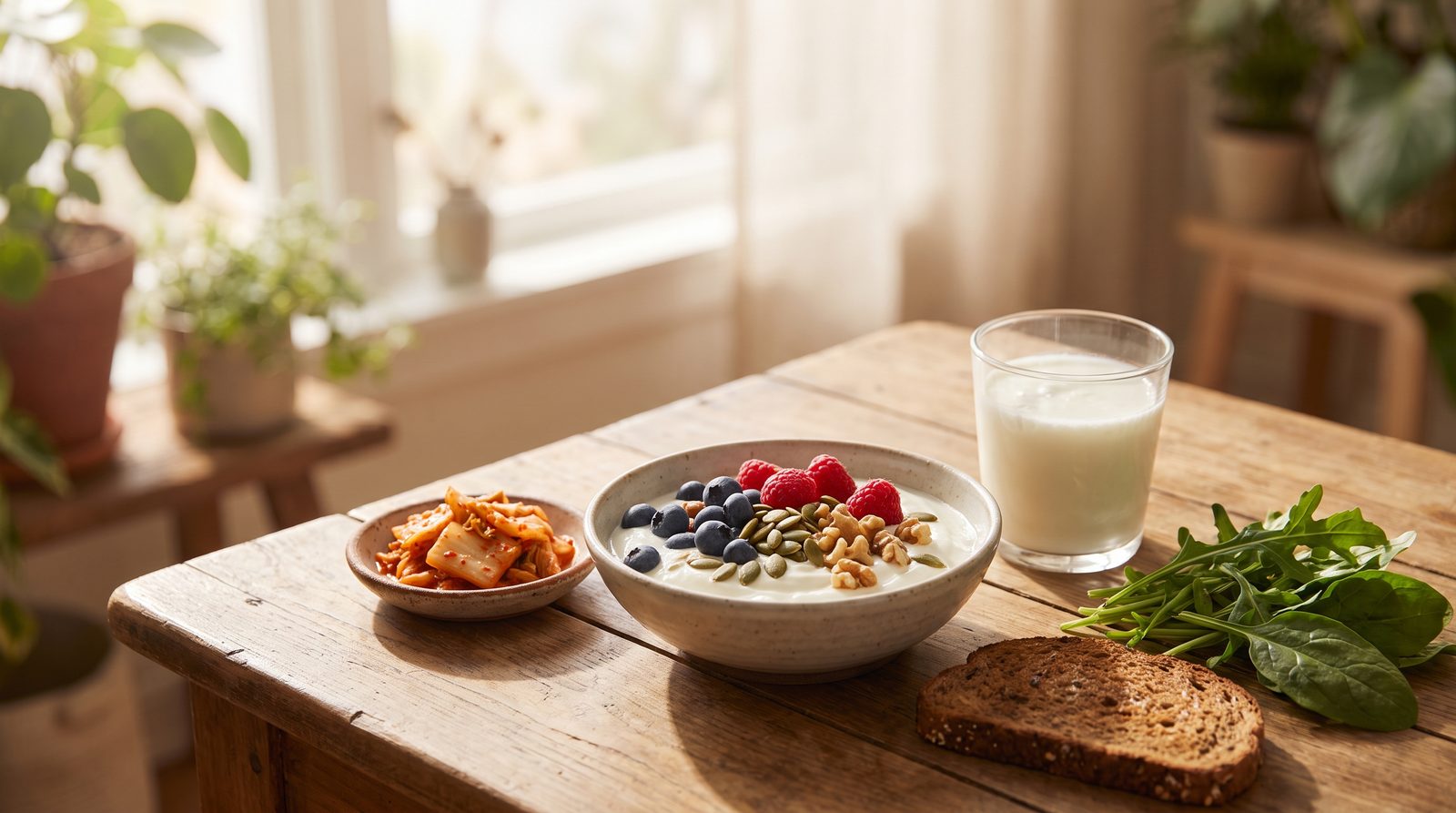
Your gut bacteria live on fiber, and most women get about half the fiber they need. Feed them a variety of plants, vegetables, beans, fruit, whole grains, nuts, and they produce the helpful molecules that keep the gut lining and the gut-brain conversation healthy. Fermented foods help too. In a Stanford study, people who added fermented foods like yogurt, kefir, kimchi, and sauerkraut saw their gut microbes grow more diverse and several markers of inflammation go down over ten weeks (Wastyk 2021). More diversity is generally a good sign for gut health. (We compare fermented foods and probiotic pills if you are deciding where to start.)
2. Build an overall eating pattern that supports mood
Zoom out from any single food and the whole pattern matters. In a landmark trial, adults with moderate to severe depression who switched to a Mediterranean-style diet, rich in vegetables, fruit, whole grains, legumes, fish, and olive oil, improved significantly more than a comparison group over twelve weeks. About a third of the diet group reached remission, compared with less than a tenth of the control group (Jacka 2017). This was a study in people already being treated, so diet was an add-on and not a replacement for care. But it is strong evidence that how you eat can support how you feel.
The honest truth about probiotic pills for mood
So should you run out and buy a "mood probiotic"? Here is where being honest matters most. When researchers pooled the trials on probiotics for anxiety, they found the evidence was not strong enough to recommend them for that purpose (Liu 2018). For depression, a later review found probiotics had a small, measurable effect on some biological markers, but the authors were careful to say firm conclusions are not possible yet, especially for otherwise healthy people (Sikorska 2023).
Translation: a probiotic pill is not a proven fix for your mood. The effects, where they exist at all, are modest and depend heavily on the specific strain. (The same strain-by-strain logic applies to whether you need a probiotic at all.) Fermented foods and a fiber-rich diet are a better place to put your energy, and they come with plenty of other benefits.
When to talk to your doctor
These habits are about supporting your everyday well-being, not treating a medical condition. If you are dealing with persistent low mood, anxiety that interferes with your life, or a big change in how you feel, please reach out to a doctor or mental health professional. Food is a helpful piece of the picture, but it is not a substitute for real care. The gut-brain axis is a reason to eat well and be kind to your body, not a reason to skip the help you deserve.
The bottom line
Your gut and brain really do talk, through nerves, the immune system, and the molecules your microbes make. You cannot hack that conversation with one magic pill, and you do not need to. Feed your gut a wide variety of plants, add some fermented foods, and lean on an overall eating pattern full of whole foods. Those simple, steady habits support both your gut and your mood, and they hold up to the honest science far better than the hype does. There is plenty more in our gut health section.
This article is for general education and is not medical advice. If you are struggling with your mood or mental health, please talk to a qualified professional.
References
- Cryan JF, et al. The Microbiota-Gut-Brain Axis. Physiological Reviews. 2019. PMID: 31460832
- Yano JM, et al. Indigenous bacteria from the gut microbiota regulate host serotonin biosynthesis. Cell. 2015. PMID: 25860609
- Wastyk HC, et al. Gut-microbiota-targeted diets modulate human immune status. Cell. 2021. PMID: 34256014
- Jacka FN, et al. A randomised controlled trial of dietary improvement for adults with major depression (the 'SMILES' trial). BMC Medicine. 2017. PMID: 28137247
- Liu B, et al. Efficacy of probiotics on anxiety: A meta-analysis of randomized controlled trials. Depression and Anxiety. 2018. PMID: 29995348
- Sikorska M, et al. Probiotics as a Tool for Regulating Molecular Mechanisms in Depression: A Systematic Review and Meta-Analysis of Randomized Clinical Trials. International Journal of Molecular Sciences. 2023. PMID: 36834489
Common questions
Can improving my gut health really change my mood?
Improving your gut health can support your mood, but do not expect a switch to flip. Your gut and brain communicate through nerves, the immune system, and molecules your gut bacteria make, so a healthier gut is linked to better well-being. In one trial, adults with depression who moved to a whole-food Mediterranean diet improved more than a comparison group. Food is a helpful piece, not a cure, and not a replacement for professional care.
Is most of my serotonin really made in my gut?
A large share of the body's serotonin is made in the gut, and gut bacteria help control how much. But that gut serotonin mostly acts locally, on things like digestion, and does not simply travel up to flood your brain. So the gut matters for mood, just through slower, indirect routes rather than a direct pipeline.
Should I take a probiotic supplement for anxiety or low mood?
The evidence does not strongly support it. When researchers pooled the studies, probiotics did not show a reliable benefit for anxiety, and the effect on depression was small and strain-dependent. Fermented foods and a fiber-rich diet are a better use of your energy, and they help your gut in other ways too.
What foods support the gut-brain axis?
Two things: fiber and fermented foods. Your microbes live on fiber from vegetables, beans, fruit, whole grains, and nuts. Fermented foods like yogurt, kefir, kimchi, and sauerkraut have been shown to increase gut-microbe diversity and lower inflammation markers. An overall whole-food eating pattern ties it all together.